Introduction: Why Does Every B2B Sales Team Need an AI-Driven Cadence?
An AI-driven sales cadence uses artificial intelligence to adapt outreach timing, messaging, and follow-ups in real time based on buyer behavior. In 2026, this approach replaces manual sequences with intelligent execution that scales personalization without increasing effort.
An AI-driven sales cadence is a structured, multi-touch engagement flow that uses artificial intelligence to decide when, how, and what to communicate with prospects across email, professional networks, and follow-ups. Unlike traditional cadences that rely on fixed schedules and manual effort, AI-driven cadences adapt in real time based on buyer behavior, intent signals, and engagement patterns.
By 2026, sales cadences have moved beyond basic automation. Modern systems replace static sequences with intelligent execution that adjusts tone, timing, and messaging automatically. This shift allows sales teams to maintain consistency and personalization at scale without relying on manual writing or scheduling.
Traditional sales cadences require significant effort researching prospects, writing messages, spacing follow-ups, and tracking responses. AI-driven cadences remove this burden. Platforms like Jeeva AI use autonomous agents to generate personalized outreach, monitor engagement, and progress conversations toward booked meetings without constant human input.
AI does more than automate outreach. It optimizes every interaction by aligning messaging with buyer intent, responding at the right moment, and continuously improving execution based on real engagement data. For modern B2B sales teams, an AI-driven cadence is no longer optional,it is the foundation for speed, relevance, and predictable pipeline growth.
What Is an AI Sales Outreach Sequence?
An AI sales outreach sequence is an adaptive, multi-channel workflow that uses real-time buyer signals to personalize messages, optimize timing, and automate follow-ups without fixed rules.
An AI sales outreach sequence, also called an AI sales cadence, is an intelligent workflow that decides how, when, and why a sales team contacts a prospect. Unlike traditional cadences that follow fixed steps, AI-driven sequences adapt in real time based on buyer behavior, intent signals, and engagement patterns.
Instead of sending the same messages on a preset schedule, AI outreach sequences learn continuously. They adjust messaging, timing, and follow-ups automatically, ensuring each interaction aligns with the prospect’s level of interest and context at that moment.
What Are the Core Elements of an AI Sales Outreach Sequence?
An effective AI outreach sequence combines automation with real-time decision-making across channels.
Key elements include:
Personalized messaging: Content adapts dynamically to each prospect
Multi-channel coordination: Outreach flows across email, professional networks, and chat
Behavior-based triggers: Follow-ups change based on opens, clicks, or replies
Continuous learning: AI improves timing and messaging with every interaction
CRM synchronization: Prospect status updates automatically in real time
AI transforms static sales cadences into responsive workflows that react instantly to buyer intent. By coordinating personalization, timing, and follow-ups autonomously, AI outreach sequences help sales teams engage prospects more effectively while reducing manual effort.
Why Does a 7-Touch AI Sales Sequence Work Best?
A 7-touch AI sales sequence works best because it aligns with B2B buyer response behavior while using real-time engagement data to keep every interaction timely, relevant, and non-intrusive.
A 7-touch AI sales sequence works because most B2B buyers do not respond after a single interaction. Independent B2B benchmarks consistently show that prospects typically require 6-8 meaningful touches before engaging with outbound outreach. Fewer touches often fail to build familiarity, while too many create noise and fatigue.
A 7-touch sequence provides the optimal balance. It creates repeated exposure without overwhelming the buyer especially when each touch is informed by real-time engagement data. When powered by AI, every interaction adapts to buyer behavior, ensuring persistence feels relevant rather than intrusive.
How Does AI Optimize Each Touch in a 7-Step Sales Sequence?
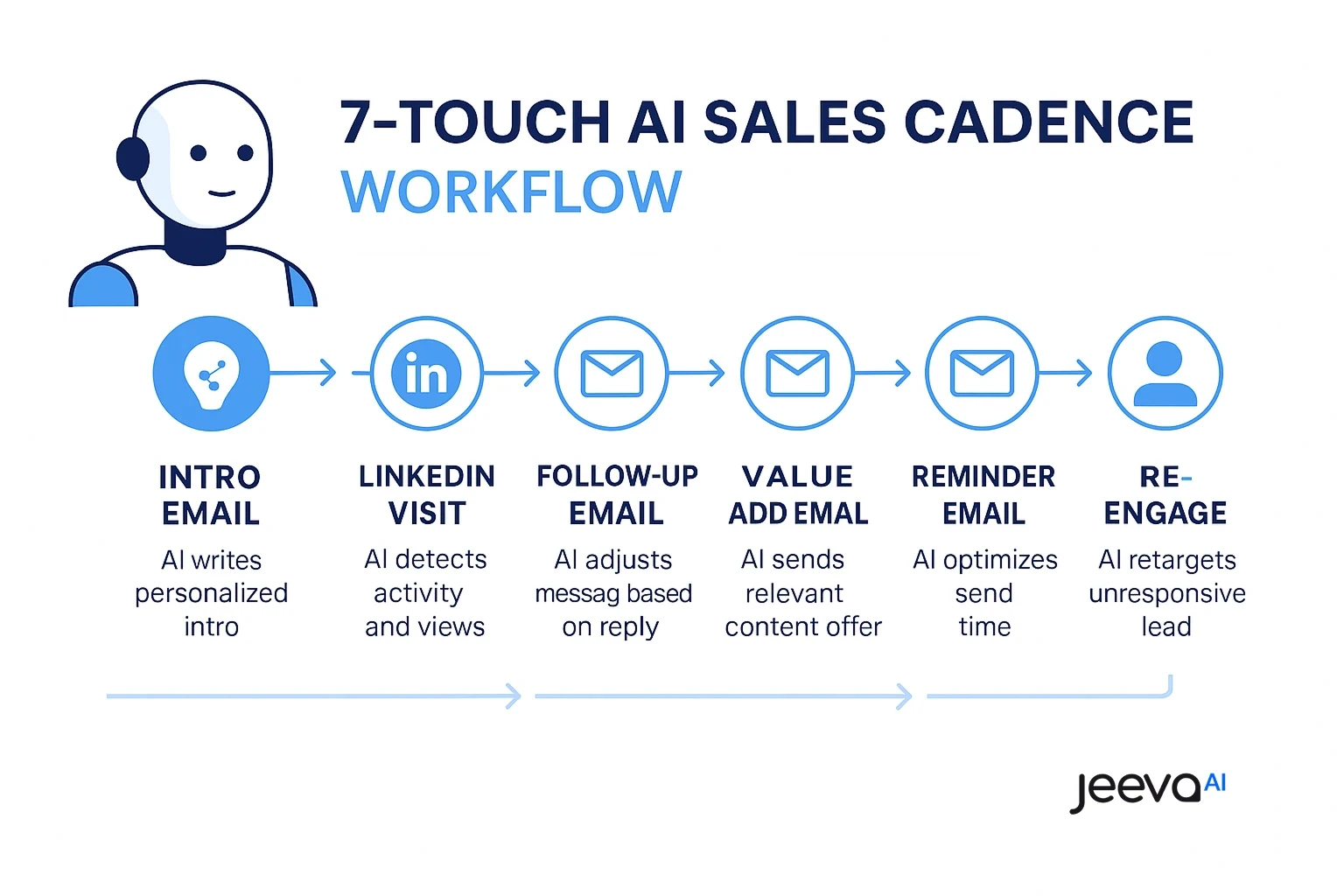
Touch | AI-Driven Action | Outcome |
|---|---|---|
1. Intro Email | Drafts a context-aware opening message | Strong, personalized first impression |
2. Profile Visit | Detects buyer activity and visibility signals | Builds early familiarity |
3. Follow-Up Email | Adjusts tone based on opens or clicks | Sustains interest without pressure |
4. Direct Message | Personalizes outreach using shared context | More human-like engagement |
5. Value Message | Selects the best case study or demo CTA | Clear value delivery |
6. Reminder Touch | Sends at the optimal time based on behavior | Higher reply probability |
7. Re-Engagement | Warms, re-qualifies, or closes the loop | Converts or cleans pipeline |
AI ensures that each touch serves a purpose rather than repeating the same message. Instead of running a static cadence, the sequence evolves based on how the buyer reacts adjusting timing, messaging, and calls to action automatically.
Platforms like Jeeva AI personalize all seven touches autonomously, ensuring every follow-up adds relevance and value rather than contributing to inbox fatigue.
Market Context: Why Multi-Touch, Multi-Channel Outreach Is Now Essential?
B2B outreach performs best when sales teams use multiple touches across multiple channels, as single-channel email alone delivers limited engagement and slower pipeline results.
Modern B2B outreach requires more than a single message or channel. Buyers are harder to reach, attention is fragmented, and decision-making involves multiple touchpoints over time. As a result, successful sales engagement depends on repeated, coordinated interactions across channels rather than isolated emails.
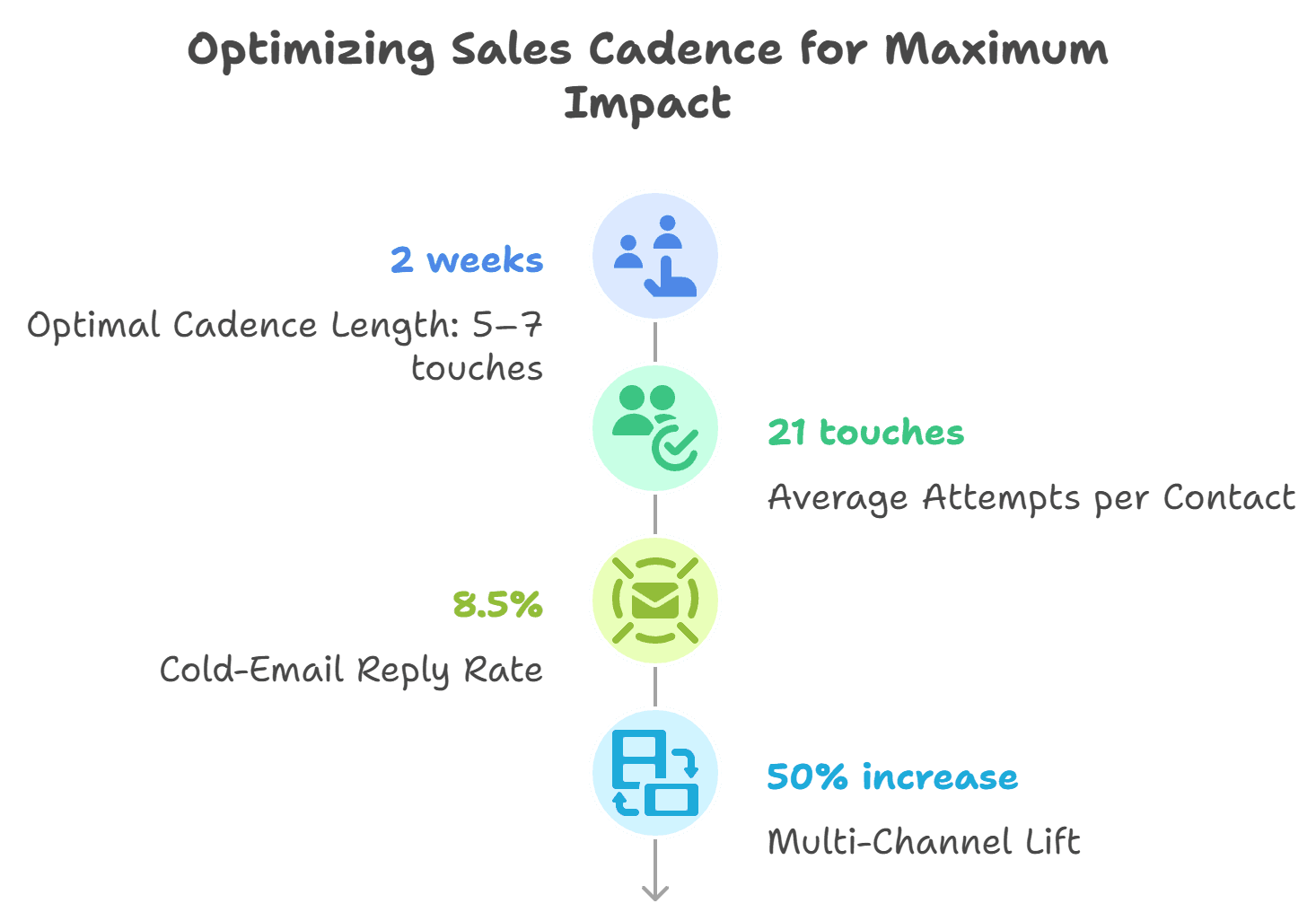
Recent outreach benchmarks highlight this shift:
Average attempts per contact: 21 touches before engagement
Optimal cadence length: 5–7 touches over a two-week window
Cold email reply rate: 8.5% when email is used alone
Multi-channel lift: 50% higher engagement when combining email with professional networks and voicemail
These numbers make the implication clear. Relying on email alone limits reach and response, even with strong personalization. Buyers engage more consistently when outreach spans multiple channels and reinforces messages over time.
Bottom line: In today’s competitive B2B landscape, multi-touch, multi-channel outreach is no longer optional it is the minimum requirement for predictable engagement and pipeline growth.
Why Exactly Seven Touches Work Best in B2B Outreach?
Seven-touch sales sequences perform best because buyer response rates peak around the seventh interaction, after which engagement plateaus and fatigue or spam risk increases.
Seven touches work best because buyer response probability increases steadily up to that point and then levels off. Research from Woodpecker and Salesloft shows that engagement rises meaningfully through the sixth and seventh touch, while additional attempts deliver diminishing returns and increase the risk of spam complaints or disengagement.
The effectiveness of seven touches is amplified when outreach is spread across multiple channels. Each channel plays a distinct role in reinforcing awareness and intent:
Email: Scales efficiently but faces inbox saturation, requiring precise personalization
Voice or voicemail: Cuts through digital noise and creates urgency
Professional networks: Enable conversational, context-driven engagement
This pattern is also supported by behavioral research. Buyers typically need 5–7 brand impressions, spaced over 10–14 days, to build familiarity and trust without experiencing fatigue. A seven-touch cadence aligns naturally with how buyers recognize and respond to new vendors.
Conclusion: Seven touches represent the optimal balance between persistence and restraint maximizing engagement while minimizing friction.
AI-Optimized Blueprint for a 7-Touch Sales Cadence
An AI-optimized 7-touch cadence uses real-time data to personalize, time, and sequence outreach across channels, maximizing engagement while avoiding buyer fatigue.
A 7-touch cadence performs best when each interaction is timed, personalized, and channel-aware. AI enables this by deciding what to send, where to send it, and when to act based on real-time data rather than fixed schedules. The result is consistent engagement without fatigue.
How Does an AI-Optimized 7-Touch Cadence Work?
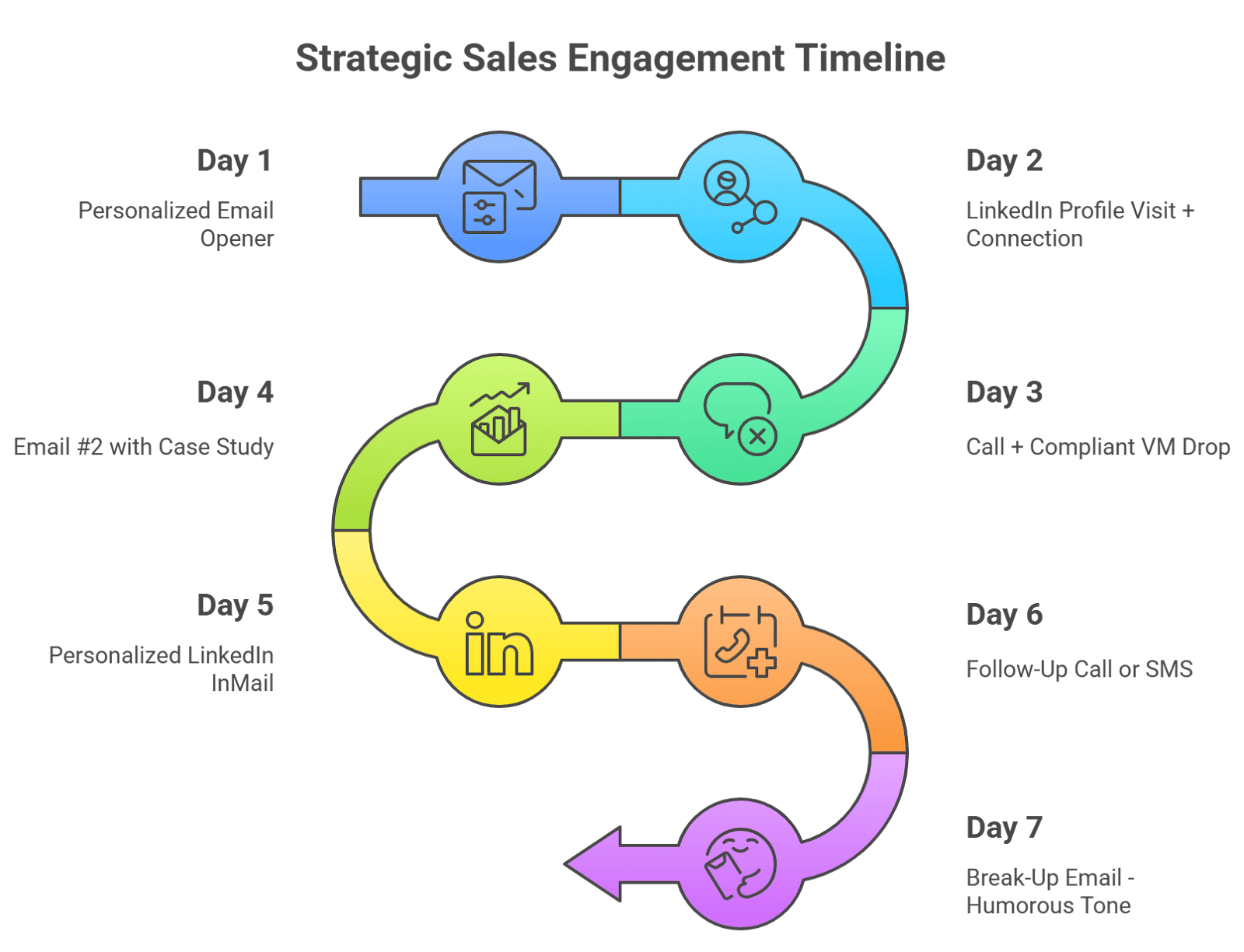
Day | Channel & Action | AI Enhancement | Primary Goal |
|---|---|---|---|
1 | Personalized email opener | Uses real-time firmographic and technographic data | Build awareness |
2 | Profile visit and connection request | Generates a short message referencing recent activity | Create micro-engagement |
3 | Call with compliant voicemail | Produces a context-aware voice script | Establish credibility |
4 | Follow-up email with case study | Inserts industry-specific results dynamically | Provide social proof |
5 | Direct message | Personalizes messaging using shared context | Increase peer relevance |
6 | Follow-up call or message | Optimizes timing based on timezone and behavior | Create urgency |
7 | Break-up email with light tone | A/B tests tone and copy automatically | Prompt final response |
AI ensures that each touch adds new information or context rather than repeating the same message. Timing, tone, and channel selection adapt continuously based on how the prospect engages, keeping outreach relevant instead of repetitive.
Independent research supports this approach. Studies from Martal Group and Salesforce show that delivering outreach during peak response windows typically Tuesday to Thursday, 9–11 a.m. or 1–3 p.m. can improve open and response rates by up to 30% when paired with multi-touch cadences.
How Do You Build an AI-Powered 7-Touch Sales Cadence?
An AI-powered 7-touch sales cadence uses real-time data to personalize messaging, balance channels, optimize timing, and continuously improve outreach until a meeting is booked.
Building an AI-powered 7-touch sales cadence requires more than automating messages. The goal is to use AI to decide who to contact, what to say, when to engage, and how to adapt based on real buyer behavior.
Step-by-Step Guide to Building an AI-Driven 7-Touch Cadence
Step 1: Define Your ICP and Buyer Intent Signals: Start by clearly defining your ideal customer profile, including role, industry, geography, and company size. Feed your CRM or enrichment system with accurate, verified data so AI can identify high-intent prospects and trigger outreach at the right moment.
Step 2: Automate Personalization at Scale: Use AI to generate tailored introductions, tone variations, and calls to action for each buyer persona. Instead of static templates, messaging adapts dynamically based on prospect context and intent. Platforms like Jeeva AI apply autonomous writing agents to handle this continuously.
Step 3: Balance Outreach Across Channels: Combine email, professional network messages, and reminders into a single coordinated flow. AI tracks performance across channels and adjusts the mix automatically, ensuring no channel is overused or underutilized.
Step 4: Add Timing Intelligence: AI analyzes time zones, historical reply patterns, and engagement signals to schedule each touch at the optimal moment. This removes guesswork and improves response rates without manual scheduling.
Step 5: Monitor and Optimize Continuously: AI tests subject lines, cadence spacing, tone, and messaging variations in real time. Based on engagement outcomes, it refines execution automatically to improve replies and booked meetings over time.
When powered by AI, every step of a 7-touch cadence becomes adaptive rather than fixed. From initial discovery to meeting booked, the cadence evolves based on how buyers respond turning structured outreach into an intelligent, self-improving system.
Navigating Compliance Risks in AI-Driven Sales Outreach
AI-driven sales outreach must embed TCPA, CAN-SPAM, and channel-specific safeguards directly into execution to scale multi-channel engagement without increasing compliance risk.
As sales outreach becomes faster and more automated, navigating compliance is no longer optional. Regulatory frameworks and channel-specific limits directly affect how AI-driven outreach can be executed without legal or reputational risk. Effective AI sales systems must embed compliance into execution not treat it as an afterthought.
Key compliance considerations include:
FCC and TCPA regulations: Automated calls, ringless voicemail, and AI-generated voice messages require explicit written consent under guidance from the Federal Communications Commission and interpretations referenced by the National Law Review.
State-level mini-TCPA laws: States such as Florida, Oklahoma, and Michigan enforce stricter rules, with penalties ranging from $500 to $1,500 per violation.
Multi-channel outreach limits: Email, messaging, and voice channels all impose usage thresholds and engagement constraints that must be respected to avoid account restrictions or deliverability issues.
To operate safely at scale, AI-driven outreach must actively manage these constraints. Jeeva AI addresses this by embedding compliance controls directly into its execution layer, including:
CRM-linked consent verification before outreach
Automated throttling across multi-channel outreach
Synchronized opt-outs to prevent repeat contact across channels
By enforcing compliance automatically, AI-powered sales teams can scale outreach confidently maintaining speed and personalization while reducing legal and platform risk.
Example: Jeeva.AI’s 7-Touch AI Sales Cadence Template
Touchpoint | Channel | AI Personalization Logic | Goal |
|---|---|---|---|
1 | Personalized opener referencing company trigger | Awareness | |
2 | Multi Channel Visit | Smart engagement before message | Familiarity |
3 | Follow-up Email | Adjusted tone if no response | Nurture |
4 | Multi Channel Message | Uses mutual connection or role insights | Engagement |
5 | Value Email | Dynamic CTA based on ICP | Conversion |
6 | Reminder | AI calculates best send time | Response |
7 | Re-Engage | Adaptive follow-up if cold | Recovery |
Benefits of Using AI for Sales Outreach Sequences
AI sales outreach sequences improve efficiency and engagement by automating personalization, timing, and follow-ups while integrating directly with CRM systems and compliance requirements.
AI-powered sales outreach sequences help B2B teams operate faster, more consistently, and with greater relevance. By replacing manual execution with adaptive intelligence, AI improves both efficiency and engagement without sacrificing personalization.
Key benefits include:
Reduce manual SDR workload by up to 80% by automating research, writing, and follow-ups
Personalize outreach at scale using reasoning-driven AI that adapts to buyer context
Increase reply rates by 2–3× through better timing and relevance
Automate follow-ups dynamically based on opens, clicks, and responses
Integrate seamlessly with CRMs such as HubSpot and Salesforce
Maintain compliance with GDPR and CAN-SPAM through built-in consent and opt-out controls
Platforms like Jeeva AI apply agentic execution to outreach sequences, allowing sales teams to engage prospects continuously while preserving human context and intent. Instead of working longer hours, reps benefit from systems that operate intelligently around the clock.
What Are the Most Common Mistakes in AI Sales Sequences (and How Can You Avoid Them)?
AI sales sequences underperform when they rely on static automation, but adaptive systems that personalize messaging, adjust timing, and sync with CRM data consistently drive better engagement.
AI sales sequences fail when automation is applied without context, feedback loops, or system alignment. While AI can scale outreach, poor implementation often recreates the same problems as manual cadences—just faster. Avoiding these mistakes is critical to maintaining relevance, response rates, and pipeline quality.
Common Mistakes That Reduce AI Sales Sequence Performance
Over-automation without context: Messages feel generic when personalization is missing buyer-specific signals
No follow-up logic: Sequences fail when timing does not adjust based on opens, clicks, or replies
Static messaging: Fixed copy quickly becomes outdated as buyer behavior changes
Lack of CRM synchronization: Leads stall or disappear when engagement data is not updated automatically
How to Avoid These Mistakes
Effective AI sales sequences must adapt continuously. Messaging should change based on engagement, timing should respond to buyer behavior, and CRM data must stay synchronized in real time.
Platforms like Jeeva AI address these issues by using an adaptive cadence engine that rewrites messages, reschedules outreach, and refines sequencing automatically based on live prospect feedback. This ensures AI-driven outreach remains relevant, timely, and aligned with pipeline execution.
Conclusion: The Future of AI Sales Cadence
AI sales cadences represent the future of prospecting by replacing static sequences with adaptive systems that personalize, time, and optimize every touch based on real buyer behavior.
AI sales outreach sequences are becoming the foundation of modern B2B prospecting. As buyer behavior accelerates and attention windows shrink, static cadences and manual follow-ups can no longer deliver consistent results. AI-driven cadences replace guesswork with real-time decision-making, ensuring every touch is timely, relevant, and purposeful.
With platforms like Jeeva AI, sales cadences evolve continuously. Messaging adapts based on engagement, timing adjusts automatically, and follow-ups are coordinated across channels without manual effort. The result is not more outreach, but smarter outreach that improves with every interaction.
Instead of relying on fixed sequences, AI turns sales cadences into living systems learning from buyer behavior, optimizing execution, and scaling personalization without increasing workload. For B2B teams in 2026, this approach is no longer experimental; it is the new standard.
Final takeaway: Teams that master AI-driven, multi-touch cadences will consistently convert cold prospects into warm conversations faster, more predictably, and with greater relevance.
FAQ
What is an AI sales cadence?
Why do AI-driven sales cadences work better for B2B outreach?
What channels are used in an AI sales outreach sequence?
Is AI sales outreach compliant with regulations?
How does Jeeva AI support AI-driven sales cadences?