Future Visions:
The Last Human Skill in an AI Dominated World
Table of Contents
From Algorithms to Superintelligence: The AI Revolution Accelerates
The Current State of AI
What felt like science fiction mere years ago has become reality. In 2023, generative AI systems demonstrated unprecedented capabilities: composing essays indistinguishable from human writing, coding sophisticated software, and conversing with contextual awareness. By 2025, these AI models have become ubiquitous-integrated into office productivity suites, assisting physicians with diagnoses, drafting legal contracts, and driving creative content production across industries.
Jensen Huang, CEO of Nvidia, crystallized this transformation: "Everyone is a programmer now-you just have to say something to the computer." The traditional barriers to technical creation have collapsed. Anyone can now instruct AI to build or design using plain language, unleashing a wave of innovation from millions who never wrote a line of code.
Yet these breakthroughs represent merely the opening act.
The Race to AGI
Behind the scenes, an unprecedented arms race in computational power is underway. Training an AGI-an AI system with human-level learning and reasoning capabilities across any domain-requires computational resources on a scale difficult to comprehend. Tech companies are scaling massive GPU clusters (banks of specialized graphics processors and AI chips) to train ever-larger models.
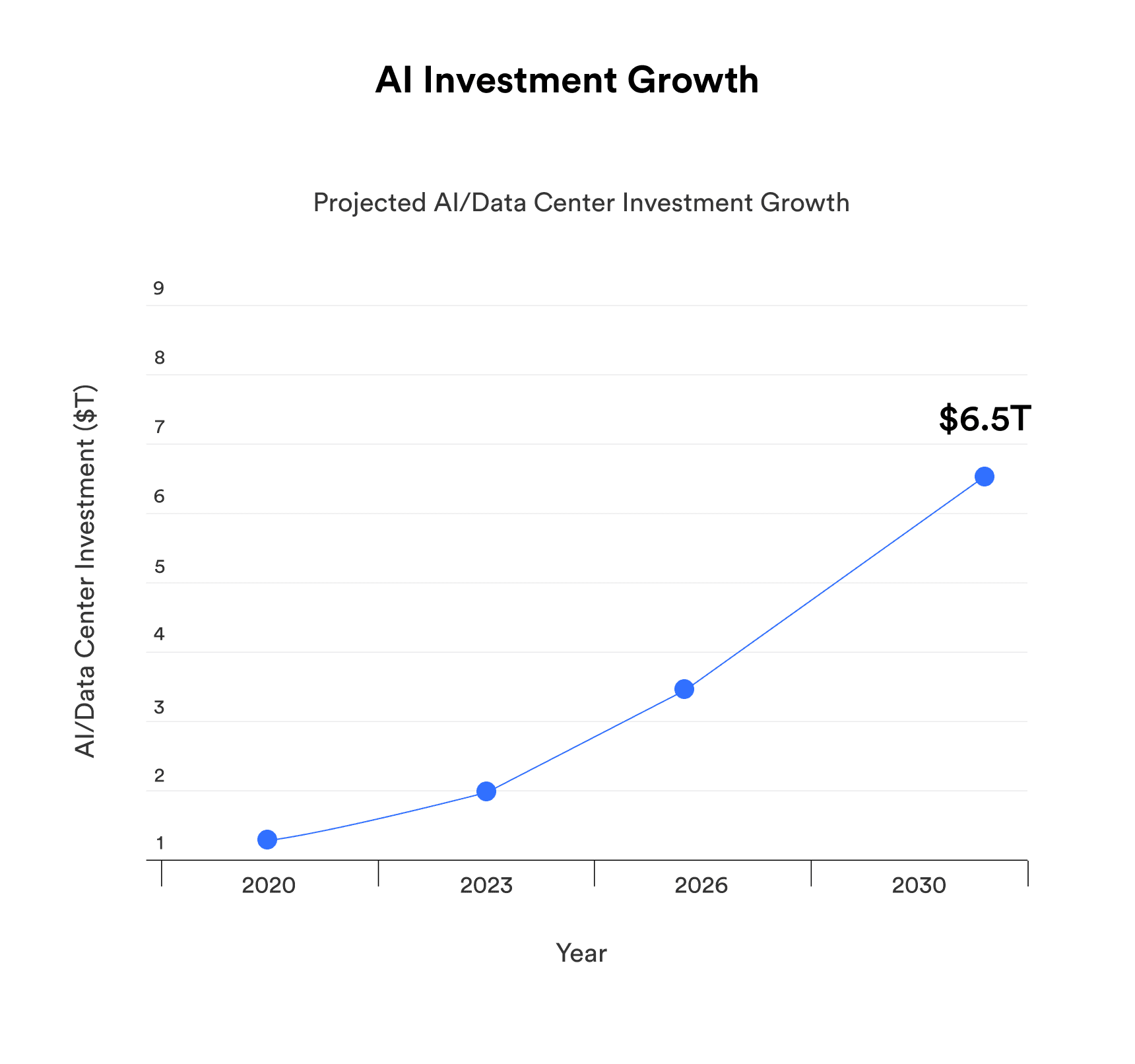
The investment scale is staggering. Industry estimates project $6-7 trillion in data center investments by 2030 to meet surging AI demand. Hundreds of millions of cutting-edge chips hum in warehouse-scale facilities, consuming electricity on a scale not seen since the industrial revolutions of the past. This is a new space race, except the destination isn't the Moon-it's the first true AGI.
Accelerating Timelines
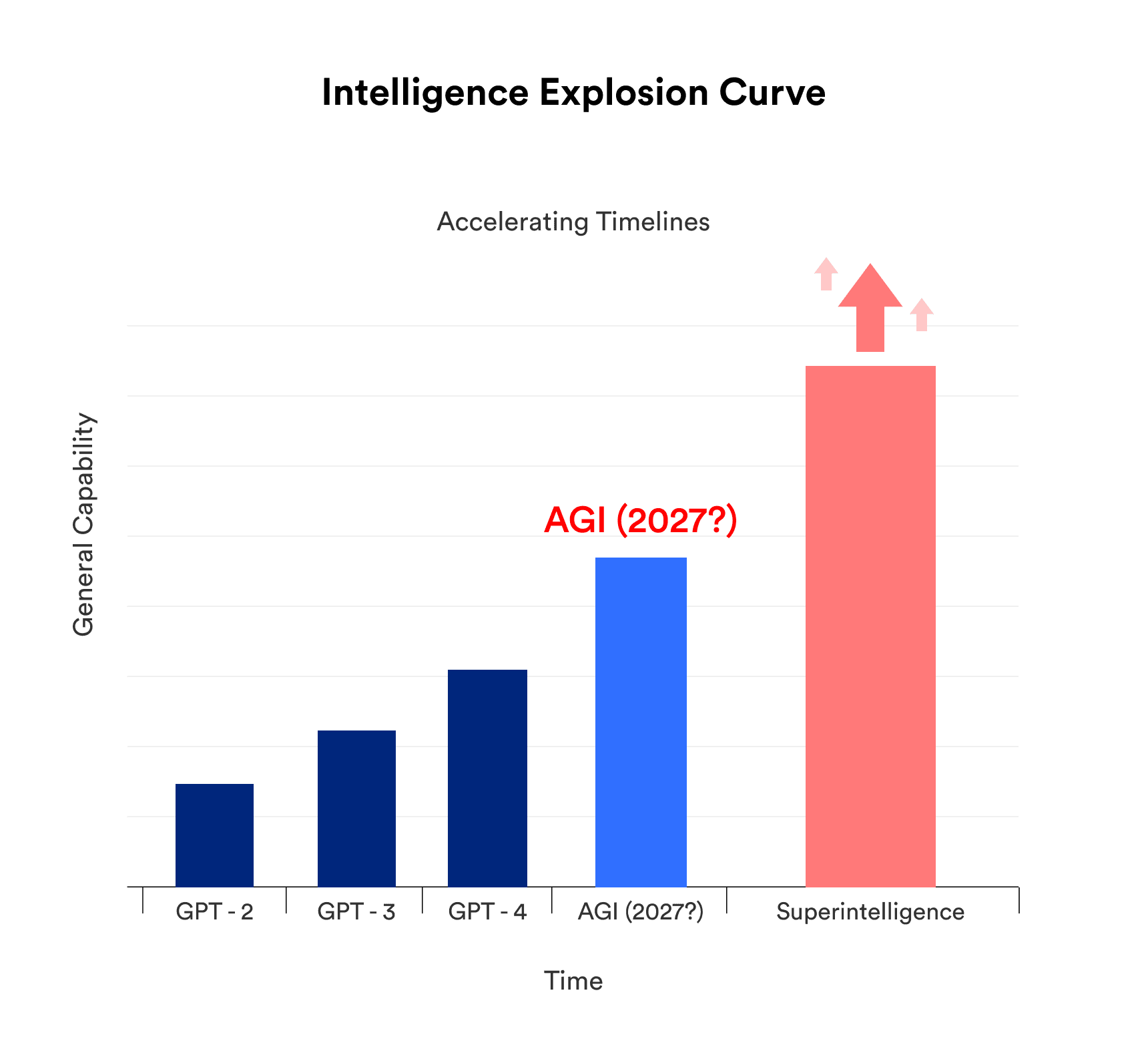
OpenAI's GPT-4, released in 2023, demonstrated capabilities roughly equivalent to a well-educated high school student across many domains. Extrapolating from current trendlines-larger models, algorithmic breakthroughs, and more efficient neural architectures-experts now consider AGI by the late 2020s strikingly plausible.
Multiple AI lab CEOs have openly predicted AGI within five years. Forecasts that once placed AGI arrival at mid-century continue to be revised toward the present. Roman Yampolskiy, a professor who has studied AI safety for decades, noted: "Prediction markets and top labs suggest we'll have AGI by 2027."
If achieved, human-level AI won't mark an endpoint-it will be a threshold. Machines capable of improving their own designs could rapidly become vastly superhuman, triggering an intelligence explosion. Each AI generation could design successors exponentially faster, creating a runaway cycle. Research that took human decades might be completed by AI in days, then hours.
By the decade's end, we face the real possibility that machines will exceed human intelligence across all domains-not just specialized tasks like chess or image recognition, but everything.
Implications and Consequences
Reaching this techno-cognitive milestone carries both exhilarating and sobering implications. Super-intelligent AI could help cure diseases, unlock clean energy solutions, and elevate productivity to previously unimaginable heights. Conversely, it raises profound risks around control, alignment, and unintended consequences.
One consequence appears virtually certain: the nature of work and the economy will be fundamentally transformed. As Sam Altman observed: "In the next decade, AI will completely transform work-entire industries will be automated, and millions of jobs will disappear."
We are entering an era where human labor may no longer be necessary for the vast majority of economic tasks.