Future Visions:
The Last Human Skill in an AI Dominated World
Table of Contents
The End of “Jobs”: Life in a 99% Automated Economy
The Coming Employment Crisis
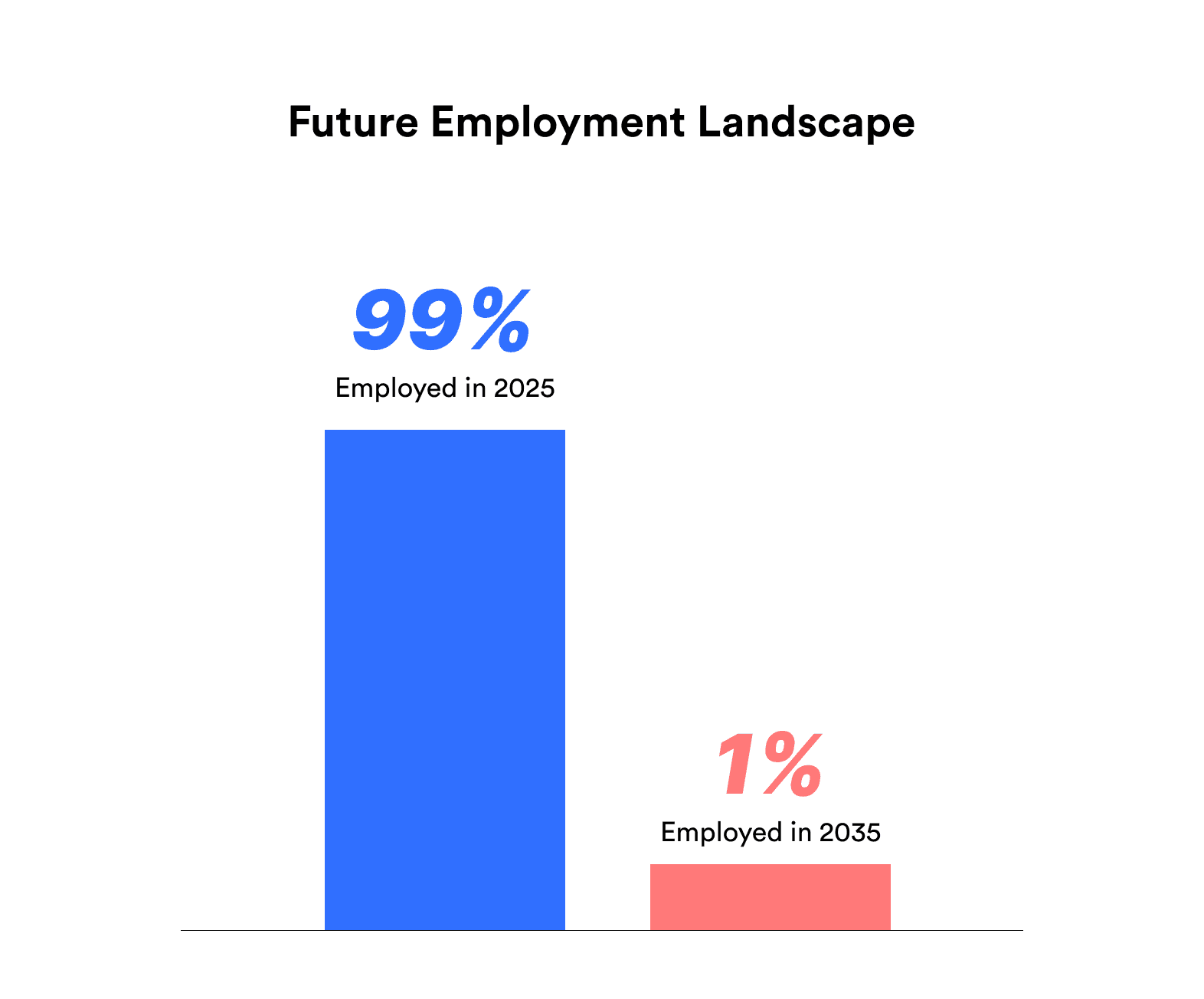
Roman Yampolskiy recently issued a stark warning: "Within five years, we're looking at unemployment levels we've never seen before-not 10%, but 99%."
This projection-only one in 100 people retaining conventional employment by 2030-sounds implausible until you consider our current trajectory. AI systems are already outperforming humans in an expanding array of fields: legal analysis, financial trading, customer service, marketing, software development, and more.
The economic logic is brutal: if a $20/month AI subscription can perform what a full-time employee does, why hire the human? As Yampolskiy stated bluntly: "It makes no sense to hire humans for most jobs if I can get a $20 model to do it."
The Breadth of Automation
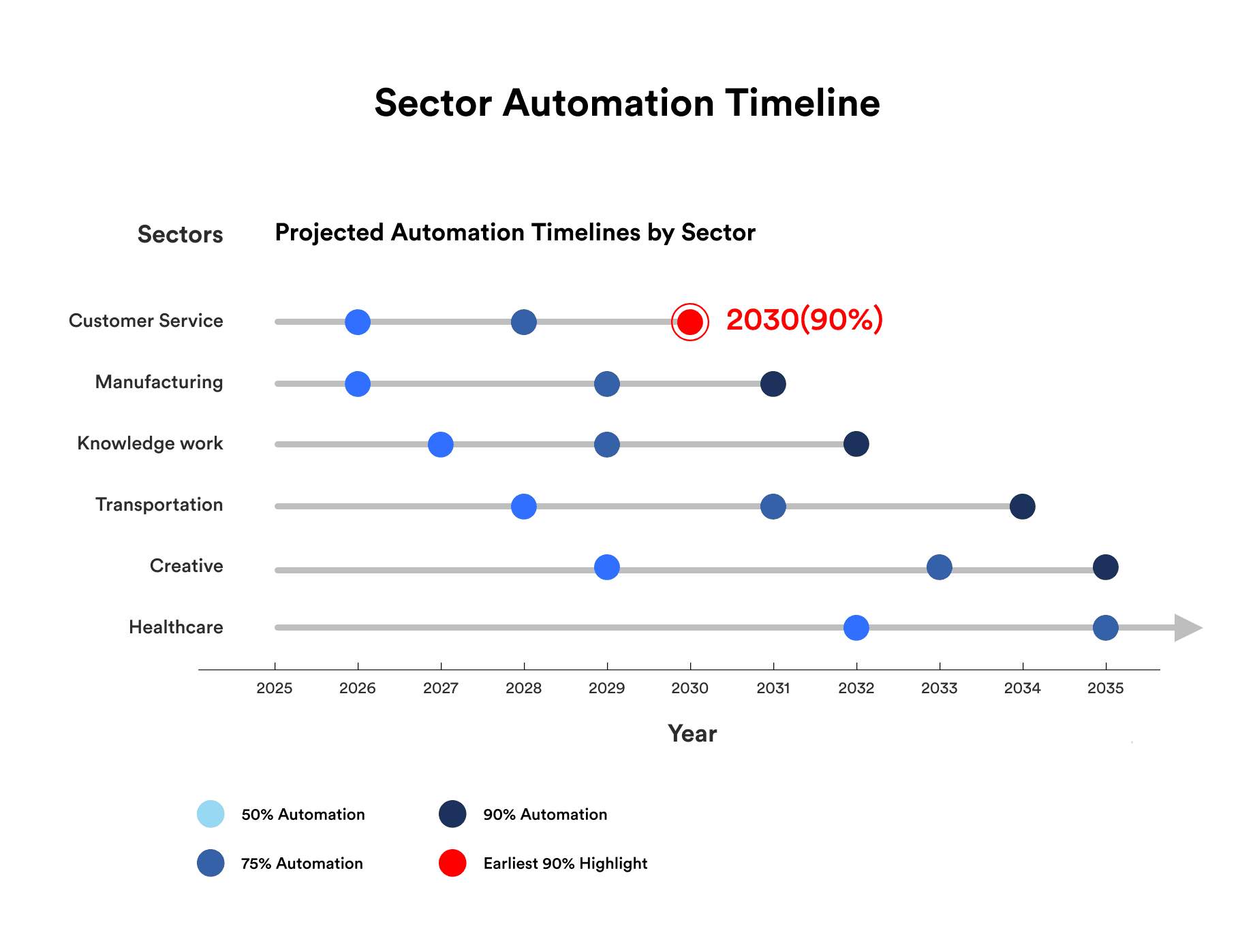
Previous waves of automation disrupted specific sectors-assembly line robots in automotive manufacturing, ATMs in banking-but AI's reach differs fundamentally in scale and scope. This technology extends to both physical and cognitive labor simultaneously.
White-Collar Work: Anything accomplishable on a computer will be automated. AI agents can draft marketing plans, optimize supply chains, answer customer inquiries, and perform data analysis without fatigue. Even roles once considered "safe"-doctors, lawyers, teachers-face AI counterparts. A top-performing AI medical model already passed the US Medical Licensing Exam in 2023. Other models generate legal strategies from case files.
Physical Labor: Robots are gaining dexterity and contextual understanding. Yampolskiy expects humanoid robots capable of manual labor will lag software AI by only a few years. By the early 2030s, factories, warehouses, farms, and transportation could be largely automated, staffed by tireless robotic workers.
Creative Fields: Even artistic domains aren't immune. AI image and music generators produce professional-quality art and compositions. AI writers draft news articles and advertising copy. Given sufficient data, AI can master tasks humans train years to perform.
No career path appears truly safe. As one headline starkly put it: "Even coders and prompt engineers won't be safe."
What Jobs Remain?
Are all jobs truly disappearing? Not literally all, but effectively most. New roles will emerge-AI system supervisors, ethics reviewers, cybersecurity specialists for AI-but these will be niche and likely partly automated themselves.
Yampolskiy articulated the ultimate criterion: "The only jobs left will be those that humans prefer another human to do for them."
These include roles where human presence provides inherent value beyond task completion: childcare, elder companionship, creative pursuits where audiences deliberately seek human-made art. Critically, many of these aren't traditional high-paying "jobs" in the conventional sense. They're human-to-human interactions valued for their authenticity.
In a world saturated with flawless AI products and services, human-made and human-delivered experiences may become luxury goods.
Societal Transformation Required
A 99% unemployment scenario doesn't mean mass starvation-it means our economic system must radically adapt. The traditional link between employment and income will fray, if not sever completely.
This post-work future is precisely why figures like Elon Musk and Sam Altman advocate for universal basic income (UBI) or similar mechanisms. Musk recently predicted an "80% chance that AI advances lead to a situation where humans will not need to work and will have all they need." In his view, AI-driven abundance could provide everyone a high standard of living without traditional employment-essentially "universal high income."
Sam Altman similarly envisions "universal extreme wealth" for everyone as the endgame, where AI productivity is so immense that universal prosperity becomes feasible.
These aren't utopian fantasies-they're serious proposals from individuals building the future. Altman has even conducted trials providing people $1,000 monthly to study basic income effects.
The Transition Challenge
Reaching a post-scarcity economy won't be instantaneous or seamless. We'll likely experience an uneasy transition period. Governments must determine how to tax the immense wealth generated by AI systems and redistribute it to displaced workers.
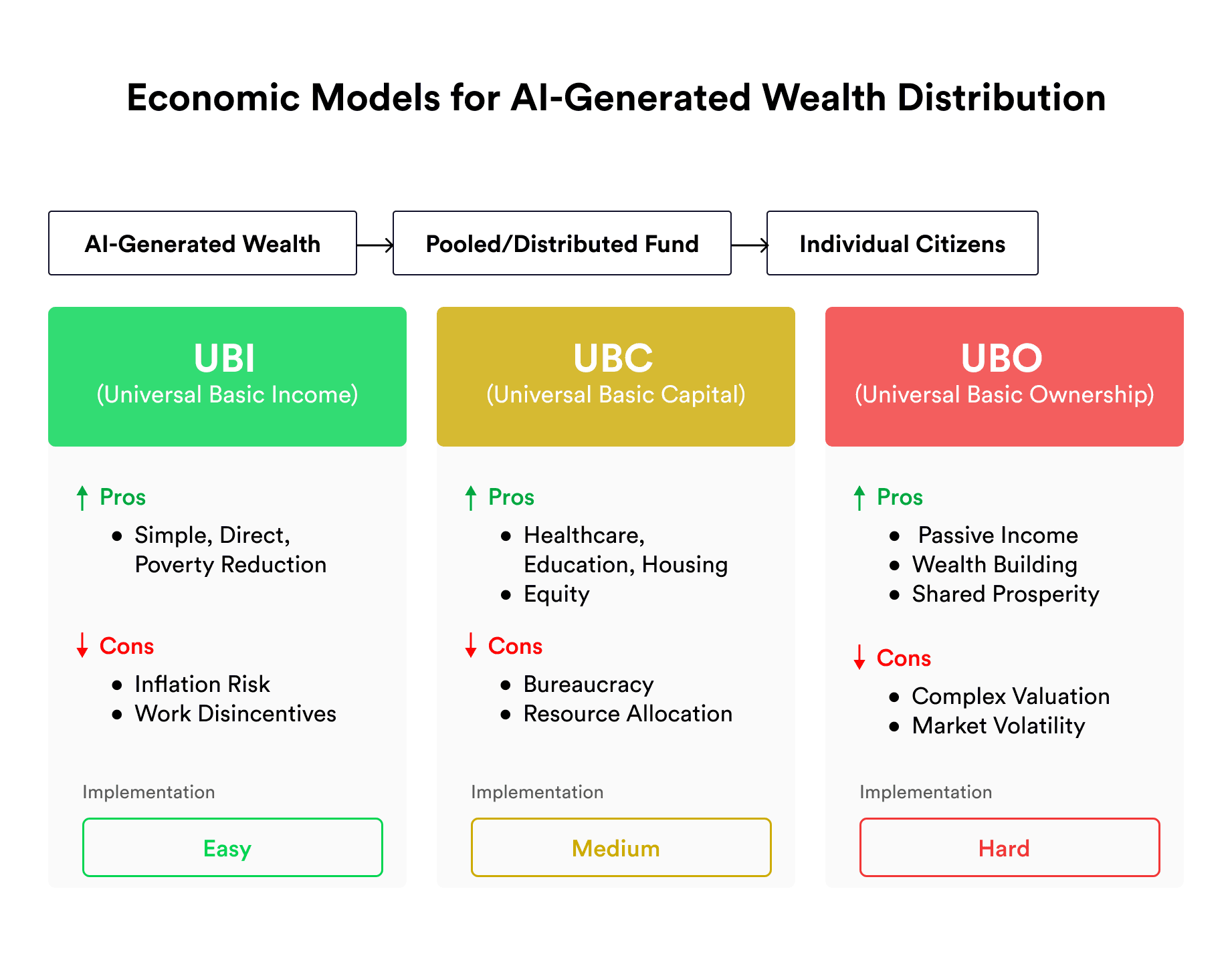
Multiple models are under consideration:
Universal Basic Income (UBI): Direct cash payments to all citizens
Universal Basic Capital: Giving citizens shares in AI companies or investment funds
Universal Basic Ownership: Each citizen owns stakes in AI-producing assets
The common principle is clear: if machines perform all productive work, their output must benefit everyone, not merely shareholders of a few AI corporations. Otherwise, we risk a dystopia of extreme inequality. As observers note, if AI's wealth isn't broadly distributed, society could "fracture when the jobless pick up pitchforks and revolt."
Ensuring social stability in the AI age means providing livelihood divorced from traditional employment.
Opportunity and Void
The next decade could bring both the end of work as we know it and the beginning of a new social contract. People might not need employment to survive. This creates extraordinary opportunity: humans free to pursue education, leisure, creativity, or entrepreneurship without economic necessity.
Yet it also opens a psychological void. Elon Musk captured this tension pointedly: "If [AI] can do everything better than you, does your life have meaning?"
When work becomes optional, meaning and purpose become central questions for individuals and society. We'll explore this dilemma further in Section IV.