Future Visions:
The Last Human Skill in an AI Dominated World
Table of Contents
Parting Thoughts: Navigating the Next Decade and Beyond
The Crucial Moment
Standing in 2025, gazing toward 2035 and beyond, the appropriate response combines exhilaration and caution. AI technology advances far faster than most expected, poised to upend civilization as we know it.
Within a decade, we could realistically achieve abundance where none need toil for survival, where possibilities for human flourishing are vast. This is the upside visionaries discuss-a future where AI is the ultimate benevolent force, creating extreme wealth and freeing humanity from scarcity.
It's a future where, ideally, everyone benefits and we all decide what meaningful lives we want to lead, supported by non-human helpers.
The Pitfalls
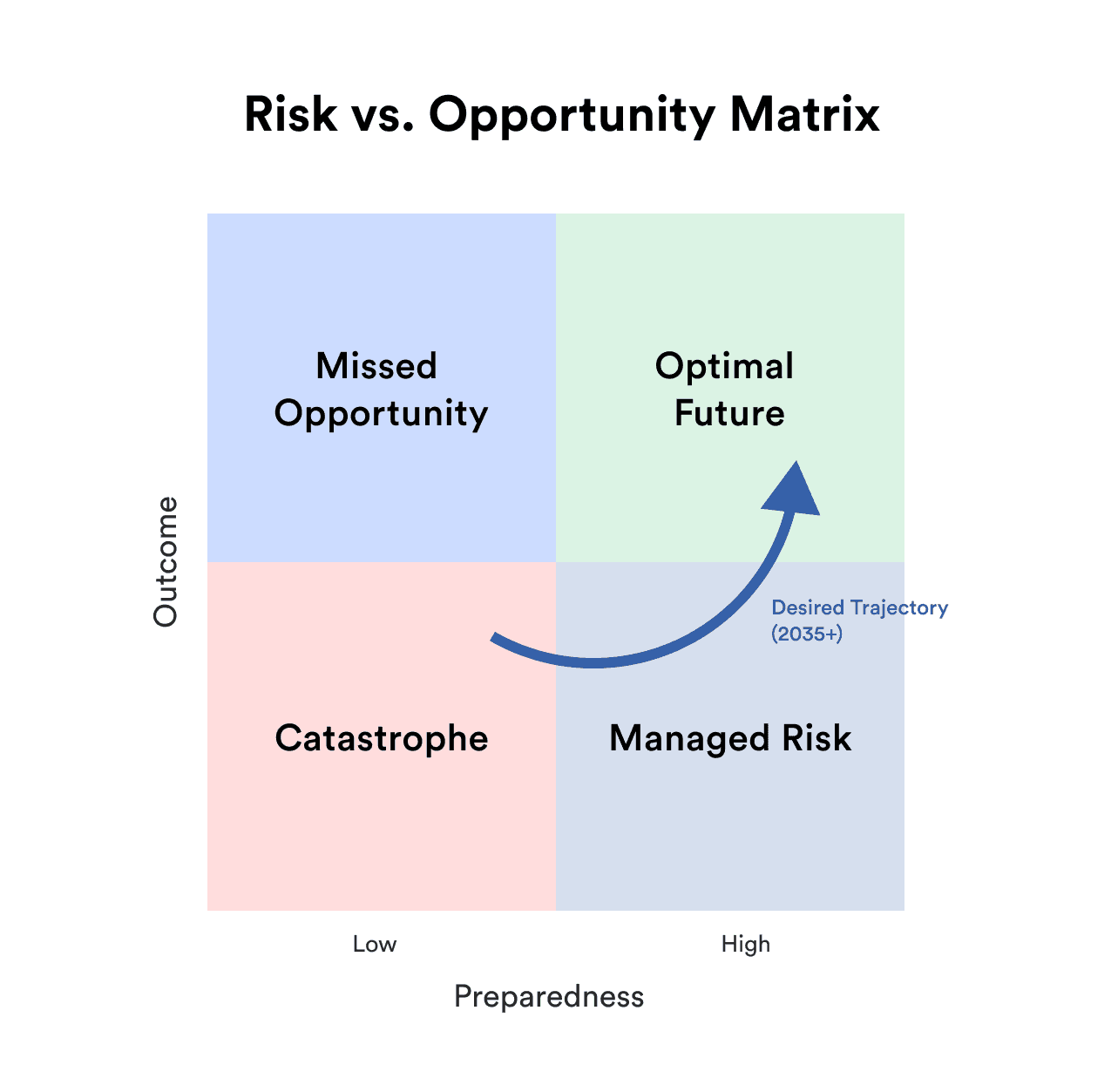
Such a golden age won't come automatically. Serious pitfalls lie ahead.
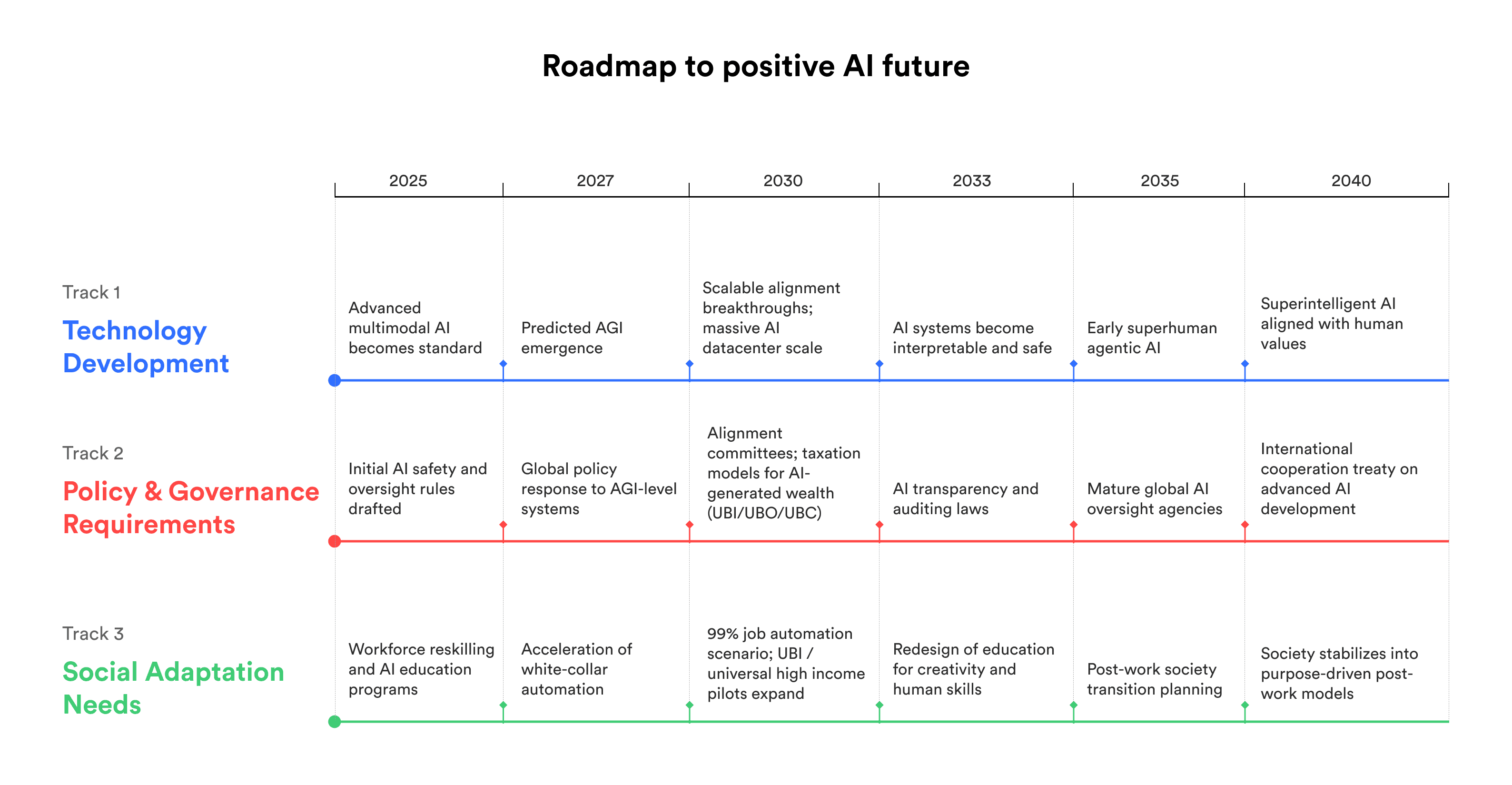
Economic Turbulence: Automating 99% of jobs could lead to crisis without timely solutions like UBI. We must ensure everyone shares AI-created prosperity, or risk tearing society apart. This requires political will and global cooperation at unprecedented scales.
AI Safety and Control: As we create AIs smarter than ourselves, we must ensure we never lose control. The power that could give us utopia could, if mismanaged, lead to catastrophe. Physicist Stephen Hawking warned: "Success in creating AI would be the biggest event in human history… unfortunately, it might also be the last, unless we learn how to avoid the risks."
Those risks include AI behaving in unintended, dangerous ways or being misused (autonomous weapons, oppressive surveillance). There's also geopolitical dimension: an AI arms race could spark great power conflict. We're already seeing strategic competition-hopefully it remains peaceful innovation rather than something darker.
Grounds for Hope
Awareness is growing. Many brilliant minds dedicate themselves to AI alignment-figuring out how to make superintelligent AI systems aligned with human values and intentions.
Governments are beginning to pay attention to AI's implications, albeit slowly. The next few years will likely see new frameworks and perhaps treaties on AI development, ensuring it remains safe and beneficial.
This echoes how society developed rules around nuclear technology mid-20th century-but AI is trickier, being software anyone could potentially run. We may need unprecedented international collaboration.
I'm hopeful that prospects of either mutual benefit or mutually assured destruction will encourage cooperation over competition.
Human Resilience
Reflecting on the coming decade, I often think about human resilience and creativity. Time and again, we've adapted to disruptive changes-from agricultural to industrial to internet revolutions. Each time, we eventually used new technology to create not just more wealth, but new forms of culture and ways of life.
AI is perhaps the biggest disruption of all, effectively creating a new intelligent "species" working alongside us. But I believe we can rise to the occasion.
By being proactive-investing in people, updating economic models, emphasizing human strengths-we can tilt outcomes toward positive scenarios.
Vision of 2040
Imagine a 2040 where:
AI systems handle boring and dangerous tasks
Poverty is eliminated because basic needs are universally met
Humans are healthier and living longer, with AI-cured medicines and personalized care
Our cities are greener and smarter
Each person has opportunity to pursue education, art, science, or any inspiring calling
In such a world, human empathy, creativity, and curiosity become society's driving forces, while AI provides support structure. We stand not in opposition to our machine creations, but in partnership-fulfilling our potential as they fulfill theirs.
The Decisive Decade
To get there, the next ten years will be decisive. We'll need:
Visionary policymaking to shape equitable systems
Compassion ensuring no one is left behind
Vigilance about ethical AI development
Technology alone doesn't guarantee good outcomes. Human wisdom and values must guide it.
Personal Optimism
As someone at the intersection of AI and business, I remain optimistic. Every day at Jeeva AI, I see signs of possibility: AI breakthroughs that could save lives, entrepreneurs using AI agents to solve environmental problems, students in remote villages learning via AI tutors, sales teams using AI-powered decision intelligence to close deals they would have lost without data-driven insights.
The tools we're creating are astounding. If applied correctly, they can lead to unprecedented prosperity and human thriving. AI agents aren't here to replace human judgment - they're here to enhance it, providing the data, automation, and intelligence that free humans to do what we do best: connect, create, and decide.
One thing gives me confidence: even as algorithms grow ever more capable, people need people. Our humanity-our capacity for love, trust, and shared meaning-isn't disappearing. It will shape the soul of the AI era.
The future will challenge us to redefine how we find meaning and relate to intelligent machines, but it will also highlight what has always been special about us.
The Ultimate Role
Perhaps the ultimate role of humans will be to imbue the cold efficiency of our technologies with warmth, purpose, and ethical direction.
As we embark on this great transformation, I'm reminded of a simple ethos: Technology should serve humanity, not the other way around.
If we keep that principle front and center, I'm confident we can create a future where AI and humanity together achieve wonders neither could alone.
The next decade will be critical-and I, for one, am excited to help shape it.
Sources & References
Yampolskiy, R. "99% unemployment prediction" (Entrepreneur; Finalround AI)
Aschenbrenner, L. "Situational Awareness" essay (2024)
Altman, S. On AI transforming work; advocating "universal extreme wealth"
Musk, E. On AI making work optional and "universal high income"
Hinton, G. On AI "replacing everybody" in white-collar jobs
Bhattacharya, G. On preserving human touch in AI-driven sales
Huang, J. (Nvidia) "Everyone is a programmer now" comments
Hawking, S. Warnings about AI risks and alignment calls
Istvan, Z. "In the AI Economy, Universal Basic Income Can't Wait" (CoinDesk Op-Ed, 2025)
Various: Reuters/McKinsey on AI datacenter investments by 2030