Introduction: From Cold Data to Hot Demos - Faster in 2026
TL;DR: In 2026, AI pipeline generation enables sales teams to move leads from discovery to demo autonomously by acting on real-time buyer signals. By replacing manual delays with agentic execution, it shortens sales cycles from weeks to hours without losing personalization or precision.
AI pipeline generation is the use of artificial intelligence to identify, qualify, and engage B2B buyers autonomously moving prospects from first signal to booked demo in hours instead of weeks. In 2026, this is no longer an optimization tactic; it is the baseline for competitive sales execution. Manual research, delayed follow-ups, and static sequences simply cannot keep pace with how fast buyer intent now appears and disappears.
Modern AI pipeline systems have evolved beyond traditional sales automation. Instead of executing fixed rules, they interpret buyer signals, reason over context, and take action in real time. These systems continuously enrich data, personalize outreach, and coordinate follow-ups without waiting for human input, allowing sales teams to respond at the exact moment interest is highest.
With AI pipeline generation, the sales funnel compresses without sacrificing relevance or trust. Platforms like Jeeva AI apply agentic execution to transform raw data into timely, human-like engagement helping teams turn cold signals into live conversations while intent is still active.
What Is AI Pipeline Generation?
TL;DR: AI pipeline generation uses agentic AI to autonomously identify, engage, and convert prospects across the sales funnel without manual orchestration.
AI pipeline generation refers to the use of agentic AI systems that autonomously manage the entire sales funnel, from lead discovery and enrichment to personalized outreach and meeting scheduling. Unlike traditional pipeline tools that support isolated tasks, AI pipeline generation operates as a coordinated system that executes workflows end to end. These systems continuously adapt based on buyer behavior, intent signals, and engagement data, enabling pipelines to run without constant human intervention.
Unlike traditional pipeline automation, AI pipeline generation does not rely on predefined rules or manual orchestration. Instead, it reasons across data sources, decides next-best actions dynamically, and executes them autonomously. The result is a self-sustaining sales pipeline that reduces manual effort, improves consistency, and accelerates pipeline creation at scale.
Core Capabilities of AI Pipeline Generation
Lead Identification: AI identifies high-intent prospects using firmographic, behavioral, and intent data
Lead Enrichment: Continuously pulls verified details such as title, company, industry, and revenue
Personalized Outreach: Generates context-aware messages tailored to buyer role and activity
Engagement and Scheduling: Follows up automatically and books meetings without human intervention
Instead of SDRs managing spreadsheets and fragmented tools, AI agents collaborate across these stages to create a continuously operating pipeline. In platforms like Jeeva AI, specialized agents work together to identify prospects, generate messaging, and drive engagement resulting in a complete, adaptive sales pipeline that runs with minimal manual oversight.
Why Are Traditional Sales Pipelines Slowing Down?
Traditional B2B sales pipelines are slowing down because they rely heavily on manual outreach and fragmented execution. Sales development teams spend most of their time researching prospects, managing tools, and coordinating follow-ups instead of engaging buyers. As a result, response times increase, opportunities stall, and pipeline momentum drops.
Manual processes also create inconsistency. Many leads never receive timely follow-up, and personalization is often limited to static templates that fail to reflect real buyer context. This leads to lower engagement, missed buying windows, and wasted pipeline potential.
Key challenge: When outreach depends on human availability and fixed workflows, speed and relevance suffer at scale.
What Bottlenecks Are Holding Traditional Pipelines Back?
Sales reps spend most time researching, not selling
A large share of qualified leads go uncontacted
Follow-ups are delayed or missed entirely
Personalization relies on static, generic templates
Pipeline progress depends on manual coordination
AI-driven pipeline generation addresses these bottlenecks by combining speed, intelligence, and scalability. By automating research, prioritizing leads, and triggering personalized outreach in real time, AI ensures every qualified lead is contacted at the right moment with the right message.
This transforms slow, manual pipelines into responsive systems that move opportunities forward consistently.
How Does AI Accelerate B2B Pipeline Growth?
AI accelerates B2B pipeline growth by automating repetitive sales processes, improving lead prioritization, and enabling faster engagement with real decision-makers. Instead of relying on manual research or static rules, AI-driven sales systems continuously analyze buyer data and intent signals to move opportunities through the pipeline with speed and accuracy.
By combining predictive intelligence, real-time enrichment, and automated execution, AI ensures that sales teams focus only on high-quality leads while reducing delays and drop-offs across the funnel.
What Are the Key AI Levers That Drive B2B Pipeline Growth?
Predictive lead scoring: AI prioritizes high-conversion B2B leads automatically
Intent-based targeting: Detects buying signals from online and behavioral data
Smart cadence automation: Adjusts outreach timing, tone, and frequency per contact
Real-time data enrichment: Keeps lead and account records accurate and current
CRM synchronization: Ensures pipeline data stays clean, actionable, and updated
Autonomous execution: Eliminates manual guesswork in pipeline progression
Modern AI pipeline generation platforms analyze massive volumes of sales and intent data to guide every action. For example, Jeeva AI processes over 1B data points daily to identify decision-makers, prioritize accounts, and trigger personalized outreach automatically.
This allows sales teams to spend zero time on manual research and more time closing deals.
Comparing Traditional vs AI-Driven Pipeline Generation
AI-driven pipeline generation outperforms traditional methods by automating lead discovery, prioritization, and outreach in real time, resulting in faster engagement and more predictable pipeline growth.
Traditional pipeline generation relies heavily on manual effort, static rules, and delayed decision-making. While it can work at small scale, it struggles to keep up with modern B2B buying behavior, where intent signals change quickly and buyers expect timely, relevant engagement. AI-driven pipeline generation replaces manual guesswork with continuous analysis, automation, and real-time execution.
AI-driven systems focus on speed, accuracy, and consistency across the funnel. By automating research, prioritization, and outreach, they ensure qualified leads are identified and engaged at the right moment—without depending on human availability.
Traditional vs AI-Driven Pipeline Generation
Dimension | Traditional Pipeline Generation | AI-Driven Pipeline Generation |
|---|---|---|
Lead discovery | Manual research and list building | Automated identification using data and intent signals |
Lead prioritization | Static rules and manual scoring | Predictive, real-time lead scoring |
Personalization | Template-based and inconsistent | Context-aware, dynamic personalization |
Speed-to-lead | Delayed by manual handoffs | Instant activation based on signals |
Data freshness | Periodic or outdated updates | Continuous real-time enrichment |
Follow-up execution | Manual or fixed cadences | Adaptive, behavior-driven follow-ups |
Pipeline consistency | Highly rep-dependent | Systematic and repeatable |
Scalability | Limited by team size | Scales without added headcount |
Forecast reliability | Inconsistent and lagging | More predictable and data-driven |
In summary: traditional pipeline generation depends on effort and timing, while AI-driven pipeline generation depends on intelligence and execution speed.
Why Is Response Speed Essential for Pipeline Growth?
Response speed drives pipeline growth because faster lead engagement increases win rates and shortens sales cycles, while delays rapidly reduce conversion and overall pipeline velocity.
Response speed is essential for pipeline growth because it directly determines how quickly qualified leads move toward conversion. Faster responses increase engagement, shorten sales cycles, and improve win rates across the funnel. In modern B2B sales, delays are not neutral, they actively reduce pipeline potential.
Pipeline velocity is a core sales metric that captures this relationship:
Pipeline Velocity = Number of SQLs × Win Rate × ACV ÷ Sales Cycle Length
When response times increase, sales cycle length expands and win rates decline, slowing overall pipeline growth even when lead volume remains constant.
Research from Forrester highlights this impact. CROs who reduce lead-to-demo handoff time by 50% can see pipeline growth accelerate by 18% faster compared to peers. Faster response does not just improve efficiency it compounds revenue outcomes.
What Happens When Sales Teams Respond Too Slowly?
Slow response times create measurable friction throughout the pipeline. In practical terms, delays lead to lost intent, reduced engagement, and lower conversion probability.
Key indicators of slow response include:
Average first response time: ~29 hours
High-intent lead conversion: 75–80% when contacted within one hour, dropping below 40% after 24 hours
SDR capacity limits: Only 4–6 sales-accepted opportunities per rep per month
These constraints make it difficult for traditional SDR teams to meet buyer expectations without increasing headcount or costs.
Why This Matters for Modern B2B Sales
Today’s buyers expect immediacy. When response speed depends on manual workflows and human availability, pipelines slow and opportunities decay. To sustain pipeline growth without escalating costs, sales teams must reduce response time systematically not incrementally.
Bottom line: Faster response speed is no longer a tactical advantage; it is a structural requirement for scalable pipeline growth.
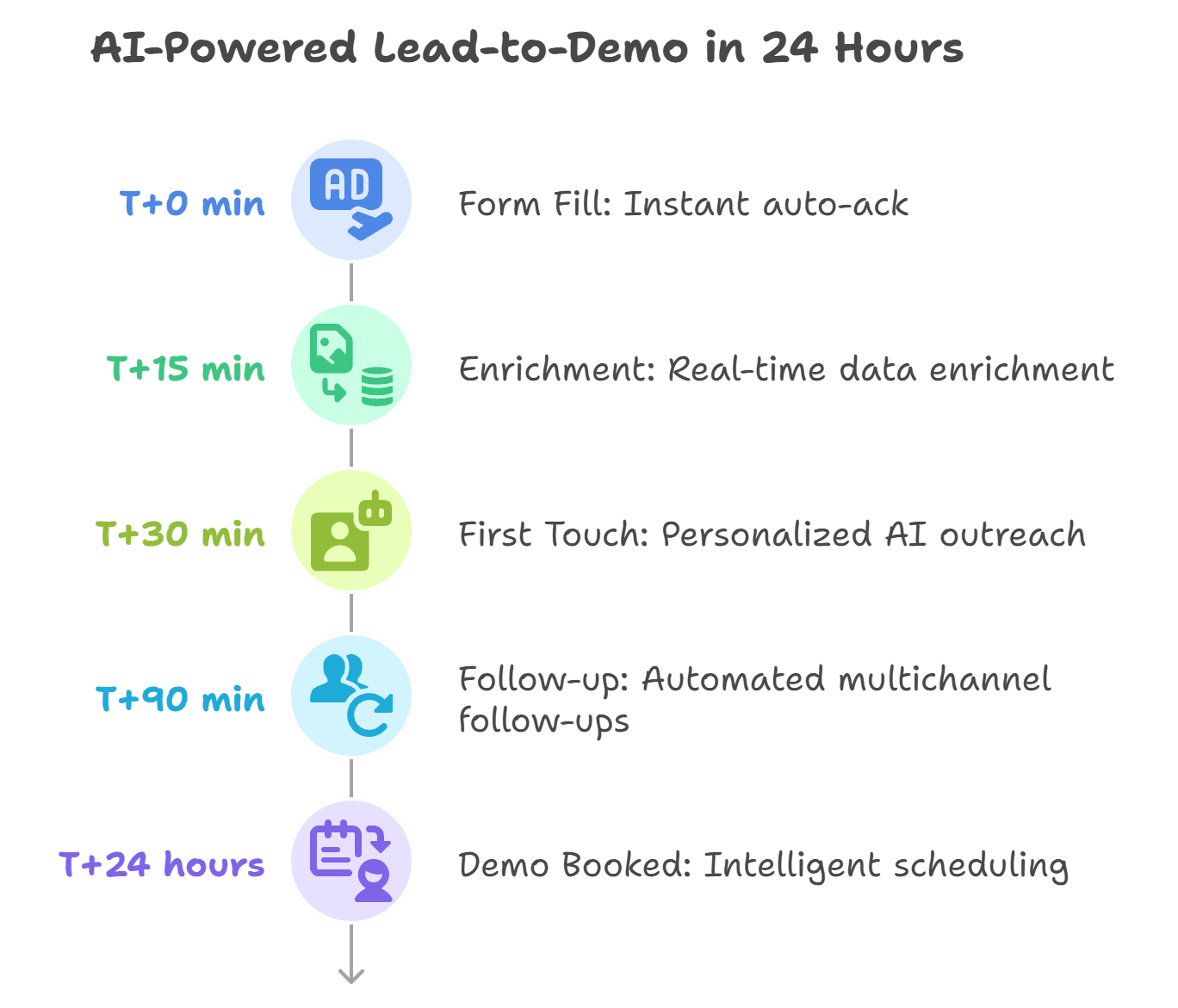
The AI-Powered Blueprint: 24-Hour Lead-to-Demo Pipeline
Pipeline Stage | Traditional B2B Sales | AI-Powered 24-Hour Pipeline |
|---|---|---|
Lead discovery | Manual list building and research | Automated identification using intent signals |
Data enrichment | Periodic or batch updates | Real-time contact and account enrichment |
Lead qualification | Static rules or manual scoring | Predictive, AI-driven lead scoring |
Outreach creation | Generic templates or manual writing | Personalized messages generated automatically |
Outreach timing | Delayed by human availability | Triggered instantly based on buyer activity |
Follow-up execution | Fixed cadences, often missed | Adaptive follow-ups driven by engagement |
CRM updates | Manual data entry | Automatic, real-time CRM synchronization |
Speed-to-demo | Several days to weeks | Within 24 hours of first signal |
Sales effort required | High manual workload | Minimal manual intervention |
Pipeline predictability | Inconsistent and rep-dependent | Consistent and system-driven |
A 24-hour lead-to-demo pipeline is only possible when AI coordinates enrichment, prioritization, personalization, and outreach as a single autonomous system rather than disconnected manual steps.
Why Traditional Sales Platforms Fall Short of Agentic AI in Sales?
Unlike traditional platforms such as Salesforce and HubSpot, agentic AI in sales introduces an AI Sales Agent that autonomously interprets signals and executes pipeline actions in real time rather than relying on manual or rule-based workflows.
Most widely adopted sales platforms are designed to support human-led workflows, not to operate as autonomous systems. While they are essential infrastructure, they were not built to function as an AI Sales Agent that reasons, decides, and executes actions independently.
Salesforce is a powerful system of record for pipeline management, forecasting, and reporting. However, it depends on manual configuration, rule-based automation, and human-driven follow-ups to move deals forward.
HubSpot enables marketing and sales alignment through workflows and sequences, but personalization, prioritization, and timing still rely heavily on predefined rules and SDR effort.
Both platforms excel at tracking and organizing sales activity, but they do not function as agentic systems. They do not independently interpret buyer signals, adapt outreach strategies in real time, or execute end-to-end pipeline actions without human intervention.
This is where Agentic AI in Sales represents a fundamental shift. Instead of supporting sellers with tools, an AI Sales Agent actively runs parts of the sales process on their behalf—handling enrichment, prioritization, personalized outreach, and follow-ups as a coordinated, autonomous workflow.
Jeeva AI operates alongside platforms like Salesforce and HubSpot as an execution layer, transforming static CRM data into real-time action. Rather than replacing existing systems, it activates them turning stored information into continuous pipeline movement.

How Do You Implement an AI Sales Agent Effectively?
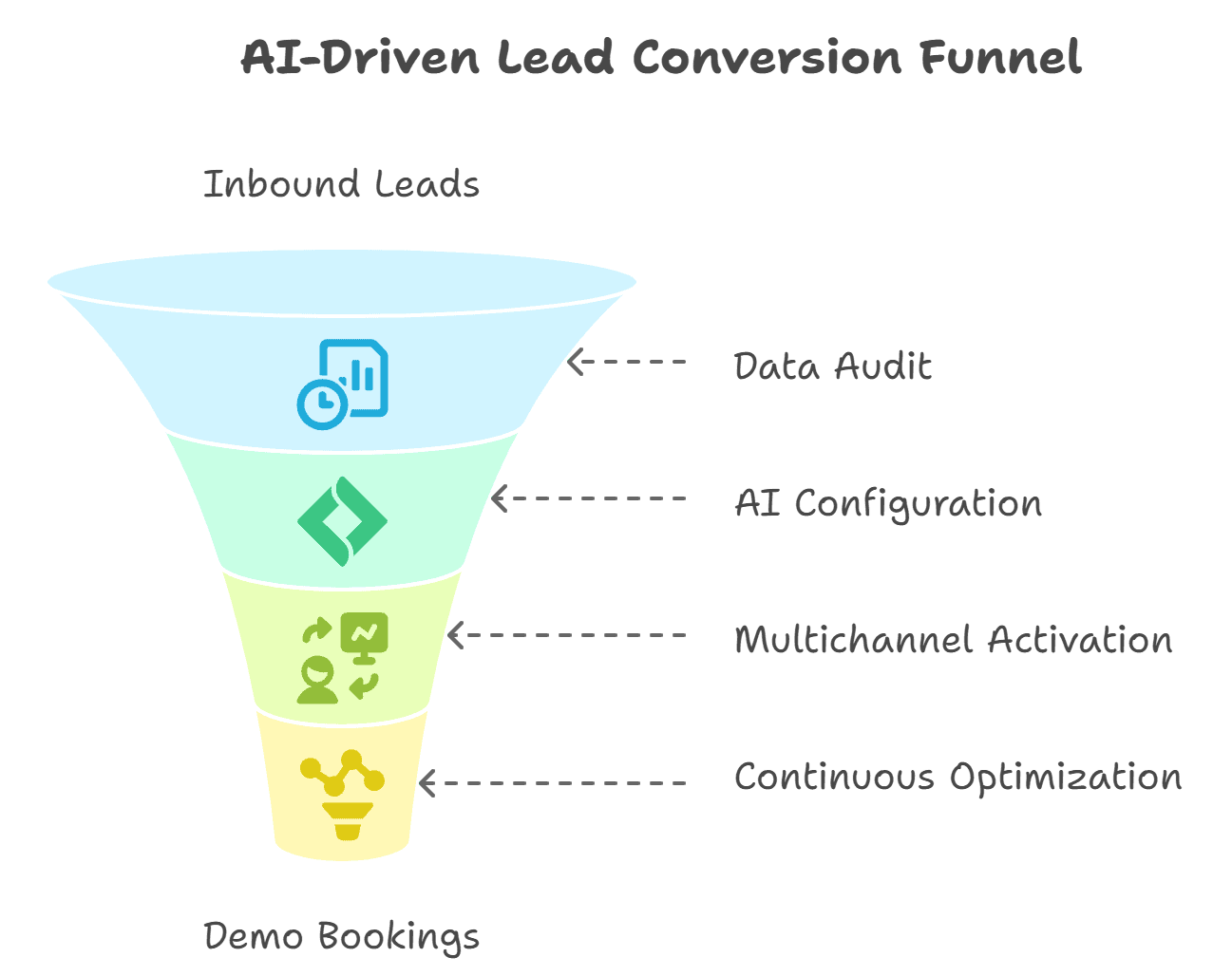
Implementing an AI Sales Agent involves auditing response delays, enabling real-time enrichment, activating compliant multichannel outreach, and continuously optimizing execution using engagement data.
Step 1: Conduct a Sales Data Audit: Review inbound and outbound leads to identify response delays, missed follow-ups, and stalled opportunities. This establishes a clear baseline for speed-to-lead and pipeline friction.
Step 2: Configure Your AI Sales Agent: Set up Jeeva AI by connecting APIs, enabling real-time enrichment, and defining persona-based messaging rules. This ensures outreach adapts to buyer role, intent, and context.
Step 3: Activate Multichannel Sequencing: Enable compliant outreach across email, professional networks, and voice channels. AI coordinates timing and messaging automatically to maintain consistency without manual effort.
Step 4: Continuously Optimize with Engagement Data: Monitor responses, booked meetings, and conversion speed. Use engagement insights to refine targeting, messaging, and follow-up logic so demo-booking rates improve over time.
When implemented correctly, this checklist allows an AI Sales Agent to operate as a continuous execution layer turning inbound and outbound signals into scheduled conversations without relying on human availability.
How to Implement AI Pipeline Generation in Your B2B Team
AI pipeline generation is implemented by connecting an autonomous AI layer to your CRM, defining your ideal customer profile, and activating agents that identify, engage, and schedule meetings automatically in real time.
Implementing AI pipeline generation requires a clear sequence that connects data, decision-making, and execution. The goal is not to replace your existing sales stack, but to add an autonomous layer that accelerates how leads move from discovery to booked meetings.
Step-by-Step Implementation of AI Pipeline Generation
Step 1: Connect AI to Your CRM: Integrate Jeeva AI with your existing CRM such as HubSpot, Salesforce, or Zoho. This ensures lead data, activity, and pipeline stages stay synchronized in real time.
Step 2: Import or Enrich Your Lead Data: Upload existing lead lists or connect real-time enrichment sources. This allows AI to validate contacts, update firmographic details, and ensure every record is actionable before outreach begins.
Step 3: Define Your Ideal Customer Profile (ICP): Set clear filters such as geography, job title, company size, revenue range, and industry. These parameters guide AI decision-making and ensure outreach targets only high-fit accounts.
Step 4: Activate AI Agents Across the Funnel: Enable autonomous AI agents to handle pipeline execution end to end:
Prospector Agent: Identifies and prioritizes high-intent accounts
Writer Agent: Generates personalized outreach messages
Engagement Agent: Executes follow-ups and manages responses
Step 5: Monitor Pipeline Performance Metrics: Track key indicators such as response rate, booked meetings, conversion speed, and pipeline velocity. AI continuously optimizes actions based on these outcomes.
With this setup in place, most B2B teams see their first AI-scheduled meetings within 24 hours. By removing manual delays and coordinating execution automatically, AI pipeline generation turns intent into conversations while buyer interest is still high.
Conclusion: The 24-Hour Sales Pipeline Shift
B2B sales has always been driven by timing. Today, agentic AI changes how timing works by removing delays between data, outreach, and action. When lead discovery, enrichment, personalization, and follow-up happen automatically, pipelines move at the pace buyers expect not the pace manual teams can manage.
With platforms like Jeeva AI, sales teams can identify high-intent accounts, engage them with relevant messaging, and move prospects to booked meetings before competitors respond. Agentic, multi-agent systems coordinate these steps continuously, ensuring no qualified opportunity waits in a queue.
The result is a compressed sales funnel where intent is captured while it is still active. From first signal to scheduled demo, AI enables pipeline progress within hours instead of days.
Bottom line: The next generation of pipeline growth is not about working harder - it is about responding faster. Teams that adopt agentic AI now will consistently outperform those still bound by manual timelines.
Start your AI pipeline with Jeeva AI | Book a Demo
FAQ
How does AI improve lead quality in the sales pipeline?
How is AI pipeline generation different from traditional lead generation?
Does AI pipeline generation replace SDRs or sales reps?
What data does AI use for pipeline lead generation?
How does Jeeva AI support AI pipeline lead generation?