Introduction
Sales teams lose the most time and pipeline opportunity due to missing, outdated, or incomplete lead data. Bad phone numbers, wrong titles, incorrect emails, or outdated company details lead to wasted outreach.
Real-time lead enrichment solves this by continuously updating your lead data with verified, accurate information fueling AI sales systems with clean, actionable insights.
In 2026, real-time enrichment has become the backbone of AI lead generation software across the US, UK, Canada, Australia, and New Zealand. It ensures that every prospect entering your pipeline is valid, qualified, and ready for multi-channel outreach.
What Is Real-Time Lead Enrichment?
Real-time lead enrichment is the process of automatically updating, correcting, and completing lead data the moment it changes. Instead of relying on static lists or periodic updates, AI continuously refreshes contact and company information so sales systems always operate on current data.
Fact: Sales teams lose 27-40% of pipeline due to outdated or incomplete data.
Real-time enrichment ensures that scoring, personalization, routing, and outreach decisions are based on live signals, not stale assumptions. This keeps AI-powered sales pipelines accurate and effective.
What Real-Time Enrichment Fixes?
Wrong job titles: Updates roles as people change positions
Invalid emails: Replaces bounced or risky addresses
Missing LinkedIn profiles: Adds verified social context
Outdated phone numbers: Refreshes contact details
Company funding changes: Captures growth and budget signals
Tech stack updates: Reflects tools currently in use
Every contact stays fresh, accurate, and outreach-ready. This eliminates wasted messages and improves conversion across the pipeline.
Why Real-Time Enrichment Matters for AI Sales Pipelines?
Real-time enrichment is essential because AI decisions are only as good as the data behind them. When lead data is outdated or incomplete, AI systems mis-score leads, personalize incorrectly, and route opportunities to the wrong stage. Continuous enrichment keeps inputs accurate so AI can act with confidence.
Cause → Effect: Better data → better targeting → better conversions.
Modern sales pipelines depend on live signals - role changes, company growth, tech updates, and intent events. Real-time enrichment ensures AI operates on current reality, not stale records.
AI Functions That Depend on Clean Data
Lead scoring: Prioritizes prospects using accurate fit and intent
ICP matching: Filters accounts with up-to-date firmographics
Personalization: References correct roles, tools, and context
Qualification: Assesses readiness using valid engagement signals
Routing: Sends leads to the right owner or stage instantly
Outreach timing: Triggers messages when buyers are most receptive
Clean, real-time data eliminates wasted outreach. Sales pipelines become more efficient, predictable, and conversion-focused.
How AI Performs Lead Enrichment Automatically?
AI performs lead enrichment by continuously collecting, verifying, and updating prospect data without human involvement. Instead of relying on static lists or one-time lookups, AI systems monitor multiple data streams in real time and fill in missing or outdated information the moment it changes.
This automation removes manual research entirely and ensures every lead is accurate, complete, and ready for outreach.
Fact: AI-driven enrichment reduces research time by 80–90%, while significantly improving data quality.
How the Enrichment Process Works
AI follows a structured, repeatable workflow:
Detects incomplete or outdated lead records
Pulls fresh data from multiple trusted sources
Cross-verifies information for accuracy
Updates CRM and outreach systems automatically
Triggers scoring, personalization, or routing actions
This happens continuously, not as a one-time cleanup.
Data Sources AI Uses for Enrichment
AI aggregates and validates data from diverse signals to build a complete lead profile:
Social: Job titles, seniority, role changes, and company updates
Public databases: Business registrations, domains, and firmographics
Tech footprint datasets: Tools, platforms, and software usage
CRM history: Past interactions, deal stages, and engagement context
Website activity: Page visits, product interest, and content behavior
Hiring signals: Open roles, team expansion, and growth indicators
Company funding alerts: New rounds, acquisitions, or financial changes
Why Automatic Enrichment Matters
Because enrichment happens in real time:
Outreach stays relevant and personalized
Lead scoring reflects true buying potential
Qualification decisions improve instantly
CRM data stays clean without manual updates
AI turns lead data into a living system that improves continuously. Sales teams stop researching and start engaging with confidence.
Real-Time Enrichment vs Static Enrichment
Feature | Static Enrichment | Real-Time Enrichment |
|---|---|---|
Update speed | Occasional | Instant |
Data accuracy | Medium | High |
Personalization quality | Limited | Strong |
AI performance | Inconsistent | Reliable |
Fit for enterprise | Poor | Excellent |
Lead waste | High | Near zero |
Key Data Points Added During AI Enrichment
AI enrichment builds a complete, decision-ready profile for every prospect by automatically filling missing or outdated data at both the contact and company level. This creates a 360° view that powers accurate targeting, personalization, scoring, and routing across the sales pipeline.
Instead of relying on partial records, AI ensures every lead is context-rich and outreach-ready.
Contact Enrichment (Individual-Level Data)
AI continuously verifies and updates personal details so outreach reaches the right person, in the right role, at the right time.
Verified email: Confirms deliverability and reduces bounce risk.
Direct phone number: Enables faster connection for high-intent leads.
LinkedIn URL: Provides role context, career history, and social signals.
Correct job title: Ensures relevance and avoids outdated role targeting.
Seniority level: Distinguishes decision-makers from influencers.
Team structure: Identifies reporting lines and buying committees.
Why this matters: Accurate contact data improves inbox placement, reply rates, and qualification accuracy.
Company Enrichment (Account-Level Data)
AI enriches firmographic and technographic data to determine fit, timing, and sales readiness.
Employee count: Indicates company size and buying capacity.
Revenue bracket: Helps align pricing, packaging, and deal size.
Funding rounds: Signals growth momentum and purchase readiness.
Tech stack: Reveals compatibility, integrations, and replacement opportunities.
Industry segment: Enables industry-specific messaging and use cases.
Growth stage: Differentiates startups, scale-ups, and mature enterprises.
Why this matters: Company context improves ICP matching, lead scoring, and outbound relevance.
Outcome of Complete AI Enrichment
When contact and company data are enriched together:
Personalization becomes precise
Lead scoring becomes predictive
Qualification becomes faster
Routing becomes smarter
Outreach becomes conversion-focused
AI enrichment transforms raw leads into sales-ready profiles, ensuring every message is informed, relevant, and timely.
Why Real-Time Enrichment Beats Batch Processing
Challenge | Batch Enrichment (Legacy) | Real-Time Enrichment (Modern) |
Data Decay | Records outdated by next send (2-3% monthly) | Enriched milliseconds before send |
Bounce & Spam Risk | Stale emails cause soft/hard bounces | Live verification ensures <2% bounce SLA |
Relevance | Static titles and tech stacks | Up-to-date roles, funding, and hires |
Speed to Lead | Hours to days for processing | SDRs notified within seconds |
The result? Teams adopting real-time enrichment report 21–27% faster pipeline velocity and 14–18% higher close rates on average.
Anatomy of a Real-Time Enrichment Pipeline
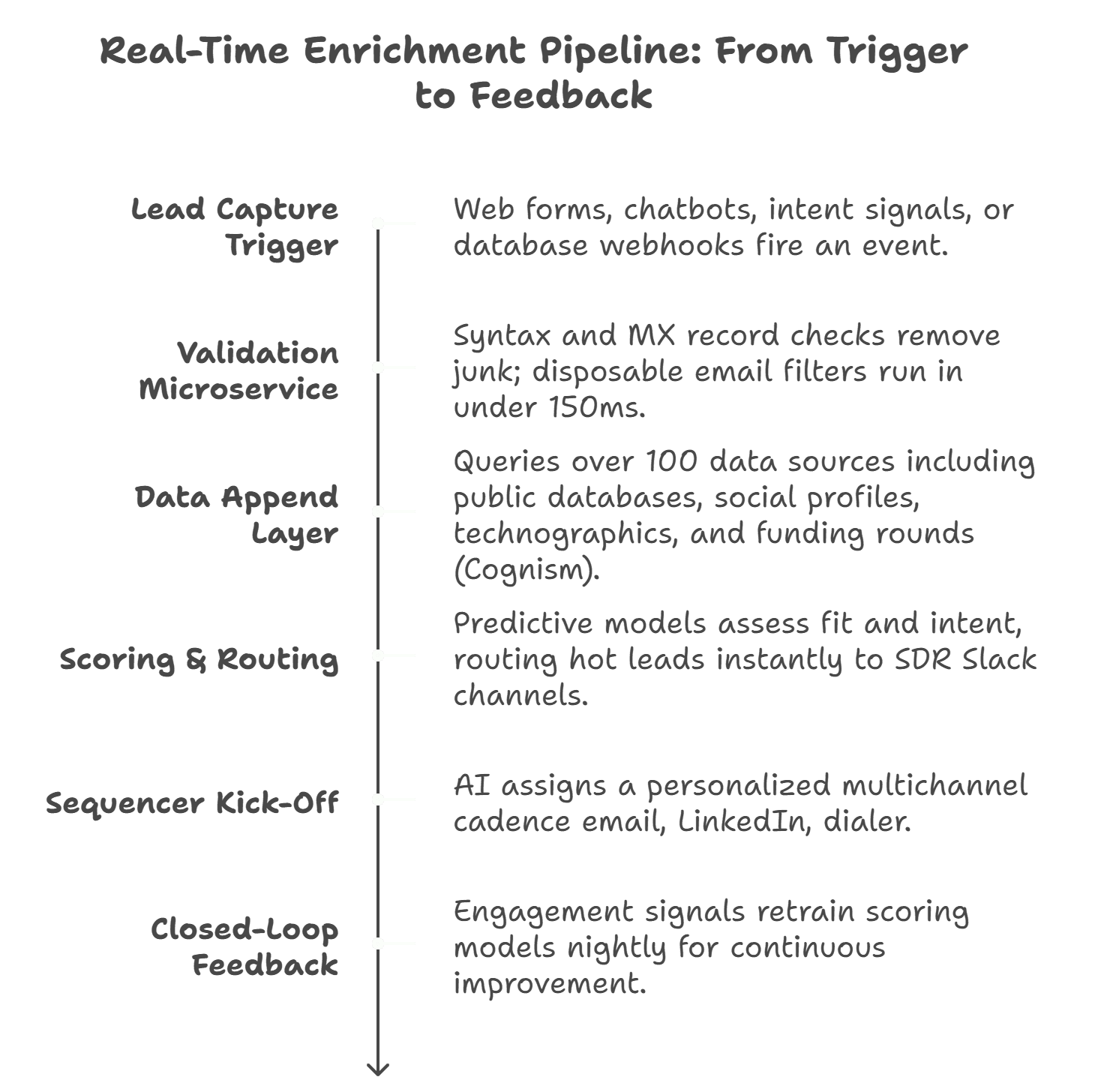
A real-time enrichment pipeline is designed to move a lead from capture to action in seconds, not hours. Each stage works independently but feeds the next, ensuring speed, accuracy, and continuous learning across the sales system.
The goal is simple: capture → enrich → score → act → learn, all in real time.
1. Lead Capture Trigger
The pipeline starts the moment a lead signal appears. This can come from multiple entry points across your funnel.
Web forms
Website chatbots
Intent data providers
Product sign-ups
Database or CRM webhooks
Why it matters: Every trigger initiates enrichment instantly, eliminating delays caused by manual handoffs.
2. Validation Microservice
Before enrichment begins, the system validates the raw input to prevent bad data from entering the pipeline.
Email syntax checks
MX record verification
Disposable and role-based email filtering
Domain reputation checks
All validation runs in under 150 milliseconds.
Why it matters: Early validation protects deliverability, sender reputation, and downstream AI accuracy.
3. Data Append Layer
Once validated, the lead is enriched using parallel API calls across a large data graph.
Public business databases
Social profiles (LinkedIn, company pages)
Technographic datasets
Hiring and growth signals
Funding rounds and financial data
This layer typically queries 100+ data sources simultaneously.
Why it matters: Parallel enrichment ensures completeness without slowing the pipeline.
4. Scoring & Routing Engine
With enrichment complete, predictive models evaluate the lead in real time.
ICP fit scoring
Intent and urgency detection
Seniority and buying role analysis
Account-level prioritization
High-intent leads are routed instantly to the right team or channel (CRM, Slack, inbox, calendar).
Why it matters: Hot leads are acted on immediately, not hours later.
5. Sequencer Kick-Off
Once scored, AI automatically launches the appropriate engagement flow.
Personalized email sequences
LinkedIn outreach
Dialer tasks
Multi-channel cadences
Messaging, timing, and channel choice are based on enrichment and scoring outputs.
Why it matters: Outreach begins while intent is still fresh.
6. Closed-Loop Feedback System
Every interaction feeds back into the system to improve future decisions.
Opens, clicks, replies
Objections and sentiment
Meeting outcomes
Conversion results
Models are retrained nightly, continuously refining scoring, routing, and personalization logic.
Why it matters: The pipeline improves over time without manual tuning.
Real-Time Enrichment Configuration Checklist (Jeeva AI Context)
Component | Key Settings | Best Practice Tip |
API / Webhooks | HTTPS, JWT authentication | Throttle requests at 100/sec to avoid CRM limits |
Data Sources | Firmographic, technographic, hiring, funding, social | Prioritize industry-relevant sources (e.g., BuiltWith for SaaS) |
Verification Logic | SMTP ping, domain health checks | Auto-refund credits if bounce >2% |
Scoring Model | Fit (ICP score) × Intent (signal intensity) | Weight intent 60/40 for SMB, invert for enterprise |
Field Mapping | Custom objects for funding, tech stack | Use lookup tables to prevent free-text chaos |
Privacy Layer | Consent flags, data provenance metadata | Surface provenance in CRM for auditability |
Failover | Secondary enrichment vendor | Switch on 250ms timeout to maintain SLA |
Metrics & Benchmarks
KPI | Good | Great |
Bounce Rate | ≤3% | ≤2% (Gmail benchmark) |
Deliverability | 95% | ≥98% |
Lead-to-SQL Rate | 22% | 30%+ with predictive scoring |
Time-to-First-Touch | <10 minutes | <2 minutes (real-time) |
Email Click-Through | 2% | ≥4% |
Economic upside: Every 1% gain in deliverability can add roughly $12,000 pipeline per 10,000 leads (DemandSage, assuming $200 CPL).
30-60-90 Day Roll-Out Plan
Phase | Objectives | Milestones & KPIs |
0–30 Days | Stand up API & data hygiene | Webhook live; reduce bounce to <5% in sandbox |
31–60 Days | Launch enrichment & scoring | Achieve 90% firmographic coverage; baseline SQL rates |
61–90 Days | Multichannel orchestration & optimization | Add LinkedIn signals; target 25% reduction in sales cycle time |
Why Jeeva AI Delivers the Best Real-Time Enrichment?
Jeeva AI delivers best-in-class real-time enrichment by running multiple autonomous agents in parallel, each responsible for collecting, validating, correcting, and updating lead data continuously.
Instead of relying on static databases or batch updates, Jeeva’s agentic system refreshes information the moment it changes so every downstream AI decision is based on live, accurate inputs.
This architecture ensures that scoring, routing, personalization, and outreach never operate on stale or incomplete data.
Why Jeeva AI Wins
Live LinkedIn + tech stack updates: Detects role changes, company moves, and tool adoption in real time.
Continuous validation: Re-checks emails, domains, and contact fields automatically to prevent decay.
Multi-agent accuracy cross-checks: Independent agents verify the same data points to eliminate false positives.
Automatic ICP scoring: Recalculates fit and priority instantly when new data arrives.
Smart Inbox for reply enrichment: Learns from replies, objections, and intent signals to improve future targeting.
Real-time CRM sync: Pushes clean, enriched data directly into your CRM without manual cleanup.
Outcome: No bad data means no wasted messages, no missed opportunities, and no pipeline leakage.
Jeeva AI turns enrichment into a live, self-correcting system that keeps your sales engine accurate, fast, and conversion-ready at all times.
Conclusion
Real-time lead enrichment is no longer optional. In 2026, it is the engine behind every successful AI sales pipeline. From finding missing contact data to validating emails and updating job roles, enrichment ensures your outreach is accurate, relevant, and conversion-ready.
With platforms like Jeeva AI, sales teams eliminate data waste and focus on what matters most: converting high-quality prospects.
FAQ
How is real-time enrichment different from nightly batch updates?
What data fields can I enrich in real time?
Does real-time enrichment slow down form submissions?
Is Jeeva compliant with GDPR and the EU AI Act?
When can we expect ROI?