Introduction : Automated Sales Outreach
Sales outreach has changed more in the last two years than in the last decade. Manual prospecting, slow follow-ups, and inconsistent messaging no longer keep pace with today’s buyers. Automated sales outreach tools now help teams deliver fast, relevant communication at scale all powered by AI and multi-channel workflows.
This guide explains how these tools work, why they improve conversions, and how sales teams across the US, UK, Canada, Australia, and New Zealand are using automation to build predictable pipeline.
What Are Automated Sales Outreach Tools?
Automated sales outreach tools are platforms that use AI and automation to send personalized sales messages, manage follow-ups, track engagement, and route replies without requiring reps to manually execute each step. These tools replace repetitive outbound work with intelligent systems that act continuously and consistently.
Instead of manually writing emails, remembering follow-ups, or checking replies, automation handles execution while reps focus on high-value conversations.
Cause → Effect: Automation handles repetitive tasks → reps focus on conversations → higher conversions and faster pipeline movement.
Modern outreach tools go beyond simple email scheduling. They analyze buyer behavior, detect intent signals, and decide the next best action automatically.
Core Functions of Automated Sales Outreach Tools
Send automated emails: Personalized messages triggered at the right time
Manage follow-ups: Adaptive sequences based on opens, clicks, and replies
Track buyer behavior: Monitors engagement across email, LinkedIn, and websites
Score replies: Classifies interest, objections, or no-interest responses
Identify intent: Detects buying signals from content and behavior
Sync with CRM: Updates lead status, notes, and activities automatically
Automated outreach creates consistency and speed without sacrificing relevance. Sales teams reach more prospects while maintaining high-quality engagement.
👉 Related Reading : Multi-Channel Outreach & Automation Engines
How Automated Outreach Improves Lead Conversion?
Automated outreach improves lead conversion because it optimizes timing, relevance, and consistency - the three biggest drivers of buyer responses. Instead of relying on manual execution, automation ensures every prospect is contacted at the right moment with the right message and followed up without gaps.
Fact: Sales teams using automated outreach see 2.5× higher conversion rates on outbound campaigns.
Automation removes human error from the sales process. Leads are never forgotten, responses are handled faster, and outreach adapts dynamically based on buyer behavior. This creates a smoother buyer experience and shortens the path from first touch to conversion.
Why Conversion Improves With Automated Outreach
No missed follow-ups: Every prospect is followed up on automatically
Faster response times: Replies and actions happen instantly
Context-aware personalization: Messages adapt to role, company, and intent
Better segmentation: Outreach is tailored to specific lead groups
Right timing based on behavior: Emails and messages are triggered by engagement signals
Automated outreach creates predictable engagement. More leads move forward because timing, relevance, and persistence are handled consistently.
How Automated Sales Outreach Tools Personalize at Scale?
Automated sales outreach tools personalize messages at scale by using AI to analyze prospect data in real time and generate context-aware communication for each buyer.
Instead of sending generic templates, AI adapts messaging based on who the prospect is, what their company does, and how they behave online.
Cause → Effect: Better personalization → higher reply rates → more meetings booked.
AI-powered personalization ensures relevance without slowing down outreach. Every message is tailored automatically, even when campaigns reach hundreds or thousands of prospects.
Data Used for Personalization
Industry: Aligns messaging with sector-specific challenges
Pain points: Addresses problems relevant to the buyer’s role
Tech stack: References tools currently in use
Role: Adjusts tone and value proposition
Company growth: Uses hiring or funding signals for context
Buyer signals: Adapts outreach based on engagement and intent
Personalization becomes consistent and scalable. Sales teams maintain relevance while expanding outbound reach.
Comparison of Automated Outreach vs Manual Outreach
Feature | Manual Outreach | Automated Outreach |
|---|---|---|
Personalization | Slow | Instant, accurate |
Follow-ups | Often missed | 100% consistent |
Timing | Guesswork | Behavior-driven |
Multi-channel | Hard to manage | Fully automated |
Conversion | Unpredictable | High, repeatable |
Scaling | Limited | Unlimited |
Why Are Lead Conversions Harder Than Ever?
Lead conversion has become more difficult because buyer attention is fragmented, timing is critical, and manual processes cannot keep up. Even strong products struggle to convert when outreach is poorly timed, generic, or inconsistently followed up.
Three major forces are driving this challenge:
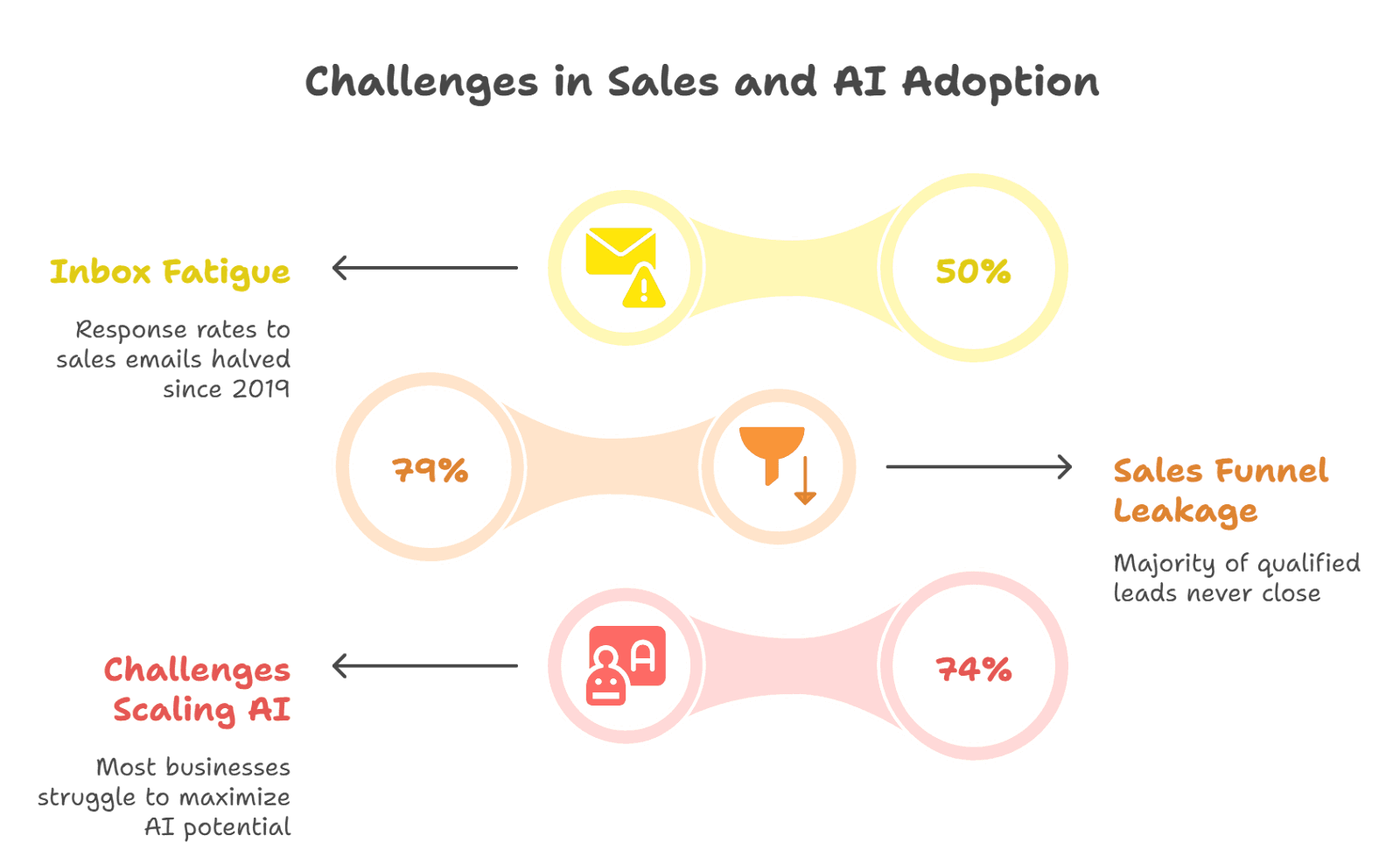
Inbox fatigue: Since 2019, response rates to sales emails have dropped by nearly 50%, and prospects now require an average of five or more touchpoints before replying. Buyers are overwhelmed, and generic outreach is ignored.
Sales funnel leakage: Around 79% of qualified leads never convert, largely due to missed follow-ups, slow response times, and poor prioritization. Leads often go cold before sales teams re-engage.
AI execution gap: While 78% of businesses use AI tools, nearly 74% struggle to extract real value from them. Many teams adopt AI without proper integration, automation depth, or real-time decision-making.
For sales leaders, the issue is no longer lead volume - it’s precision, timing, and execution quality. Conversions now depend on reaching the right buyer, at the right moment, with the right message areas where automation and agentic AI clearly outperform manual workflows.
How Automated Sales Outreach Can Boost Your Conversions?
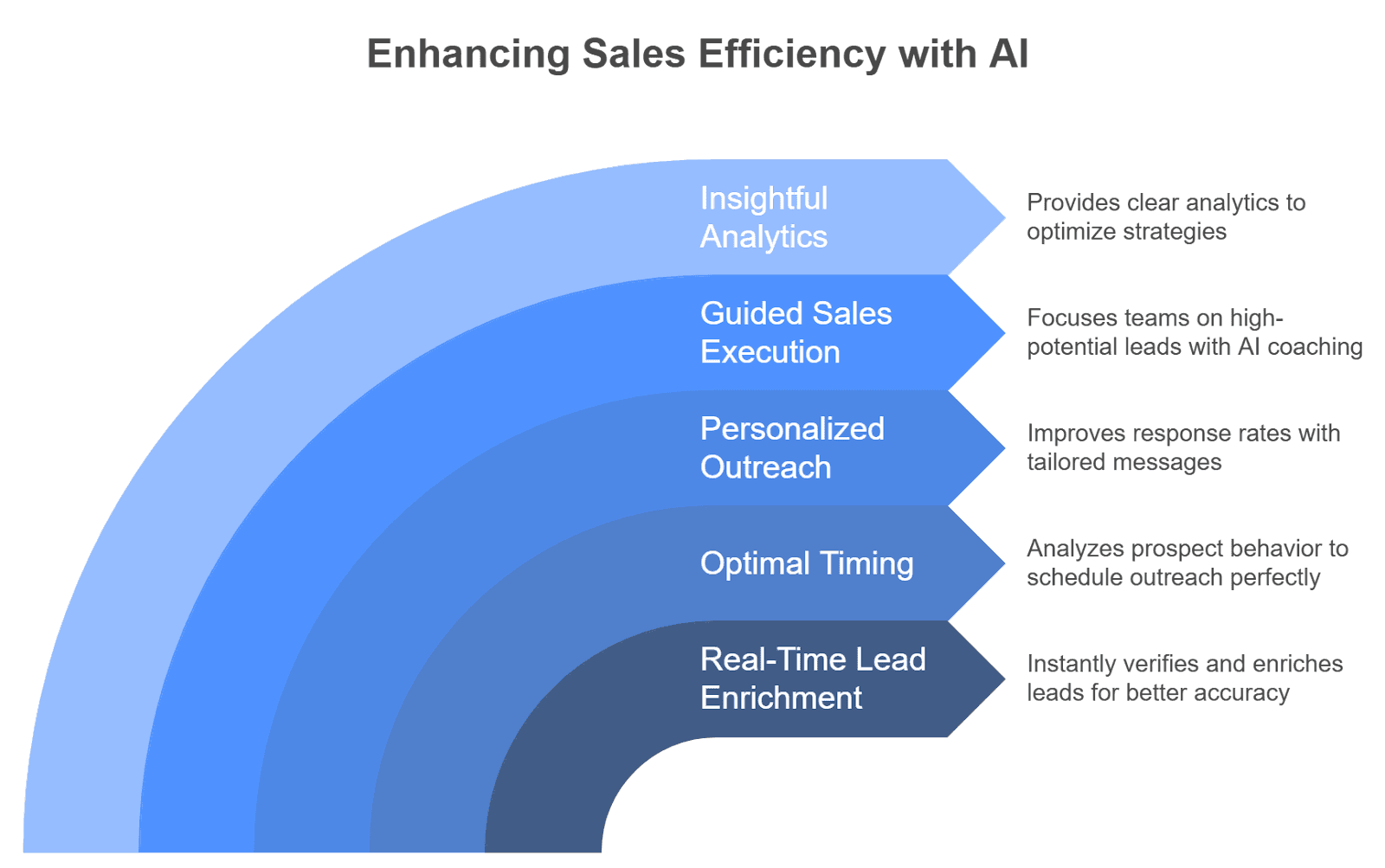
Automated sales outreach improves conversions by fixing the three biggest conversion killers: poor data, bad timing, and inconsistent execution. Modern AI systems enrich leads in real time, choose the right moment to engage, personalize messages at scale, and guide teams toward high-intent opportunities.
Below are the core ways automation directly increases conversion rates.
1. Real-Time Lead Enrichment Improves Accuracy
Automated outreach platforms use live data enrichment to ensure every lead is current, verified, and context-rich before outreach begins. Tools like Jeeva AI and Clay pull insights from 100+ sources to enrich leads with intent, firmographic, and technographic data.
Industry data shows that enriched intent data can lift conversions by up to 17% (G2).
What this means for you: RevOps teams eliminate guesswork by automating enrichment and scoring, leading to cleaner pipelines and higher-quality conversations.
2. AI-Driven Timing Increases Engagement
AI analyzes buyer behavior - opens, clicks, website visits, and past responses to determine the best time to reach out. Platforms like Nooks optimize send times automatically instead of relying on fixed schedules.
This ensures messages arrive when prospects are most likely to engage.
What this means for you: Demand-gen teams run perfectly timed sequences without manual monitoring, increasing replies and reducing wasted touches.
3. Personalized Outreach at Scale Lifts Responses
Automation enables deep personalization across thousands of prospects by using role, industry, tech stack, and intent signals. AI-written messages outperform generic templates, especially on professional channels.
LinkedIn reports a 40% higher acceptance rate for AI-assisted InMail outreach.
What this means for you: Outbound teams spend less time writing emails and more time engaging real buyers with relevant messages.
4. Guided Sales Execution Improves Focus
Advanced outreach platforms guide teams toward the highest-impact actions. Tools like Outreach use AI coaching and prioritization to help teams focus on leads most likely to convert, improving win rates.
Outreach customers have reported 26% higher win rates through better prioritization.
What this means for you: Sales leaders gain faster ramp-up, better execution consistency, and more predictable results.
5. Built-In Analytics Accelerate Optimization
Automated outreach tools connect every activity - email, follow-up, reply, and meeting to pipeline outcomes. This closes the loop between execution and revenue impact.
What this means for you: Founders and leadership teams get clear, board-ready visibility into outreach ROI without relying on separate BI tools.
Where Jeeva AI Fits in Your Tech Stack
Here's a snapshot of leading automated outreach tools:
Platform | Strengths | Weaknesses | Ideal Company Size |
Jeeva AI | Comprehensive automation, autonomous agents, real-time enrichment | Newer brand, fewer integrations | 10-5000 employees |
Clay | Rich, customizable data integrations | Needs external sequencing tools | Ops-focused firms |
ZoomInfo | Extensive data and insights | High pricing, slow customization | Large enterprises |
Apollo/Lusha | Affordable prospecting | Lighter automation | SMB/startups |
Outreach/Salesloft | Advanced sequencing, analytics | External enrichment required | Mid-market/enterprise |
Proven ROI of Automated Outreach
Automated tools provide measurable improvements in conversions:
Metric | Manual | Automated | Improvement |
Prospect-to-MQL Rate | 4-6% | 8-12% | ~2x |
Win Rate | 20% | 25-30% | +26% |
InMail Response Rate | 12% | 16-18% | +40% |
Cost Per Lead (CPL) | Baseline | ↓27% | -27% |
These numbers clearly justify why automation is essential for today's competitive sales landscape.
Tailored Strategies for Your Role
Different teams extract value from AI in different ways. Below is a role-based breakdown of how organizations use Jeeva AI effectively, aligned with scale, goals, and existing tech stacks.
Founders (10–100 Employees)
Early-stage teams need speed, clarity, and fast feedback loops. Jeeva AI acts as an autonomous outbound engine to validate positioning and messaging without hiring additional reps.
Use autonomous AI agents to test ICPs and messaging quickly
Identify which segments respond before scaling spend
Integrate with HubSpot to track replies, meetings, and early pipeline
This helps founders find product–market fit faster with minimal overhead.
CROs / Sales VPs (100–1,000 Employees)
At this stage, the focus shifts to pipeline efficiency and prioritization. Jeeva AI strengthens existing sales motions by improving lead quality and timing.
Combine Jeeva’s enriched and scored leads with existing outreach tools
Prioritize accounts using real-time intent and fit signals
Reduce pipeline leakage caused by poor follow-ups and bad data
This results in better forecasting accuracy and higher conversion per rep.
RevOps Teams
RevOps teams use Jeeva AI to clean, enrich, and maintain CRM data automatically, eliminating manual audits and stale records.
Build a hybrid enrichment workflow: Jeeva AI → Clay → ZoomInfo
Automate nightly CRM updates and validation
Improve data consistency across sales and marketing systems
This creates a reliable, always-updated data foundation for revenue teams.
Demand Generation Professionals
Demand-gen teams leverage Jeeva AI’s intent and behavior signals to improve targeting and reduce wasted spend.
Use intent signals to build high-conversion audiences
Run targeted campaigns on LinkedIn with tighter segmentation
Lower cost per lead (CPL) by excluding low-fit accounts
Campaigns become more precise, relevant, and ROI-driven.
Key Takeaway
Jeeva AI adapts to your role and growth stage.
Whether validating messaging, prioritizing pipeline, maintaining CRM health, or improving paid acquisition efficiency, agentic AI delivers leverage where it matters most.
AI-Powered Reply Handling and Qualification
AI-powered reply handling automatically reads incoming messages, understands intent, and takes the correct next action without manual review. Instead of sales teams sorting inboxes, AI classifies replies in real time and routes only qualified conversations to humans.
Cause → Effect: AI handles sorting and qualification → reps focus only on high-quality conversations → faster deal progression.
This removes delays, prevents missed replies, and keeps follow-ups consistent across channels.
Reply Types AI Detects
Positive replies: Signals interest and routes to the next sales step
Objections: Identifies concerns and triggers the right response or escalation
Not interested: Suppresses or moves leads into nurture flows
Need more info: Sends relevant details automatically
Out-of-office: Reschedules follow-ups intelligently
Referral to another contact: Updates records and reroutes outreach
AI ensures every reply is handled instantly and correctly. Sales teams spend time engaging buyers not managing inboxes.
Best Automated Outreach Tools to Improve Lead Conversion in 2026
Tool | Best Use Case | Strength |
|---|---|---|
Jeeva AI | Full AI outreach (multi-agent) | Writes, responds, books meetings |
Apollo | Outreach + lists | Good for sequences |
HubSpot | SMB automation | CRM-native flows |
Instantly | High volume email | Deliverability strengths |
Clay | AI enrichment | Data + outreach triggers |
Read the Full Article: AI Sales Agents → Top Five AI Sales Tools to Supercharge B2B Lead Generation
How Automation Protects Deliverability & Domain Reputation
Email deliverability is critical to outbound success. Even strong messaging fails if emails land in spam or bounce. AI-powered automation protects domain reputation by monitoring sender behavior, adjusting volume, and preventing risky sends in real time something manual processes cannot do consistently.
Fact: Automated warm-up and deliverability tools improve inbox placement by up to 42%.
Modern AI systems treat deliverability as a continuous process, not a one-time setup. They adapt sending patterns based on engagement, mailbox provider feedback, and domain health to keep emails landing in the primary inbox.
Deliverability Protections AI Provides
Gradual volume increase: Warms up new domains safely by ramping sends over time
Spam word detection: Flags risky language before emails are sent
Bounce prevention: Removes invalid or risky addresses automatically
Reputation monitoring: Tracks sender score, complaints, and engagement trends
MX record validation: Confirms domains can receive email before outreach
Automation ensures outbound campaigns scale without damaging sender reputation. This keeps inbox placement high, bounce rates low, and outreach sustainable over time.
Conclusion
Automated sales outreach tools help teams work smarter, not harder. By using AI to handle research, data enrichment, personalization, timing, reply handling, and follow-ups, sales teams remove the most time-consuming parts of outbound work. This creates a faster, more consistent, and more scalable way to generate pipeline.
When outreach is automated, reps no longer spend hours building lists, cleaning data, or chasing unresponsive leads. Instead, they focus on high-value activities like live conversations, demos, discovery calls, and closing deals. AI ensures every prospect is contacted at the right time, with the right message, and followed up without gaps.
Teams that adopt automation consistently see higher reply rates, more qualified meetings, and lower cost per conversion.
Platforms like Jeeva AI take this a step further by combining agentic AI, real-time enrichment, and multi-channel execution turning outbound sales into a predictable, always-on growth engine.
FAQ
What do automated sales outreach tools do?
How does automation improve lead conversion?
Do automated tools replace SDRs?
Are AI tools better than manual outreach?
What is the best automated outreach tool?