Introduction to Agentic AI
Agentic AI is redefining sales outreach by shifting execution from manual, rule-based automation to autonomous, reasoning-driven systems. Instead of following static sequences, agentic AI observes buyer signals, evaluates context, and decides the next best action in real time across prospecting, personalization, and follow-ups.
This approach addresses the core limitations of traditional sales outreach: slow response times, generic messaging, and disconnected workflows. By combining intent detection, continuous learning, and autonomous execution, agentic AI enables sales teams to engage buyers with relevance and speed at scale.
In modern B2B environments, where buyer attention windows are short and data changes constantly, agentic AI transforms outreach from a volume-driven activity into an intelligent, outcome-focused system designed to drive higher engagement, conversion, and pipeline efficiency.
The New Model of Sales: Scaling Efficiency Without Losing Human Connection
Modern sales teams face a fundamental challenge: they must operate faster and at greater scale while still delivering personalized, human-centered buyer experiences. Traditional tools force a trade-off between efficiency and authenticity, often sacrificing one to achieve the other.
Agentic AI removes this trade-off. By automating operational complexity and reasoning through buyer context, agentic AI enables sales teams to move quickly without losing the personal connection that drives trust and conversions.
Agentic AI helps sales teams:
Streamline workflows and remove operational friction
Eliminate repetitive administrative tasks
Shift focus from mechanical work to strategic conversations
Rather than replacing salespeople, agentic AI acts as a co-pilot. It prioritizes leads, manages follow-ups, and surfaces insights that guide more meaningful interactions. The result is a sales model where efficiency supports human connection instead of undermining it.
What is agentic AI in sales?
Agentic AI in sales is autonomous AI that observes buyer signals, reasons over context, and executes next-best actions in real time to drive sales outcomes without fixed rules or manual intervention.
Agentic AI in sales is an autonomous form of artificial intelligence that can observe buyer signals, reason over context, and execute next-best actions across sales workflows without relying on fixed rules or constant human input. Unlike traditional sales automation, which follows predefined sequences, agentic AI adapts in real time based on intent signals, engagement behavior, and changing buyer conditions.
This enables sales teams to prioritize leads, personalize outreach, and coordinate follow-ups dynamically, turning sales execution from task-based automation into outcome-driven, intelligent action.
How Is Agentic AI Different from Traditional Sales Automation?
Agentic AI differs from traditional sales automation by making decisions autonomously instead of executing predefined rules. While traditional automation follows static workflows and sequences created by humans, agentic AI continuously observes buyer behavior, interprets context, and determines the next best action in real time.
Traditional sales automation is designed to scale tasks such as email sequences, reminders, and CRM updates. It improves efficiency but remains reactive and rigid. When buyer behavior changes or data becomes outdated, these systems continue executing the same steps unless manually reconfigured.
Agentic AI, by contrast, operates as an autonomous system. It reasons across multiple signals intent, engagement history, timing, and buyer context and dynamically adjusts outreach strategies. This enables faster responses, deeper personalization, and continuous adaptation without manual intervention.
Agentic AI vs Traditional Sales Automation
Dimension | Traditional Sales Automation | Agentic AI |
|---|---|---|
Decision-making | Rule-based and predefined | Autonomous and reasoning-driven |
Workflow behavior | Static sequences | Dynamic, adaptive workflows |
Response to buyer signals | Limited or delayed | Real-time interpretation and action |
Personalization depth | Template-level customization | Contextual, intent-aware personalization |
Handling data changes | Requires manual updates | Continuously adapts automatically |
Execution focus | Task execution | Outcome-oriented execution |
Scalability | Scales volume | Scales intelligence and relevance |
Human intervention | Frequent reconfiguration needed | Minimal oversight required |
In short: traditional sales automation executes instructions, while agentic AI executes outcomes.
Why Are Sales Teams Turning to Agentic AI?
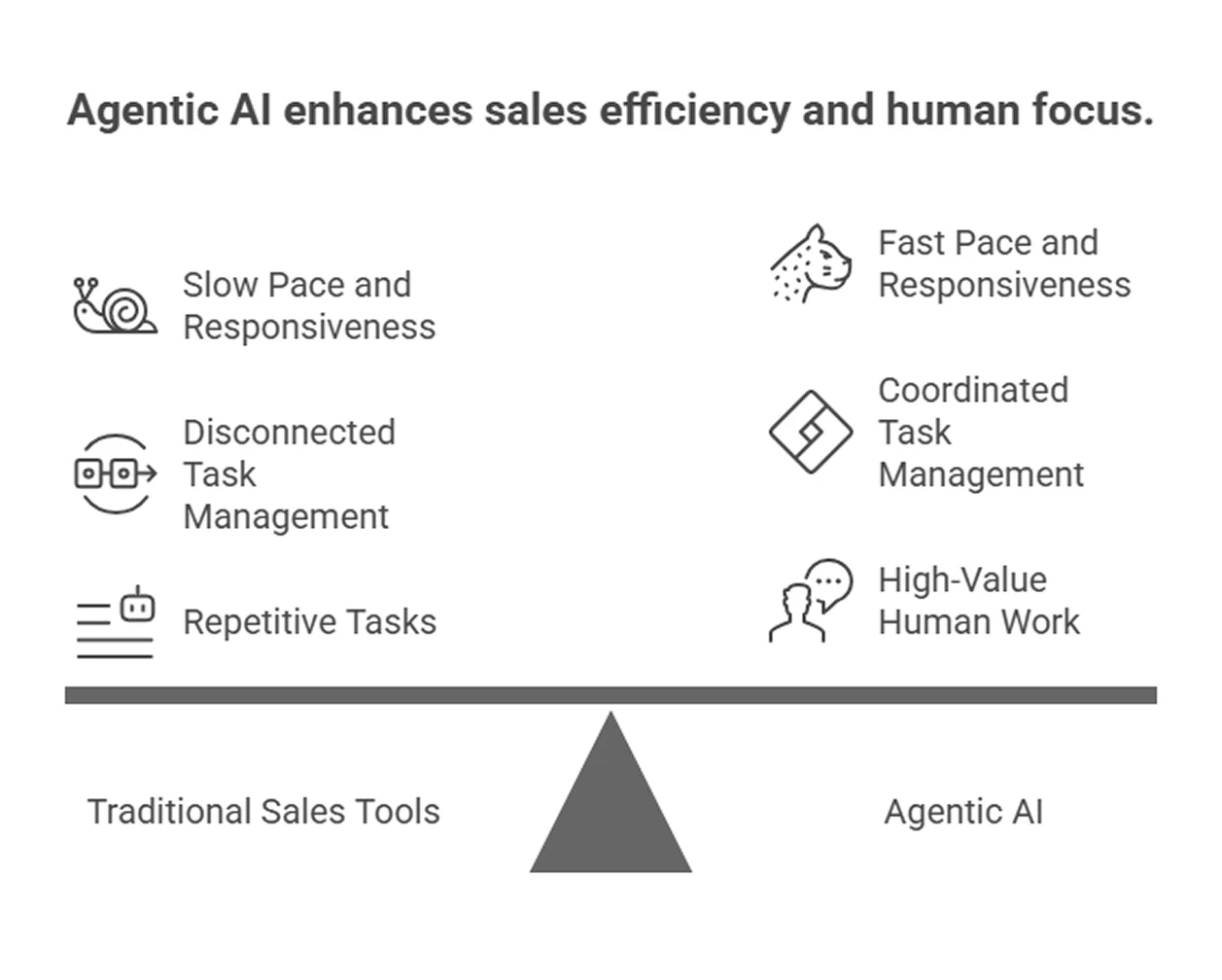
Sales teams are turning to agentic AI because it autonomously interprets buyer signals, adapts outreach in real time, and executes next-best actions allowing teams to scale efficiency without losing personalization.
Sales teams are turning to agentic AI because traditional sales tools can no longer keep pace with modern buying behavior. Buyers move faster, signals change in real time, and manual or rule-based systems struggle to respond with relevance and speed. Agentic AI addresses this gap by operating autonomously observing context, reasoning over signals, and taking action without constant human intervention.
Agentic AI helps sales teams manage complexity at scale. Instead of juggling disconnected tools for prospecting, personalization, follow-ups, and prioritization, teams use agentic systems that coordinate these tasks intelligently. This reduces operational overhead while improving responsiveness and consistency across the sales funnel.
Most importantly, agentic AI allows sales teams to focus on high-value human work. By handling repetitive tasks, interpreting intent signals, and recommending next-best actions, agentic AI frees sellers to spend more time in strategic conversations that build trust and drive conversions.
Result: Sales teams gain speed, relevance, and efficiency without sacrificing the human element of selling.
What Problems Does Agentic AI Solve for Sales Teams?
Agentic AI solves core sales execution problems by eliminating manual work, accelerating speed-to-lead, maintaining consistent personalization, and coordinating outreach autonomously across the sales funnel.
Modern sales teams struggle with slow execution, fragmented tools, and inconsistent personalization at scale. Manual workflows and rule-based automation fail to adapt when buyer behavior changes in real time. Agentic AI addresses these challenges by reasoning across signals and acting autonomously throughout the sales funnel. This allows teams to move faster, stay relevant, and reduce operational drag without sacrificing quality.
What Sales Challenges Does Agentic AI Eliminate?
Reduces manual research and repetitive administrative tasks
Accelerates speed-to-lead during high-intent moments
Maintains consistent personalization across outbound campaigns
Coordinates actions across disconnected sales tools
Adapts outreach strategy based on real-time signals
Frees reps to focus on strategic conversations
By solving execution bottlenecks instead of adding more tools, agentic AI reshapes how sales teams operate. It removes friction from daily workflows while improving responsiveness and relevance. In 2026, teams that adopt agentic AI gain a structural advantage by turning complexity into coordinated, intelligent execution.
How Jeeva AI Turns Cold Leads into Hot Pipeline?
Stage | Traditional Workflow | Jeeva AI Agent Workflow |
1. Lead Discovery | SDR scrapes LinkedIn, exports CSV, imports CRM | Agent continuously monitors 100+ intent and firmographic data feeds, scoring prospects in real time. |
Overnight third-party data refreshes | Instant API lookups and social verification in under 1 second; guarantees <2% bounce SLA. | |
3. Personalized Copy | Basic mail-merge with {{first_name}} macros | Large Language Model (LLM) generates tone-tailored, persona-specific, trigger-based copy. |
4. Sequenced Outreach | Manual scheduling of emails and LinkedIn messages | Adaptive multichannel scheduling dynamically responds to opens, clicks, and replies. |
5. Follow-Up & Booking | Reps chase follow-ups manually | Agent escalates interested leads or books meetings automatically via Calendly integration. |
What the Numbers Say
Metric | Traditional SDR Baseline | Jeeva AI Benchmark | Lift |
Meetings booked / rep / mo | 12 | 28 | +133% |
SQL volume | — | +38% | — |
Average bounce rate | 2.3% | <2% (SLA) | -13% |
Rep hours on admin | 18 hours per week | 5 hours per week | -72% |
Data aggregated internally across 37 Jeeva AI customers during Q1–Q2 2025.
How Does Agentic AI Orchestrate Sales Workflows in Real Time?
Agentic AI orchestrates sales workflows in real time by reasoning over live buyer signals and autonomously coordinating prospecting, enrichment, outreach, and follow-ups without manual intervention.
Agentic AI orchestrates sales workflows in real time by continuously observing signals, reasoning over context, and autonomously triggering the next best action across systems. Unlike static automation that follows predefined steps, agentic AI dynamically coordinates tasks based on what is happening now—not what was planned earlier.
By acting as an intelligent execution layer, agentic AI connects prospecting, enrichment, outreach, follow-ups, and CRM updates into a single, adaptive workflow. This ensures sales operations move in sync with buyer behavior rather than lag behind it.
How Does Agentic AI Coordinate Sales Activities in Real Time?
Monitors buyer intent and engagement signals continuously
Enriches lead and account data as changes occur
Prioritizes leads dynamically based on real-time context
Triggers personalized outreach at optimal moments
Adjusts follow-ups based on buyer responses
Syncs actions across CRM and sales tools automatically
Instead of relying on manual handoffs or rigid sequences, agentic AI keeps sales workflows fluid and responsive. Every action whether outreach, prioritization, or follow-up is informed by the latest data and executed without delay. In modern B2B sales environments, this real-time orchestration is what enables teams to move faster, stay relevant, and convert opportunities more consistently.
How Is Agentic Orchestration Different from Traditional Sales Workflows?
Agentic orchestration outperforms traditional sales workflows by autonomously coordinating outreach, prioritization, and follow-ups in real time based on live buyer signals rather than static rules.
Agentic orchestration differs from traditional sales workflows by coordinating actions autonomously in real time rather than executing fixed, preconfigured steps. Traditional workflows rely on rigid sequences and manual handoffs, which often break when buyer behavior changes.
Agentic orchestration adapts continuously, ensuring sales actions stay aligned with live buyer context.
Agentic Orchestration vs Traditional Sales Workflows
Dimension | Traditional Sales Workflows | Agentic AI Orchestration |
|---|---|---|
Workflow design | Predefined, static sequences | Dynamic, adaptive workflows |
Decision-making | Rule-based and human-triggered | Autonomous, reasoning-driven |
Response to buyer signals | Delayed or manual | Real-time interpretation and action |
Personalization | Template-based | Contextual and intent-aware |
Lead prioritization | Fixed scoring rules | Continuously reprioritized |
Follow-up execution | Scheduled and linear | Responsive and behavior-driven |
Cross-tool coordination | Fragmented integrations | Unified orchestration layer |
Human involvement | Frequent manual intervention | Human oversight, minimal execution |
Scalability | Scales volume | Scales intelligence and relevance |
In summary: traditional workflows automate tasks, while agentic orchestration automates decisions and execution across the entire sales motion.
What’s the Real Impact of Agentic AI on the Human Side of Sales?
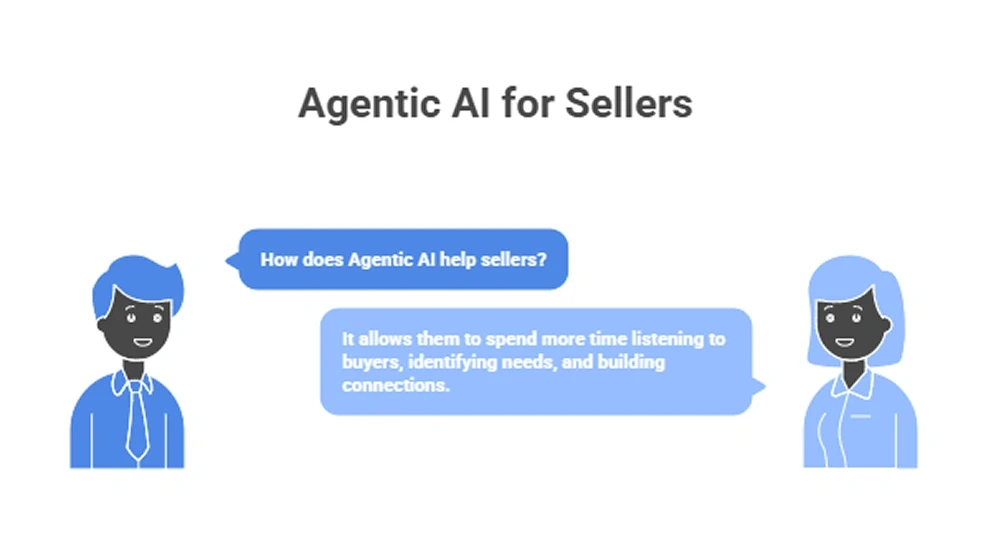
At its core, successful selling is still built on trust, timing, and empathy. Agentic AI does not replace these fundamentals, it strengthens them. By removing operational friction and reasoning over real-time context, agentic AI allows sales teams to operate with greater focus and intention.
Instead of spending time on repetitive tasks and manual coordination, sellers gain space to do what humans do best. Agentic AI handles execution mechanics in the background while surfacing the right insights at the right moment.
Agentic AI enables sellers to spend more time:
Listening to buyers and understanding context
Identifying real needs and intent signals
Building authentic, human connections
Agentic AI is not a replacement for human sellers, it is a force multiplier. It elevates top performers by removing distractions and helps newer reps ramp faster with guided execution and real-time insights.
Sales organizations are at a turning point. The future will not be defined by who deploys the most automation, but by who applies intelligent autonomy most effectively. Teams that adopt agentic AI today will not just move faster, they will consistently outperform.
Why? While others are still managing workflows, they are already engaging buyers and closing deals.
Ready to See Agentic AI in Action?
Jeeva AI is built to operationalize agentic AI across the entire sales outreach lifecycle. Instead of layering AI on top of existing tools, Jeeva AI acts as an autonomous execution layer that reasons over data, buyer signals, and workflows to drive outcomes not just tasks.
Jeeva AI continuously identifies high-intent prospects, enriches them with real-time context, and activates personalized outreach across channels without manual handoffs. Its agentic architecture allows the system to decide what action to take, when to take it, and how to adapt as buyer behavior changes.
For sales teams, this means fewer tools to manage, faster response times, and consistent personalization at scale. Reps stay focused on strategic conversations while Jeeva AI handles execution, prioritization, and follow-through in the background.
Bottom line: Jeeva AI turns agentic intelligence into practical sales execution helping teams move faster, engage smarter, and convert more consistently without losing the human element of selling.
FAQ
How is agentic AI different from traditional sales automation?
How does agentic AI orchestrate sales workflows in real time?
Does agentic AI replace human sales reps?
Why are sales teams adopting agentic AI now?
Which sales teams benefit most from agentic AI?