Introduction: Why Trust Becomes Critical When AI Starts Doing the Work
Artificial intelligence in the enterprise is going through a fundamental shift. For years, AI has primarily acted as an assistant that helps employees work faster. It could summarize documents, answer questions, generate recommendations, or provide insights based on available information. While valuable, these systems still depended on humans to make decisions, take action, and ensure the work was completed correctly.
Autonomous workers introduce a different model. Instead of simply assisting employees, they are designed to execute workflows, interact with enterprise systems, and complete operational tasks from start to finish. An autonomous IT worker, for example, may resolve employee support tickets, process access requests, update records, monitor systems, or coordinate multi-step workflows across different applications.
This transition from AI assistance to AI execution creates a new requirement for enterprises: trust. When AI only recommends an action, the human remains responsible for reviewing and executing the final step. When AI begins completing work independently, organizations need a reliable way to understand every decision and action taken along the way.
This is where audit-grade workflow logging becomes essential. It provides the visibility, accountability, and governance needed for autonomous workers to operate safely inside enterprise environments. Every workflow becomes traceable, every decision can be reviewed, and every action has a clear record.
What Is Audit-Grade Workflow Logging?
Audit-grade workflow logging is the process of creating a complete, structured record of every activity performed by an autonomous worker. It captures the entire lifecycle of a workflow, including the original request, information reviewed, decisions made, approvals collected, actions executed, exceptions encountered, and final outcome delivered.
Traditional software logs were designed mainly for technical monitoring. They help teams understand system events, application errors, login activity, or infrastructure issues. While these logs are useful, they were not created for autonomous systems that actively make decisions and perform work.
Autonomous workers require a more advanced level of logging because enterprises need to understand not only what happened but also why it happened. A simple timestamp showing that a task was completed is no longer enough. Teams need visibility into the reasoning process, business rules followed, approval paths taken, and systems affected.
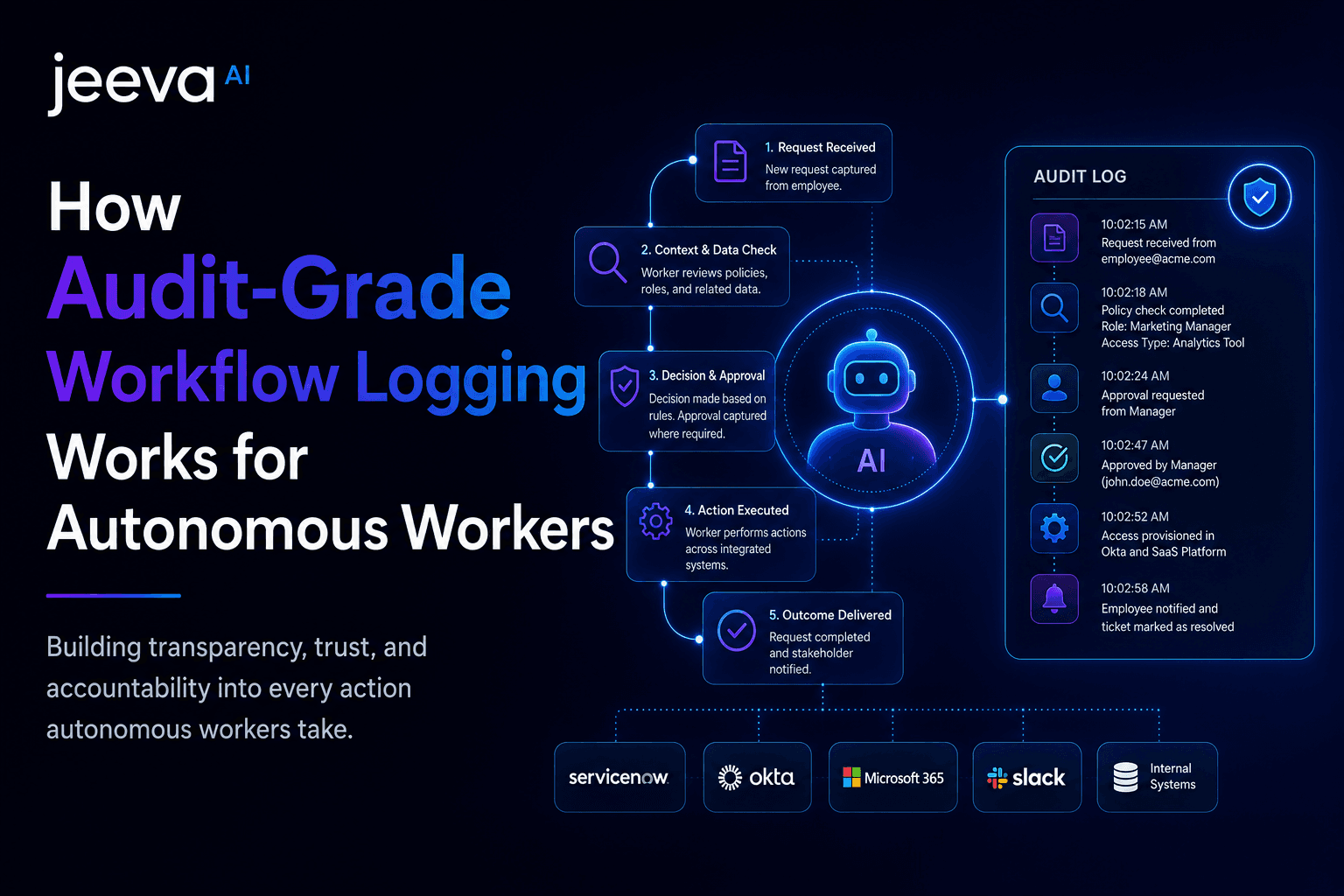
For example, if an autonomous worker approves an employee access request, the organization should have a complete record showing how that decision was reached. The log should capture whether the employee identity was verified, whether the requested permission matched company policy, whether the required approvals were received, when access was granted, and what changes were made.
The purpose of audit-grade logging is to make autonomous execution transparent instead of turning AI into an unpredictable black box.
Why Autonomous Workers Need a Strong Audit Layer
Enterprise workflows are complex because they involve multiple systems, people, policies, and security requirements. Unlike simple automation scripts that perform predefined actions, autonomous workers operate across dynamic environments where decisions may change depending on context.
A worker handling IT operations may interact with ticketing platforms, identity systems, endpoint management tools, internal databases, and communication channels during a single workflow. Without proper logging, understanding what happened across all these systems becomes extremely difficult.
Audit-grade workflow logging creates a single source of truth for autonomous execution. It allows IT teams, security teams, and business leaders to review the complete journey of every workflow. Instead of investigating disconnected events across multiple platforms, teams can see how a request moved from beginning to completion.
This visibility becomes especially important as organizations increase the number of workflows managed by AI. The more responsibility autonomous workers take on, the more enterprises need confidence that these systems are operating within approved boundaries.
How Audit-Grade Workflow Logging Works
Audit-grade logging begins the moment an autonomous worker receives a task. Before taking action, the worker creates a record of the initial request, the source of the request, and the context available at that moment.
As the worker moves through the workflow, every step is continuously documented. The system records what information was accessed, which tools were used, what decisions were made, and what actions were completed.
Consider an autonomous IT worker handling a software access request. The worker first reviews the request details and identifies the employee who submitted it. It then checks identity information, validates company access policies, determines whether approvals are required, provisions access if permitted, updates relevant systems, and records the final result.
Each of these steps creates an audit trail. If someone reviews the workflow later, they can understand exactly how the worker reached the final outcome.
This level of transparency is important because enterprise teams cannot simply know that a task was completed. They need proof that it was completed correctly.
Capturing the Reason Behind Every Decision
One of the biggest differences between basic logging and audit-grade workflow logging is decision context.
Traditional logs often tell teams that an event occurred. Audit-grade logs explain the conditions that led to the event.
This distinction becomes critical for autonomous workers because they are not only executing commands. They are interpreting information and selecting the correct path based on available context.
For example, an access management worker may approve one request automatically while escalating another. Without decision context, those actions may seem inconsistent. With audit-grade logging, teams can understand that the first request matched existing policy while the second involved elevated permissions requiring human approval.
Decision records help enterprises verify that autonomous workers are following business rules, security policies, and compliance requirements.
Maintaining Human Oversight Through Approval Tracking
Autonomous execution does not mean removing humans from important decisions. In many enterprise environments, the safest approach is controlled autonomy, where AI workers complete routine workflows independently but involve humans for sensitive decisions.
Audit-grade logging plays a key role in maintaining this balance.
Whenever a workflow requires human approval, the system records the approval request, the person responsible for reviewing it, the decision provided, and the action taken afterward.
This ensures organizations always have a clear record of human involvement.
For industries with strict compliance requirements, approval history is especially valuable because businesses need evidence that proper controls were followed.
The goal of autonomous workers is not to eliminate oversight. The goal is to remove unnecessary manual work while keeping humans involved where judgment, risk, or accountability matters most.
Improving Security and Compliance With Traceable Workflows
Security and compliance teams depend on accurate records. When an issue occurs, they need to investigate quickly and understand exactly what happened.
Audit-grade workflow logging gives organizations this ability by creating a reliable history of autonomous activity.
Instead of asking whether an AI worker performed an action correctly, teams can review the complete execution record. They can verify permissions, examine approval flows, identify exceptions, and confirm that internal policies were followed.
This is particularly important for workflows involving identity access management, security operations, infrastructure changes, employee onboarding, and compliance reporting.
As autonomous workers become responsible for more critical operations, traceability becomes one of the foundations of enterprise AI adoption.
Handling Failures and Exceptions Safely
No enterprise workflow runs perfectly every time. Systems fail, information is missing, approvals are delayed, and unexpected scenarios appear.
The difference between basic automation and enterprise-ready autonomous workers is how these situations are handled.
Audit-grade logging ensures that failures and exceptions are captured clearly. When something does not go as planned, the system records what failed, why it happened, what recovery steps were attempted, and whether the issue was escalated.
This prevents problems from disappearing inside automated processes.
A reliable autonomous worker should not only complete successful workflows. It should also provide transparency when workflows require attention.
Why Auditability Defines the Future of Enterprise AI
The next phase of enterprise AI will not only depend on how intelligent systems become. It will depend on how much responsibility organizations are willing to give them.
For AI to move from assistance to ownership, enterprises need confidence. They need to know that autonomous workers can operate securely, follow rules, explain decisions, and provide complete visibility into their actions.
Audit-grade workflow logging creates this foundation.
It allows companies to benefit from autonomous execution without sacrificing governance, security, or control.
As digital workers become a larger part of enterprise operations, the most successful AI systems will not just be the ones that complete the most tasks. They will be the ones organizations can trust with real responsibility.
At Jeeva AI, we are building autonomous digital workers designed to operate inside complex enterprise environments. With persistent memory, system integrations, human-in-the-loop controls, and audit-grade workflow logging, Jeeva workers are built to complete workflows while maintaining the transparency enterprises require.
The future of AI is not just automation.
It is accountable execution.
FAQ
What is audit-grade workflow logging in autonomous workers?
Why do autonomous AI workers need audit logs?
How does audit-grade logging improve enterprise AI security?
What information should an autonomous worker audit log capture?
How are audit logs for autonomous workers different from traditional automation logs?