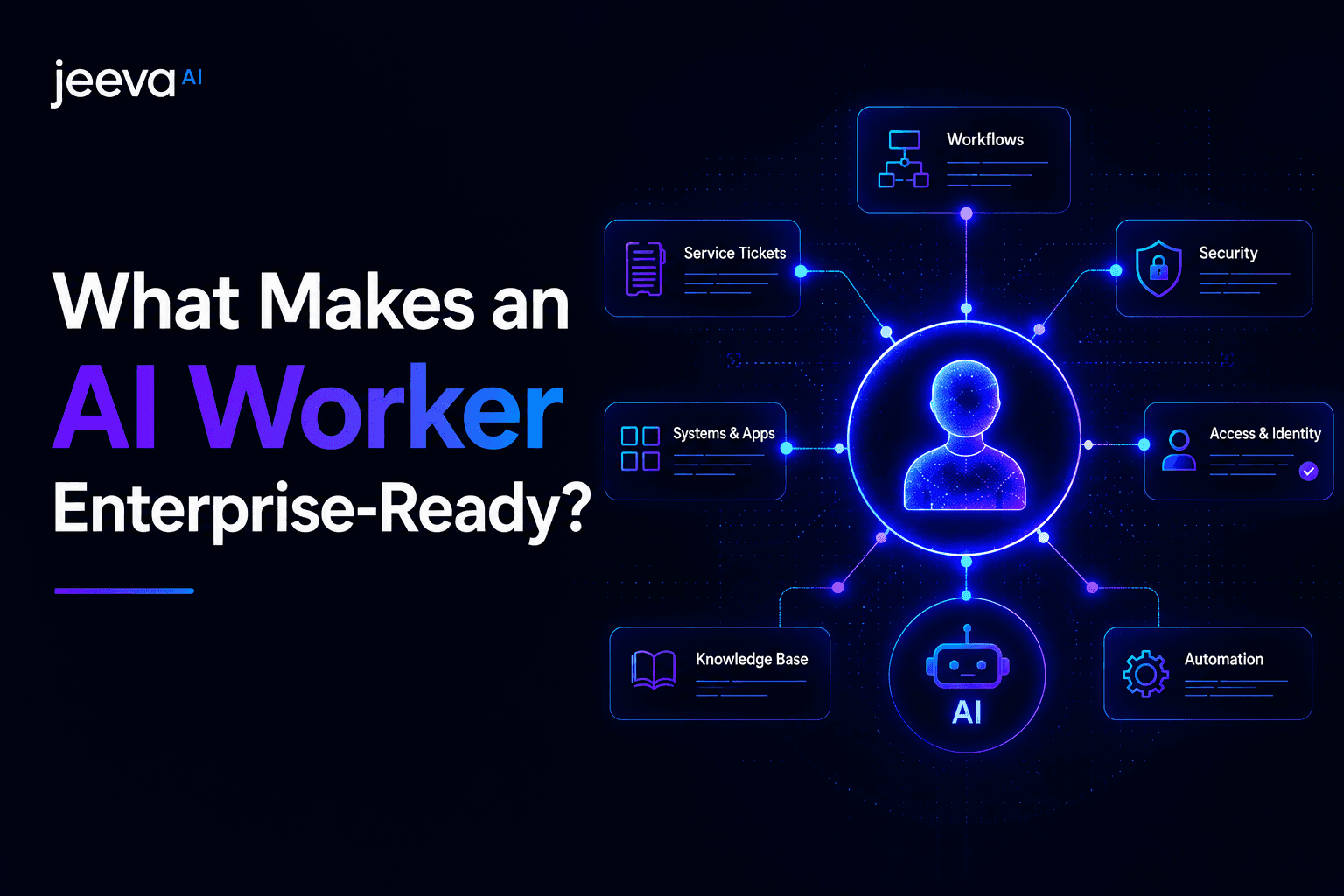
Artificial intelligence is quickly becoming a core part of enterprise operations. Over the past few years, organizations have adopted AI assistants, copilots, and agents to improve productivity, automate repetitive tasks, and help employees work faster.
While these tools have created significant improvements in individual productivity, enterprises are now asking a much bigger question: can AI move beyond assisting employees and actually take ownership of business workflows?
This question has created the next evolution of enterprise AI: autonomous digital workers.
Unlike traditional AI tools that wait for prompts or complete isolated tasks, AI workers are designed to manage complete business processes from beginning to end. They can understand objectives, create execution plans, interact with enterprise systems, complete approved actions, escalate exceptions, and continuously move workflows toward completion.
However, deploying AI inside an enterprise environment requires much more than advanced reasoning capabilities. A system that simply generates accurate responses is not automatically ready to operate within critical business workflows.
Enterprise environments involve sensitive data, complex approval processes, security requirements, compliance obligations, and interconnected technology ecosystems. For AI workers to become trusted members of enterprise teams, they need reliability, transparency, governance, and operational maturity.
So, what actually makes an AI worker enterprise-ready?
Let’s explore the capabilities that separate experimental AI tools from autonomous workers built for real enterprise execution.
What Is an AI Worker?
An AI worker is an autonomous system designed to perform the responsibilities of a specific business function or role. Instead of acting as a general assistant that responds to user requests, an AI worker is built around ownership of outcomes.
Traditional automation tools usually follow predefined instructions. If a specific event happens, they trigger a specific action. This approach works well for predictable tasks but struggles when workflows involve changing conditions, multiple systems, or exceptions.
AI agents introduced more flexibility by allowing AI systems to reason, use tools, and perform individual actions. However, many agents still operate at the task level. They complete steps but do not necessarily own the entire process.
AI workers take this further.
For example, consider an IT access management workflow. An employee requesting access to a business application might seem like a simple request, but several steps happen behind the scenes. IT teams must verify the employee’s identity, review access policies, collect approvals, provision permissions, update records, and maintain compliance documentation.
A basic AI assistant might explain how to complete the process. An automation workflow might move the request to the right queue. An AI worker, however, can manage the complete lifecycle of that request while following company policies and escalation rules.
The difference is ownership.
Enterprise-ready AI workers are not designed to provide suggestions. They are designed to complete work.
1. Persistent Memory and Context Awareness
One of the most important requirements for an enterprise AI worker is the ability to maintain context over time.
Most AI interactions today are temporary. A user provides information, the AI responds, and the interaction ends. This model works for simple assistance, but enterprise workflows rarely happen in a single conversation or session.
Real business processes continue across hours, days, or even months. They involve multiple employees, applications, approvals, and decisions.
Human employees naturally build memory around their work. An IT administrator remembers previous incidents. A security analyst understands recurring alerts. A manager knows team-specific requirements and exceptions.
AI workers require similar continuity.
Persistent memory allows an AI worker to understand previous actions, decisions, user preferences, organizational rules, and workflow history. Instead of treating every request as a new interaction, the worker can use historical context to make better decisions.
For example, an onboarding AI worker may need to track an employee’s journey across multiple stages. It needs to know whether accounts have already been created, whether equipment has been assigned, whether required approvals are complete, and which tasks remain unfinished.
Without persistent memory, AI remains reactive. With memory, AI becomes capable of managing ongoing responsibilities.
2. Deep Integration Across Enterprise Systems
Modern enterprises operate through hundreds of applications. Work does not happen in one place.
An employee support request may involve an IT service management platform, identity provider, communication system, endpoint management tool, and internal database. A security workflow may involve monitoring platforms, incident management tools, compliance systems, and documentation repositories.
This fragmentation is one of the biggest reasons enterprise work remains manual.
Employees often spend significant time moving information between systems, checking statuses, updating records, and coordinating actions across tools.
For AI workers to create meaningful impact, they cannot exist separately from the enterprise technology stack. They need secure access to the systems where work actually happens.
An enterprise-ready AI worker should integrate with existing platforms, understand data across systems, and execute workflows without requiring teams to replace their current infrastructure.
The goal is not to introduce another tool employees have to manage. The goal is to create an execution layer that works across the tools they already use.
3. Secure Autonomy With Human Oversight
One of the biggest challenges enterprises face with AI adoption is determining how much control they should give autonomous systems.
Complete manual control limits efficiency. Complete autonomy without safeguards creates risk.
Enterprise-ready AI workers require a balance between both.
Human-in-the-loop governance allows organizations to define exactly where AI can operate independently and where human approval is required.
For example, an AI worker may automatically resolve common IT issues such as password resets or software installation requests. However, actions involving sensitive permissions, infrastructure changes, or high-risk decisions may require approval from a human employee before execution.
This approach allows enterprises to benefit from automation while maintaining control over critical decisions.
The most effective AI workers are not just good at taking action. They understand when they should pause, escalate, and involve humans.
4. Auditability and Transparent Decision-Making
Enterprise trust depends on visibility.
When a human employee completes a task, organizations typically have records showing who performed the action, when it happened, and what changed.
AI workers require the same level of accountability.
Every action performed by an autonomous system should be traceable. Teams need visibility into what decisions were made, what data was used, which systems were affected, and what final outcome was produced.
This is especially important for areas like IT operations, identity management, cybersecurity, finance, and compliance.
An AI worker handling access permissions, for example, must maintain clear records showing why access was granted, who approved it, and whether the action followed company policies.
Without auditability, autonomous AI becomes difficult to trust at scale.
Enterprise-ready AI workers must operate with transparency built into every workflow.
5. Ability to Handle Long-Running Workflows
Many AI systems perform well when tasks are short and clearly defined.
Enterprise work is different.
Business workflows often involve multiple steps, waiting periods, approvals, dependencies, and unexpected changes.
A compliance audit may take weeks. Employee onboarding may span several days. Incident management may involve multiple teams working through different stages of resolution.
Enterprise-ready AI workers need long-horizon execution capabilities. They must be able to start a workflow, maintain progress, adapt to new information, pause when required, and resume execution later.
The real value of autonomous workers is not completing one action faster.
It is ensuring the entire workflow reaches completion.
6. Exception Handling and Reliability
Enterprise processes rarely follow perfect paths.
Applications fail. Information is missing. Policies change. Requests become more complicated than expected.
Traditional automation often breaks when reality does not match predefined rules.
Enterprise-ready AI workers need the ability to manage uncertainty.
A reliable worker should identify when something is wrong, understand the cause, attempt recovery where possible, and escalate when human intervention is required.
This capability is what allows AI workers to operate in real business environments where exceptions are normal.
Reliability is not about eliminating every failure.
It is about ensuring failures are handled safely.
7. Enterprise-Grade Security and Governance
As AI workers become responsible for more workflows, security becomes one of the most important foundations.
An autonomous worker may interact with sensitive company systems, employee information, customer data, or operational infrastructure.
Because of this, AI workers must follow the same security principles expected from enterprise software.
This includes identity management, permission controls, access restrictions, secure authentication, data protection, and compliance alignment.
Organizations must always understand what an AI worker can access, what actions it can perform, and where boundaries exist.
Trustworthy autonomy requires strong governance.
Conclusion: Enterprise AI Is Moving From Assistance to Execution
The future of enterprise AI will not be defined only by smarter models or faster responses.
It will be defined by AI systems that can reliably complete work.
AI assistants improved productivity by helping employees perform tasks faster. AI workers represent the next step: systems capable of taking ownership of repetitive workflows and delivering measurable outcomes.
To become enterprise-ready, AI workers need more than intelligence.
They need memory to maintain context, integrations to operate across systems, governance to ensure control, auditability to build trust, and reliability to manage real-world complexity.
At Jeeva AI, we are building autonomous digital workers designed for enterprise execution.
Workers that understand objectives, coordinate across tools, follow approval processes, escalate exceptions, and complete workflows from start to finish.
Because the next era of AI is not just about helping people work.
It is about building systems that can own the work.
FAQ
What is an enterprise AI worker?
How are AI workers different from AI agents?
What capabilities make an AI worker enterprise-ready?
Why do AI workers need persistent memory?
Are autonomous AI workers secure for enterprise use?