
Introduction
As Agentic AI becomes a core part of enterprise sales operations, where data is stored and how it flows matters more than ever. US, UK, and Canadian companies face strict requirements on data residency, cloud regions, and cross-border transfers.
For Agentic AI systems that run multi-agent workflows, enrich leads, automate outreach, and store sensitive interactions, cloud infrastructure decisions directly impact security, compliance, and performance.
This guide explains the key differences between US and global data residency rules, and how sales organizations can deploy Agentic AI safely across borders.
Related readings for deeper context: Enterprise Architecture & Compliance for Agentic AI
Why Does Data Residency Matter for Agentic AI Deployments?
Agentic AI systems process sensitive customer information—including lead data, activity logs, personal identifiers, and enrichment details. Data residency defines where this information is stored, which laws apply, and who can access it. For companies operating in multiple regions, this becomes a critical security and compliance factor.
Fact: 67% of enterprises say data residency is their “#1 barrier” to scaling AI systems globally.
Why Data Residency Impacts AI Workflows
The location of your data affects everything.
Which privacy laws apply
What security protocols are required
How quickly AI models can respond
Who can legally access the data
How enrichment and syncing occur
Whether cross-border transfers are allowed
Without proper residency control, companies risk violations and performance issues.
What’s the Difference Between US and Global Data Residency Rules?
The US focuses more on sector-specific and state-level rules (CCPA, CPRA, HIPAA), while global regions like the UK, EU, and Canada enforce strict location-based storage requirements. This difference shapes how AI platforms must architect their cloud environments.
Fact: The EU’s GDPR is the world’s strictest residency regulator, requiring explicit justification for any data leaving the EU.
Key Distinctions You Should Know
US vs global residency has several major differences.
US laws vary by state
EU/UK laws have universal standards
Canada’s PIPEDA restricts cross-border transfers
The US often prioritizes security over location
Europe prioritizes location first
Penalties differ significantly
Understanding these differences helps design compliant AI systems.
US vs Global Data Residency Comparison
Region | Residency Strictness | Data Transfer Rules | Primary Regulation |
|---|---|---|---|
United States | Medium | State-level limits | CCPA/CPRA |
United Kingdom | High | Restricted | UK GDPR |
Canada | High | Consent required | PIPEDA |
European Union | Very High | Strongly restricted | GDPR |
How Does Cloud Region Affect AI Performance for US Sales Teams?
Cloud regions determine latency, speed, and reliability of AI agents. When your data and compute are closer to your target market, AI workflows perform dramatically faster especially for tasks like enrichment, lead scoring, and outbound automation.
Fact: AI inference run in-region is up to 45% faster than cross-region execution.
Why Cloud Region Matters
Here’s what the region influences.
Response speed
Data retrieval time
API execution latency
Authentication performance
Model inference timing
Multi-agent task coordination
Localizing cloud resources improves both performance and compliance.
What Data Types in Agentic AI Require Location Control?
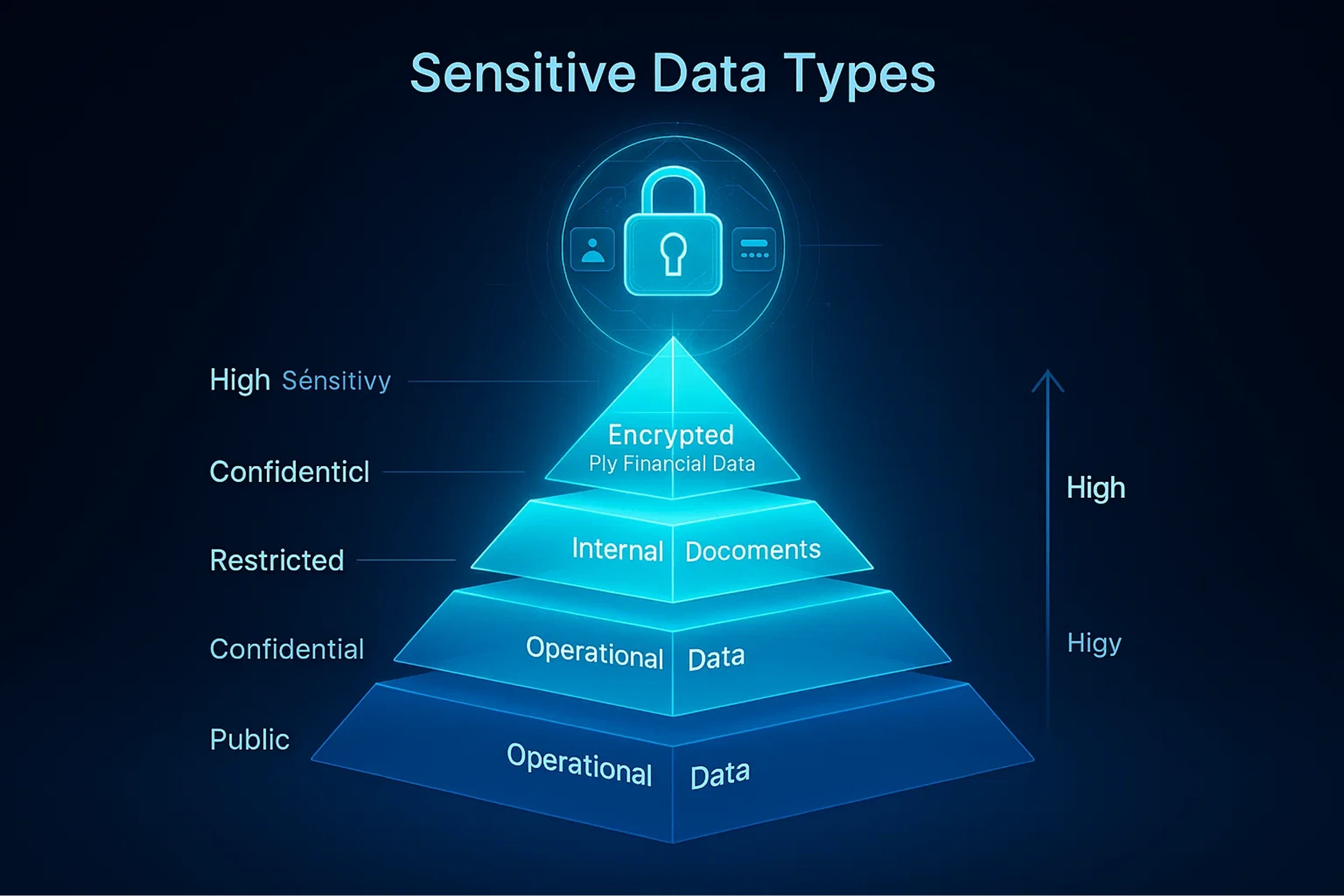
Not all data has the same sensitivity level. Some fields must stay within a region due to law, while others can be processed globally with proper safeguards.
Fact: Personal identifiers (emails, phone numbers) are the most regulated across all regions.
Sensitive Data Types to Localize
These categories require strict storage rules.
Personal identifying information
Communication logs
Behavioral intent data
Calendar and meeting details
Enrichment attributes
AI-generated summaries
AI platforms must classify and segment these data types.
Data Sensitivity Levels for Agentic AI
Data Type | Sensitivity | Residency Needed? |
|---|---|---|
Business email | Medium | Optional |
Enrichment data | High | Recommended |
Intent signals | High | Yes |
Outreach logs | Very High | Yes |
Calendar events | Very High | Yes |
CRM sync data | High | Region-dependent |
How Should AI Platforms Handle Cross-Border Data Transfers?
Transferring data across regions introduces legal risks and performance delays. Companies must justify transfers, document safeguards, and sometimes store data in isolated silos.
Fact: 56% of global companies restrict AI tools from sending any data outside their home region.
Safe Transfer Practices
Use these guardrails to stay compliant.
Minimize cross-region transfers
Use encrypted transit channels
Implement contractual safeguards
Maintain logs of every transfer
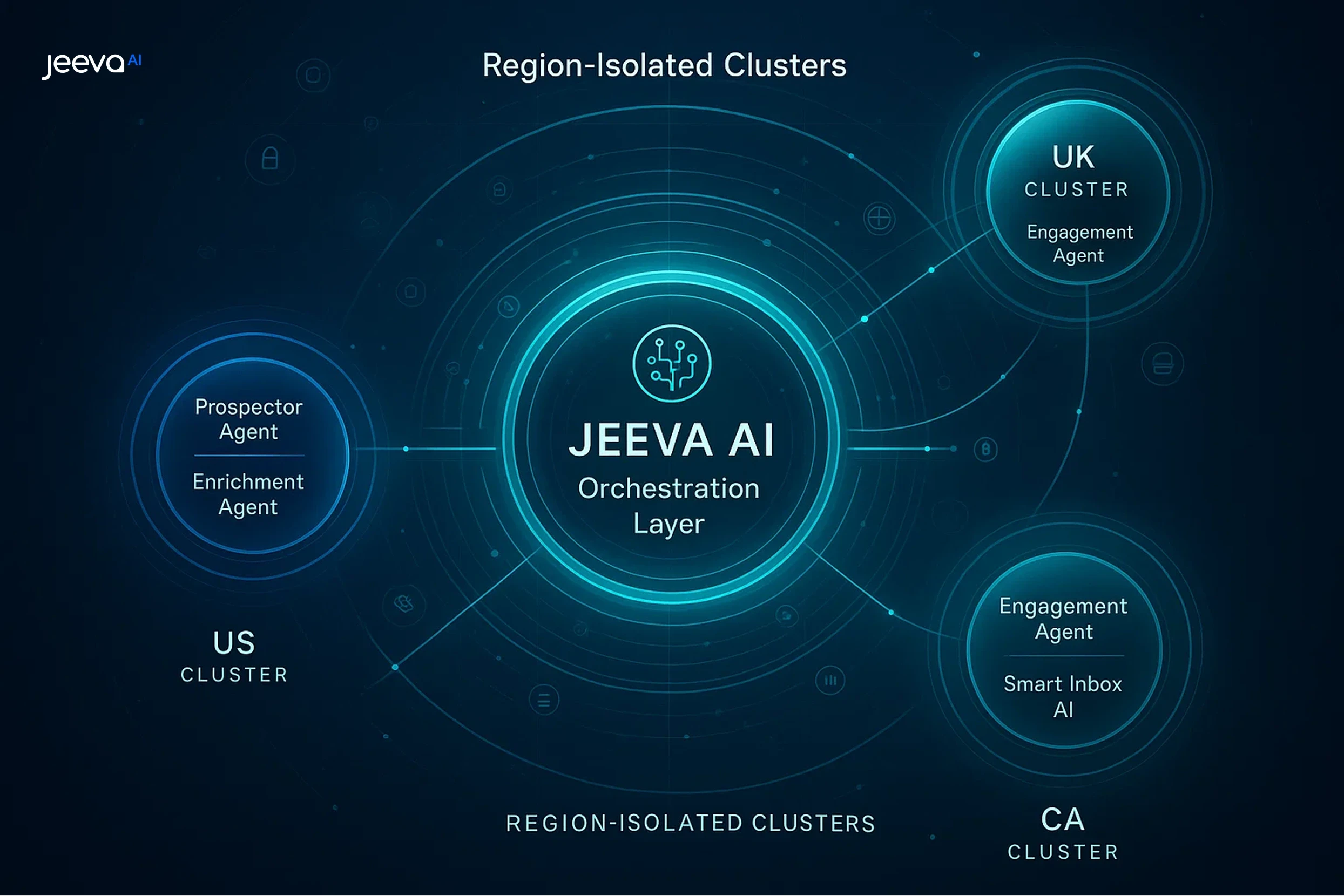
Use region-specific compute clusters
Avoid unnecessary aggregation
This ensures safe and lawful data movement.
What Cloud Architecture Is Ideal for Agentic AI in the US?
For US regions, distributed cloud architecture with regional redundancy works best. It ensures uptime, improves performance, and supports automated agents that run continuously.
Fact: 90% of US enterprises now prefer multi-zone cloud deployment for mission-critical AI systems.
Best Practices for US Cloud Deployment
A strong architecture includes:
Multi-zone redundancy
Localized compute and storage
Automatic failover
Integrated identity access
Regional API routing
Cloud-native encryption
This keeps AI workflows stable and compliant.
How Do Global Regulations Affect Multi-Agent AI Workflows?
Global laws impact how agents communicate, what data they can read, and how outputs must be stored. This directly influences sales operations running across borders.
Fact: 34% of AI workflows break compliance because agents exchange data improperly.
Global Rules to Consider
Ensure workflows follow these laws.
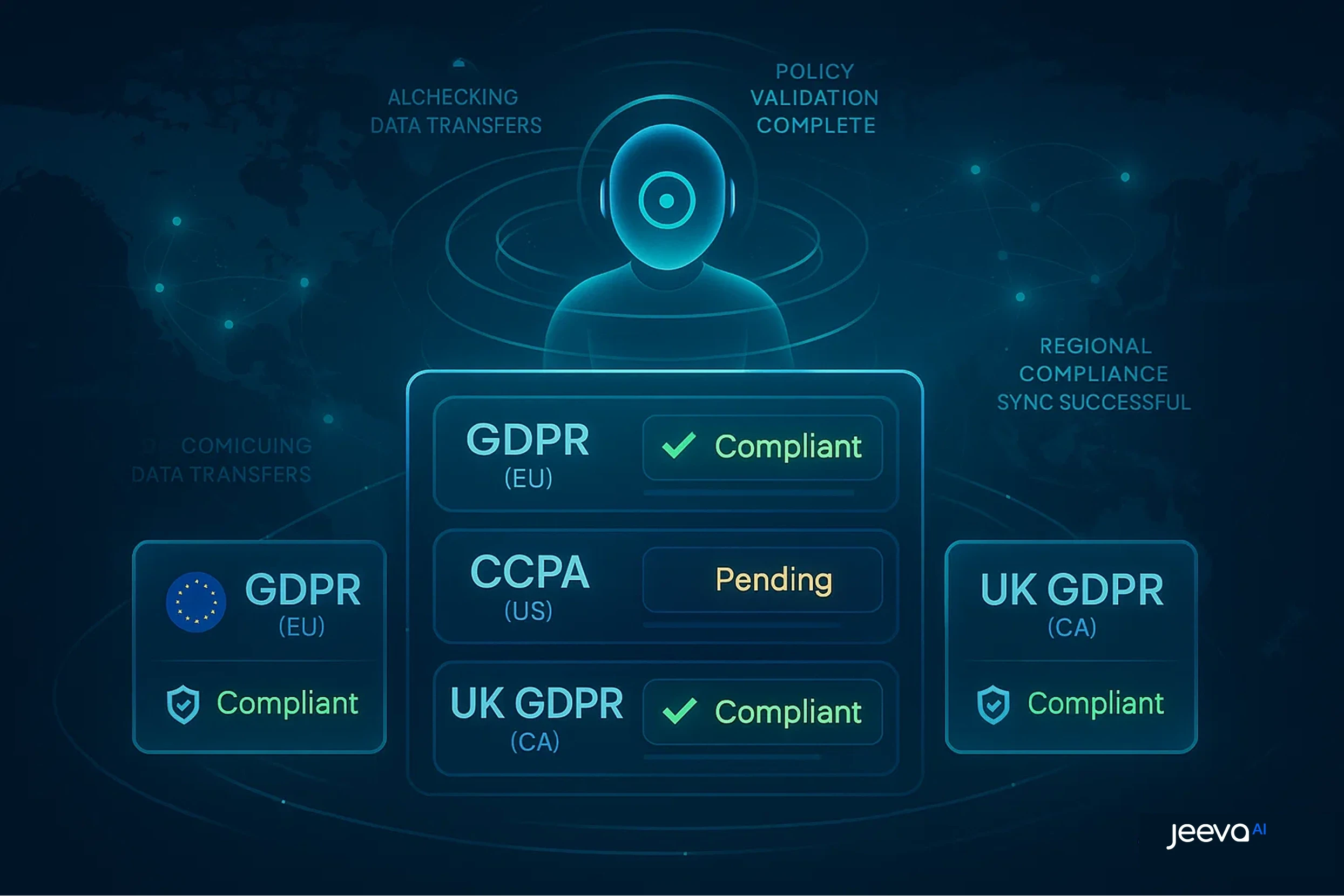
GDPR data minimization
UK transfer adequacy
PIPEDA consent requirements
CCPA consumer rights
CPRA restrictions on profiling
Local deletion laws
Multi-agent systems must have clear data boundaries.
What Infrastructure Controls Reduce AI-Related Risk?
Infrastructure controls help prevent unauthorized access, incorrect use of data, or automation errors. US and global regulators require these safeguards.
Fact: 30% of AI incidents occur due to missing infrastructure controls—not model errors.
Recommended Security Controls
Use these controls for safe deployment.
Region-specific access keys
Role-based permissions
Audit logs
Endpoint security
Multi-agent isolation
Automated anomaly detection
These ensure safe and predictable behavior.
How Do You Choose the Right Data Residency Strategy for Agentic AI?
Your strategy depends on customer location, compliance needs, and cloud provider availability. The goal is to balance performance with legal protection.
Fact: Companies using regional clusters see 38% fewer compliance issues.
Choosing the Right Strategy
Align your decisions with:
Customer geography
Regulatory landscape
API latency requirements
AI agent count
Volume of processing
Sensitivity of the data
Good strategy = safer automation + smoother operations.
Recommended Residency Strategy by Region
Target Market | Best Cloud Region | Residency Strictness |
|---|---|---|
United States | AWS/Google US-East/West | Medium |
UK | AWS/Google London | High |
Canada | AWS/Google Toronto | High |
Multi-region teams | Split-residency model | Very High |
Why Jeeva AI Delivers the Strongest Data Residency Control?
Jeeva AI’s multi-agent system is built with region-specific storage, encrypted pipelines, and SOC2-ready governance. It supports localized data processing for US, UK, and Canadian teams while enabling high-speed AI automation.
Fact: Jeeva AI reduces cross-border data movement by over 70% using region-isolated pipelines.
Related: Securing Multi-Agent AI Workflows
Why Jeeva AI Leads Globally
Jeeva AI is engineered for secure global adoption.
Regional data storage
Region-specific agent clusters
No unnecessary cross-border transfers
Strict access control
Automated compliance logs
Enterprise-ready encryption
This makes it ideal for multinational sales organizations.
Conclusion
Data residency and cloud infrastructure are now core pillars of Agentic AI design. For enterprises operating across the US, UK, and Canada, choosing the right cloud region, securing pipelines, and complying with global laws ensures safe, fast, and scalable AI operations.
Jeeva AI makes this easy through region-specific clusters, strong encryption, and multi-agent governance allowing companies to adopt AI confidently while meeting global standards.
FAQ
What is data residency in the context of Agentic AI?
Does US law require data to stay inside the US?
Is UK GDPR more strict than US laws?
Why does cloud region matter for AI speed?
Does Jeeva AI support region-based deployments?