How Autonomous AI Is Replacing Manual Sales Execution With Self-Driving Revenue Systems
The Agentic AI Playbook for Modern Revenue Teams | Jeeva AI
THE COLLAPSE OF THE TRADITIONAL SALES MODEL
The Sales Model Was Built for Human Speed
Modern sales organizations still rely on operational structures designed decades ago, when market velocity moved at human pace. These legacy systems reveal critical limitations:
Manual Prospecting: Sales representatives personally decide which accounts to contact and when to engage relying on intuition and incomplete data rather than systematic signal analysis.
Memory-Dependent Follow-Up: Subsequent touchpoints depend entirely on individual memory and personal discipline. When reps manage hundreds of active conversations, critical follow-ups inevitably slip through the cracks.
Retroactive Pipeline Management: CRM systems update only after human action, creating a historical record rather than a real-time operating system. By the time data reflects reality, that reality has already changed.
Reactive Signal Processing: Intent data and engagement indicators are reviewed periodically when reps have time, not continuously as they emerge. Opportunities are discovered hours or days after they surface.
This model assumes humans can maintain pace with modern market dynamics. In 2026, that assumption breaks down completely.
The Reality of Modern Buyer Behavior
Today's buyers conduct extensive independent research before ever engaging with sales. Intent signals surface across dozens of channels social media, content downloads, website visits, peer reviews, competitor comparisons.
Competitive context shifts in real time. By the time a human notices an opportunity and decides to act, that window of peak engagement has often closed.
The problem compounds in complex deals. Enterprise buyers involve seven to eleven stakeholders on average, each conducting independent research across different timelines. Tracking these multi-threaded buying journeys manually is impossible at scale.
The Core Problem Is Latency
Sales inefficiency today is not caused by lack of effort or inadequate training. It is caused by structural execution latency the unavoidable delays inherent in human-dependent workflows.
Where Latency Accumulates
Signal Detection to Action: Hours or days elapse between when a buying signal appears and when a sales team responds. In fast-moving markets, this delay means the difference between being first and being forgotten.
Data Enrichment to Outreach: Time passes while gathering context researching the company, understanding the decision-maker's role, crafting personalized messaging. This research-to-reach gap introduces delay during which prospect interest may cool.
Follow-Up to Response: After initial contact, the time between a prospect's response and the next sales action creates momentum gaps. Buyers interpret slow responses as lack of interest or organizational dysfunction.
Insight to Decision: When market intelligence or competitive developments emerge, they must be observed, communicated, discussed, and acted upon. This insight-to-execution cycle often spans weeks, rendering strategic adjustments reactive rather than proactive.
Even the most talented sales teams cannot eliminate this latency through headcount or process optimization alone. The constraint is architectural, not operational.
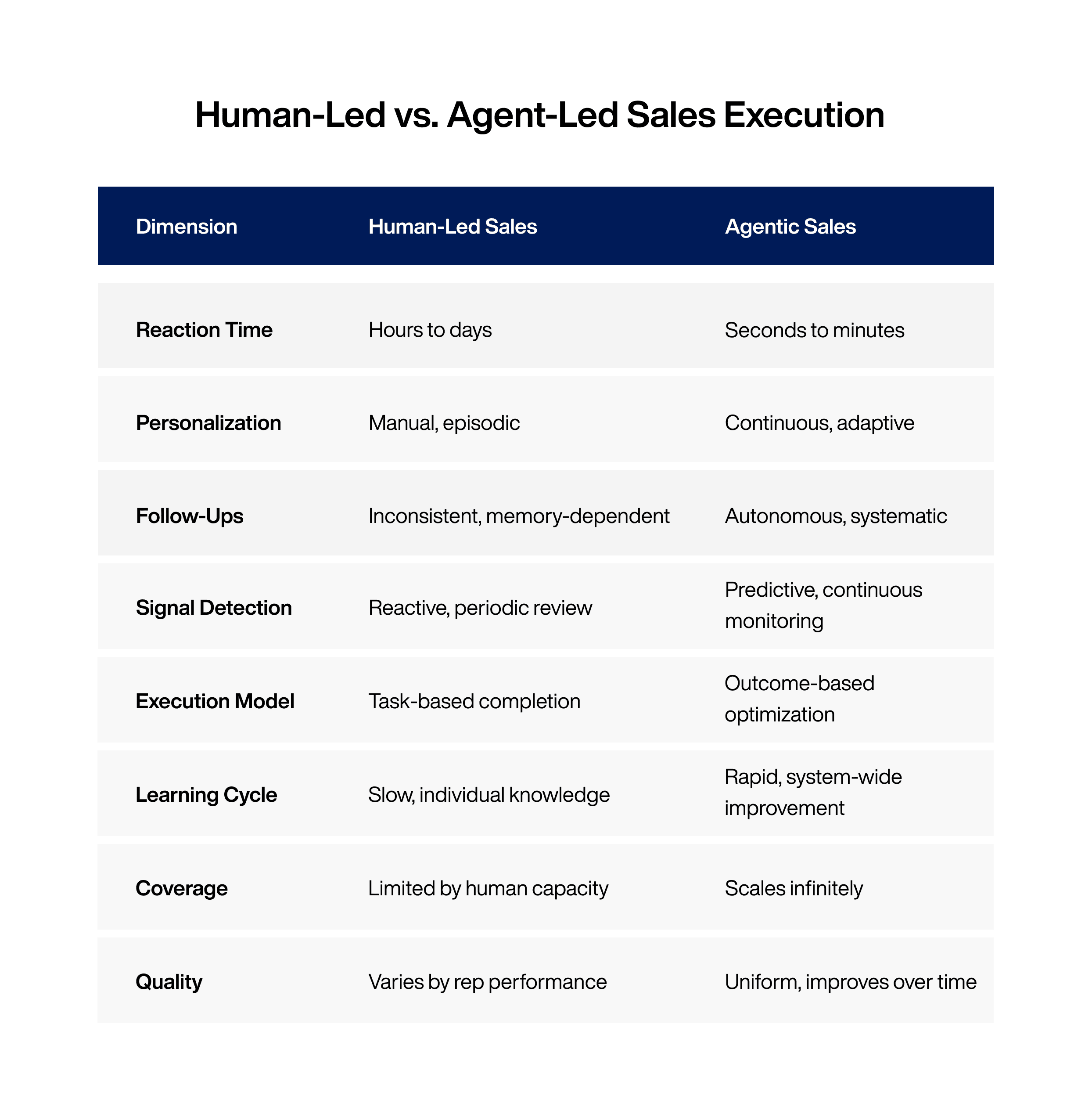
The Critical Insight
This is not a talent problem requiring better hiring. This is not a motivation problem requiring new compensation structures. This is a system design problem requiring fundamental architectural change.
The traditional sales model was optimized for an era when buyers moved slowly, information was scarce, and quarterly sales cycles were acceptable. That era has ended. Organizations that continue optimizing human-speed systems will compete against organizations that have built machine-speed systems.
The question is no longer whether agentic systems will replace human-led execution. The question is how quickly your organization can make the transition before the performance gap becomes insurmountable.
WHAT IS AGENTIC AI IN SALES?
Agentic AI refers to autonomous software systems that operate independently across the complete execution cycle. Unlike tools that augment human productivity, agentic systems function as independent operators capable of end-to-end workflow execution.
An agentic AI system possesses five core capabilities that distinguish it from conventional sales technology:
Perception: The system continuously monitors and interprets signals from data streams, market environments, buyer behaviors, and competitive dynamics. It doesn't wait for humans to pull reports, it actively observes the landscape in real time.
Reasoning: The system analyzes context across multiple dimensions acount history, industry trends, timing factors, competitive positioning, and strategic objectives. It synthesizes disparate information to form a coherent understanding of complex situations.
Decision-Making: The system determines what action to take next based on its analysis, balancing multiple competing priorities and optimization goals. It chooses between alternatives without requiring human approval for each decision.
Autonomous Execution: The system carries out the chosen action sending communications, updating records, triggering workflows, scheduling activities without requiring human initiation or oversight at each step.
Continuous Learning: The system analyzes outcomes from its actions, identifies patterns in what works and what doesn't, and automatically adjusts its future behavior to improve performance over time.
In sales, this means AI systems that don't just assist representatives, they independently run revenue workflows from signal detection through execution and optimization.
Agentic AI Is Not...
The market suffers from widespread confusion about what constitutes truly agentic AI. Many vendors label conventional tools as "agentic" when they merely add AI features to existing paradigms. Understanding what agentic AI is not helps clarify the distinction:
Not a Chatbot: Conversational interfaces that answer questions or summarize information are reactive tools. They wait for human queries and provide responses. Agentic systems initiate action based on their own analysis of when intervention is needed.
Not a Sequence Tool: Email automation platforms that send predetermined messages on fixed schedules follow rigid, human-designed logic trees. Agentic systems dynamically adjust messaging, timing, and approach based on real-time signal interpretation and outcome data.
Not a CRM with AI Features: Customer relationship management systems enhanced with predictive scoring, email drafting assistance, or insight recommendations still require humans to review suggestions and take action. Agentic systems execute directly.
Not a Predictive Dashboard: Analytics platforms that forecast outcomes or highlight opportunities provide information for human decision-making. Agentic systems make and implement decisions themselves.
The fundamental difference is autonomy of execution. Traditional tools support humans who remain the primary actors. Agentic systems are the primary actors, with humans providing strategic direction and handling exceptions.
Core Sales Agent Roles
In a fully realized agentic sales model, execution responsibility is distributed across specialized agents, each focused on a distinct domain of the revenue workflow.
This specialization enables depth of capability while maintaining system-wide coordination.
Agent Type | Core Responsibility | Autonomous Actions |
Prospecting Agent | Identify and prioritize ICP-matched accounts continuously | Scans market databases, monitors company news, detects expansion signals, ranks accounts by fit and timing |
Enrichment Agent | Maintain data accuracy and completeness in real time | Refreshes contact information, updates company profiles, tracks organizational changes, fills data gaps |
Qualification Agent | Assess buyer intent and readiness dynamically | Analyzes engagement patterns, scores intent signals, determines sales-ready status, routes qualified leads |
Outreach Agent | Generate and deliver personalized communications | Crafts contextual messaging, selects optimal channels, determines send timing, personalizes at scale |
Follow-Up Agent | Optimize engagement cadence and persistence | Analyzes response patterns, adjusts follow-up timing, varies message approach, knows when to pause or escalate |
Revenue Orchestrator | Coordinate priorities and workflow handoffs | Allocates agent resources, manages competing priorities, ensures workflow continuity, escalates strategic decisions |
The Power of Orchestrated Agents
Individually, each specialized agent delivers significant value by handling its domain with consistency and speed impossible for human execution. A prospecting agent never misses a signal. An enrichment agent never works with stale data. A follow-up agent never forgets a touchpoint.
Together, these agents form a self-executing revenue system that operates as a coordinated organism rather than a collection of tools. The prospecting agent identifies an account showing buying signals. The enrichment agent immediately gathers current context.
The qualification agent assesses readiness and intent strength. The outreach agent crafts and sends a personalized message at the optimal moment. The follow-up agent monitors response and adapts accordingly. The revenue orchestrator ensures smooth handoffs and resource allocation across the entire workflow.
This coordinated autonomy creates something fundamentally different from enhanced productivity, it creates a revenue system that operates continuously, learns constantly, and scales infinitely while maintaining quality and consistency that improves over time.
The Paradigm Shift
Traditional sales technology asks:
"How can we help humans work faster?"
Agentic AI asks:
"What if the system could execute the workflow itself?"
This shift from human-assisted to human-directed represents the most significant change in sales operations since the introduction of CRM systems. Sales professionals transition from being executors of tasks to being strategists who design systems, define objectives, handle complex exceptions, and focus on the high-judgment activities where human creativity and relationship-building remain irreplaceable.
The organizations that recognize this distinction earliest will build compounding advantages that become increasingly difficult for competitors to overcome.
FROM SALES AUTOMATION TO AGENTIC SALES
Why Automation Hit a Ceiling
Sales automation emerged with a clear value proposition: reduce manual effort, standardize task execution, and improve operational efficiency. It succeeded up to a point.
Early automation delivered measurable productivity gains. Email sequences removed manual follow-ups. Task reminders eliminated forgotten touchpoints. Data entry tools reduced administrative burden. Sales teams could do more with the same headcount.
But the limitations became increasingly apparent. Sales automation fundamentally relies on three constraining assumptions:
Predefined Rules: Every action must be explicitly programmed in advance. If X happens, then do Y. These rule sets grow complex as organizations account for more scenarios, but they can never anticipate every situation.
Static Workflows: Once designed, automation sequences follow fixed paths regardless of changing context. A five-touch email cadence runs identically whether the prospect is highly engaged or showing disinterest.
Human-Defined Triggers: Automation only activates when specific conditions are met or when humans manually initiate workflows. If the trigger doesn't fire, opportunities go unaddressed.
As markets accelerate and buyer behaviors become more unpredictable, these constraints transform from acceptable limitations into critical liabilities. The rigidity that made automation reliable makes it obsolete in environments demanding continuous adaptation.
The Core Distinction
Automation executes instructions with perfect consistency. Agentic systems execute intent with intelligent flexibility.
The Fundamental Shift
Automation optimizes activities. It makes tasks faster, more consistent, and less labor-intensive. Success is measured in emails sent, calls logged, and time saved. The focus remains on execution efficiency.
Agentic systems optimize outcomes. They focus on revenue generated, deals closed, and pipeline created. Activities are merely means to those ends, dynamically adjusted based on what's working.
This distinction manifests in practical differences:
Automation sends more emails with less effort. Agentic systems generate more qualified conversations that advance toward closed revenue. Automation distributes the same message to everyone in a segment. Agentic systems craft unique approaches based on each account's context, timing, and signals. Automation sends according to schedule. Agentic systems send at the optimal moment based on engagement patterns.
The result is not incremental improvement but exponential differentiation in results.
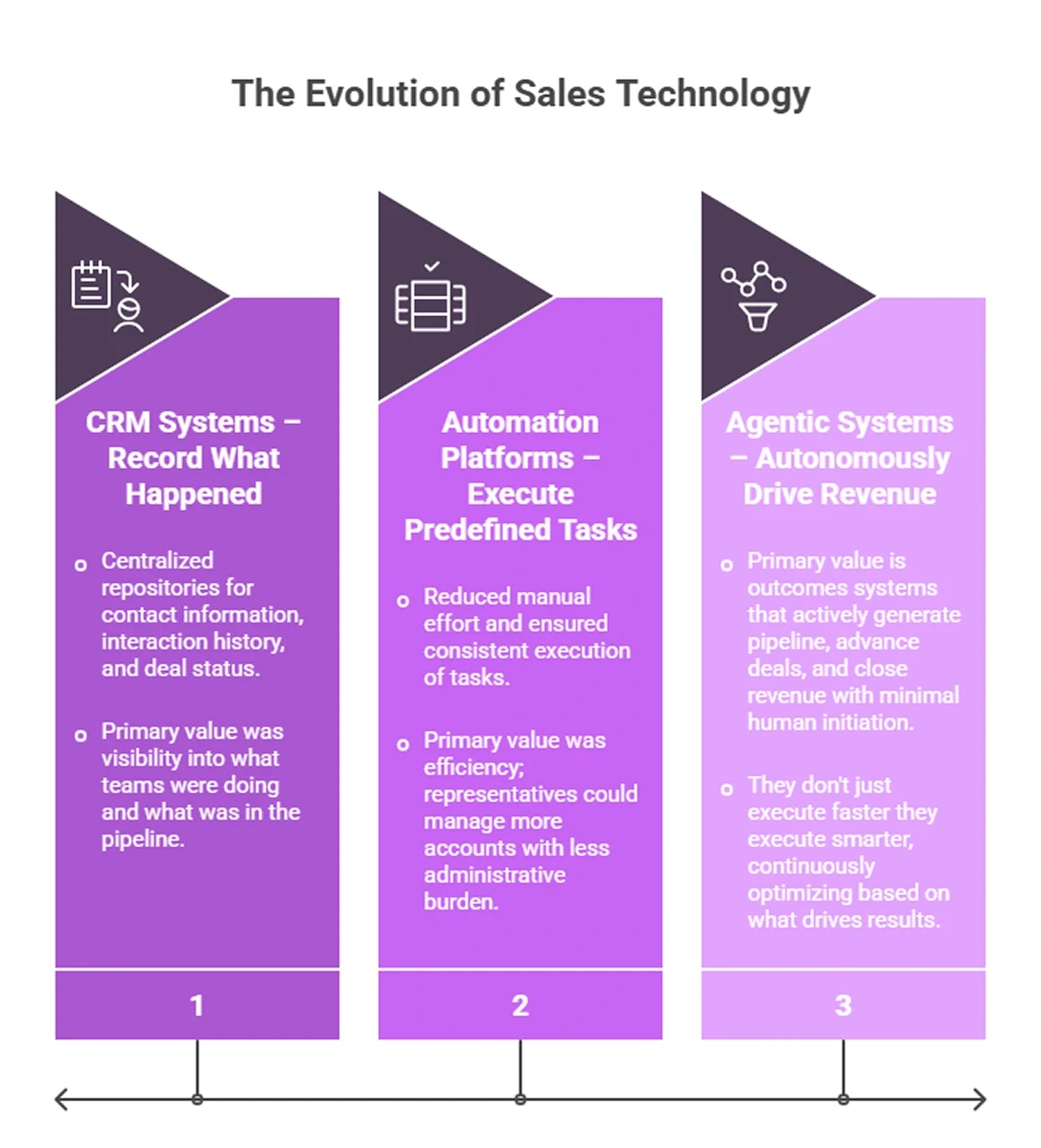
What Changes in the Agentic Era
From Episodic to Continuous: Traditional sales operates in discrete sessions during business hours. Agentic systems operate 24/7, monitoring signals continuously, responding within minutes of opportunity detection, and maintaining persistent engagement without gaps.
From Static to Adaptive: Traditional workflows follow fixed sequences regardless of response. Agentic systems dynamically adjust their approach based on real-time signals changing message tone when sentiment shifts, escalating priority when intent strengthens, pausing outreach when timing is poor.
From Rep-Initiated to System-Led: Traditional sales requires human decision-making at every step. Agentic systems independently identify opportunities, determine optimal actions, execute workflows, and only escalate to humans when strategic judgment is required.
The Role of Human Sellers
This shift does not eliminate human sellers; it elevates them from tactical executors to strategic architects of revenue systems.
In the automation era, top performers succeeded by executing more activities with greater discipline. In the agentic era, top performers succeed by designing better systems, defining clearer outcomes, and applying judgment to complex situations where human creativity remains irreplaceable.
Sales professionals transition to strategic roles: designing agent behaviors and optimization priorities, editing and refining system outputs for quality, governing ethical boundaries and escalation protocols, and focusing on high-value activities like executive relationship-building, complex deal negotiation, strategic account planning, and market intelligence.
The most successful sales organizations won't be those that resist this transition. They'll be those that embrace it earliest and most completely, reimagining what sales professionals should focus on when execution itself is no longer the constraint.
THE THREE WAVES OF AGENTIC REVENUE
Why Most Sales Teams Are Solving the Wrong Problem
AI adoption in sales follows three distinct waves, each representing a fundamentally different level of organizational transformation. Most organizations focus narrowly on the first wave and mistakenly believe progress there guarantees long-term competitive advantage.
It does not.
Understanding which wave your organization is operating in determines whether you're creating temporary productivity gains or building durable market leadership. The difference compounds with each passing quarter.
The Three Waves of Agentic Revenue
Wave | Primary Focus | What Changes | What Doesn't Change | Business Impact |
Wave 1 | Efficiency | Faster outreach, task automation | Sales structure, human decision-making | 10-30% productivity gains |
Wave 2 | Quality | Better personalization, targeting | Human initiation, approval workflows | 30-60% conversion improvement |
Wave 3 | New Systems | Autonomous execution, continuous operation | Outcome ownership, organizational architecture | 10x scale without proportional headcount |
Wave 1 improves speed. Organizations accelerate existing activities—sending more emails faster, logging data more efficiently, scheduling follow-ups automatically. The fundamental workflow remains unchanged; it simply executes with less friction.
Wave 2 improves output quality. Organizations enhance what they produce—more personalized messages, better targeting, strategic timing. The human still initiates and approves, but execution quality improves substantially.
Wave 3 changes how revenue is produced entirely. Organizations redesign revenue generation from the ground up, shifting from human-executed workflows to autonomous systems that operate continuously, learn constantly, and scale infinitely.
The Critical Insight
Success in Wave 1 is not a predictor of success in Wave 3. Heavy investment in Wave 1 optimization can actually impede Wave 3 transformation by entrenching existing workflows and creating organizational resistance to fundamental redesign.
Many teams invest heavily in AI tools that optimize existing workflows AI email writers, predictive lead scoring, automated data entry. These tools deliver measurable ROI and productivity gains. Leadership sees metrics improve and concludes their AI strategy is working.
Then they discover those workflows themselves are becoming obsolete.
Competitors aren't optimizing the old model they're building entirely new systems where autonomous agents handle execution end-to-end. The productivity gains from Wave 1 tools pale in comparison to the structural advantages of Wave 3 systems.
The Fundamental Difference
Wave 1 and Wave 2 are incremental. They make existing teams more productive within the constraints of human-initiated, human-paced workflows. Gains are linear each additional dollar invested yields diminishing returns.
Wave 3 is exponential. It removes the constraint of human execution capacity, enabling continuous operation, perfect consistency, and infinite scalability. Each dollar invested compounds as the system learns and improves autonomously.
Wave 3 requires system redesign, not incremental improvement. You cannot gradually optimize your way from Wave 1 to Wave 3. The transition demands rethinking organizational structure, redefining roles, and fundamentally changing how work gets done.
What Wave 3 Actually Means for Sales
Sales execution no longer depends on rep initiation. The system observes signals, identifies opportunities, determines optimal actions, and executes without waiting for human direction. Representatives don't start their day deciding who to contact the system has already initiated the right conversations.
Signals trigger action automatically. When a target account visits your pricing page or shows intent signals, the system responds within minutes not hours later when a rep reviews their alerts.
Revenue workflows run continuously. Prospecting, qualification, outreach, and follow-up operate 24/7 across all markets and time zones. The system never sleeps, never forgets a follow-up, and maintains perfect consistency.
Human effort shifts upstream to system design. Sales professionals become architects of systems rather than operators of workflows. They define success criteria, set strategic priorities, design agent behaviors, handle complex exceptions, and focus on high-stakes situations where human judgment creates irreplaceable value.
Where Durable Competitive Advantage Is Created
Wave 1 advantages are temporary. Competitors can purchase similar tools and achieve similar productivity gains within months.
Wave 2 advantages are moderate. Better targeting and personalization create differentiation, but competitors can eventually match quality through optimization.
Wave 3 advantages compound over time and become increasingly difficult to replicate. An autonomous revenue system gets smarter with every interaction, learns from millions of patterns simultaneously, and continuously improves without additional human investment.
The organization that builds this system first doesn't just move faster it pulls further ahead each month. The performance gap widens. The learning gap deepens.
This is where durable competitive advantage is created not in having better tools, but in having fundamentally different systems that operate at a scale and consistency impossible for human-driven competitors to match.
The Strategic Choice
Every sales organization faces a choice: optimize the existing model through incremental improvements, or commit to the fundamental redesign required for Wave 3 transformation.
The comfortable path is incremental improvement. The competitive path is system redesign. Most will choose comfort. The organizations that choose transformation will define the next era of revenue leadership.
THE AGENTIC REVENUE SYSTEM (ARS)
A New Revenue Primitive
An Agentic Revenue System (ARS) is not a collection of tools stitched together through integrations. It is not a suite of productivity features added to existing workflows. It represents a fundamentally new architectural layer for go-to-market execution, a coordinated intelligence that operates as a unified organism rather than a set of disconnected applications.
Where traditional sales technology asks "how do we help humans work faster," an ARS asks "how do we enable autonomous revenue generation with strategic human oversight." This shift in framing changes everything about how systems are designed, implemented, and measured.
An Agentic Revenue System is a network of autonomous AI agents that collectively function as an intelligent revenue engine through four core capabilities:
Continuous Signal Monitoring: The system maintains persistent observation of buyer behaviors, market dynamics, competitive movements, and intent signals across all relevant channels and data sources. Unlike periodic human review, this monitoring operates 24/7 with millisecond response times.
Shared Context Reasoning: Agents access and analyze unified context spanning account history, engagement patterns, market conditions, and strategic priorities. They reason across this information to understand complex situations and determine optimal actions based on multiple factors simultaneously.
End-to-End Workflow Execution: The system independently executes complete revenue workflows from initial signal detection through qualification, outreach, follow-up, and conversion not just supporting human execution but serving as the primary executor with human oversight for exceptions and strategic decisions.
Outcome-Based Optimization: Through continuous feedback loops, the system analyzes which actions produce desired outcomes, automatically adjusts its approach based on performance data, and improves its effectiveness over time without requiring manual reconfiguration.
Core System Components
An ARS operates through five interconnected architectural layers, each serving a distinct function while maintaining tight coordination with other layers:
Layer | Primary Function | Key Activities | Output |
Signal Layer | Environmental awareness | Monitor intent signals, track behavioral changes, detect market shifts, identify trigger events | Real-time opportunity and risk alerts |
Reasoning Layer | Intelligence and decision-making | Analyze signal significance, prioritize opportunities, determine optimal actions, evaluate trade-offs | Contextual action recommendations and decisions |
Execution Layer | Action and interaction | Generate personalized outreach, deliver messages across channels, manage follow-up sequences, route qualified leads | Completed revenue activities and customer interactions |
Orchestration Layer | Coordination and sequencing | Manage agent collaboration, sequence workflow steps, allocate system resources, resolve conflicts | Coordinated multi-agent operations |
Learning Layer | Continuous improvement | Track outcome data, identify performance patterns, adjust agent behaviors, optimize system parameters | Enhanced decision models and improved performance |
Eliminating Latency at the System Level
This shift eliminates the fundamental latency that constrains human-driven sales execution. In traditional models, every action requires human observation, decision-making, and execution introducing unavoidable delays at each step.
Even with perfect discipline and infinite capacity, humans cannot monitor all signals continuously, evaluate all options instantly, and execute all actions immediately.
An ARS operates at machine speed across all these dimensions simultaneously. Signals are detected in real-time. Decisions are made in milliseconds. Actions are executed immediately. Follow-ups happen precisely when optimal. The system never sleeps, never gets distracted, and never forgets.
The result is not just faster execution of the same workflows, it's fundamentally different performance characteristics that create compounding advantages over time.
The Paradigm Shift
Building an ARS requires thinking about revenue operations as system design rather than process management. Success depends not on optimizing individual tasks but on architecting an intelligent organism that learns, adapts, and improves continuously.
Organizations that master this shift don't just gain efficiency, they build revenue engines that compound their advantages with every interaction, creating competitive moats that widen rather than erode over time.
AUTONOMOUS SALES WORKFLOWS
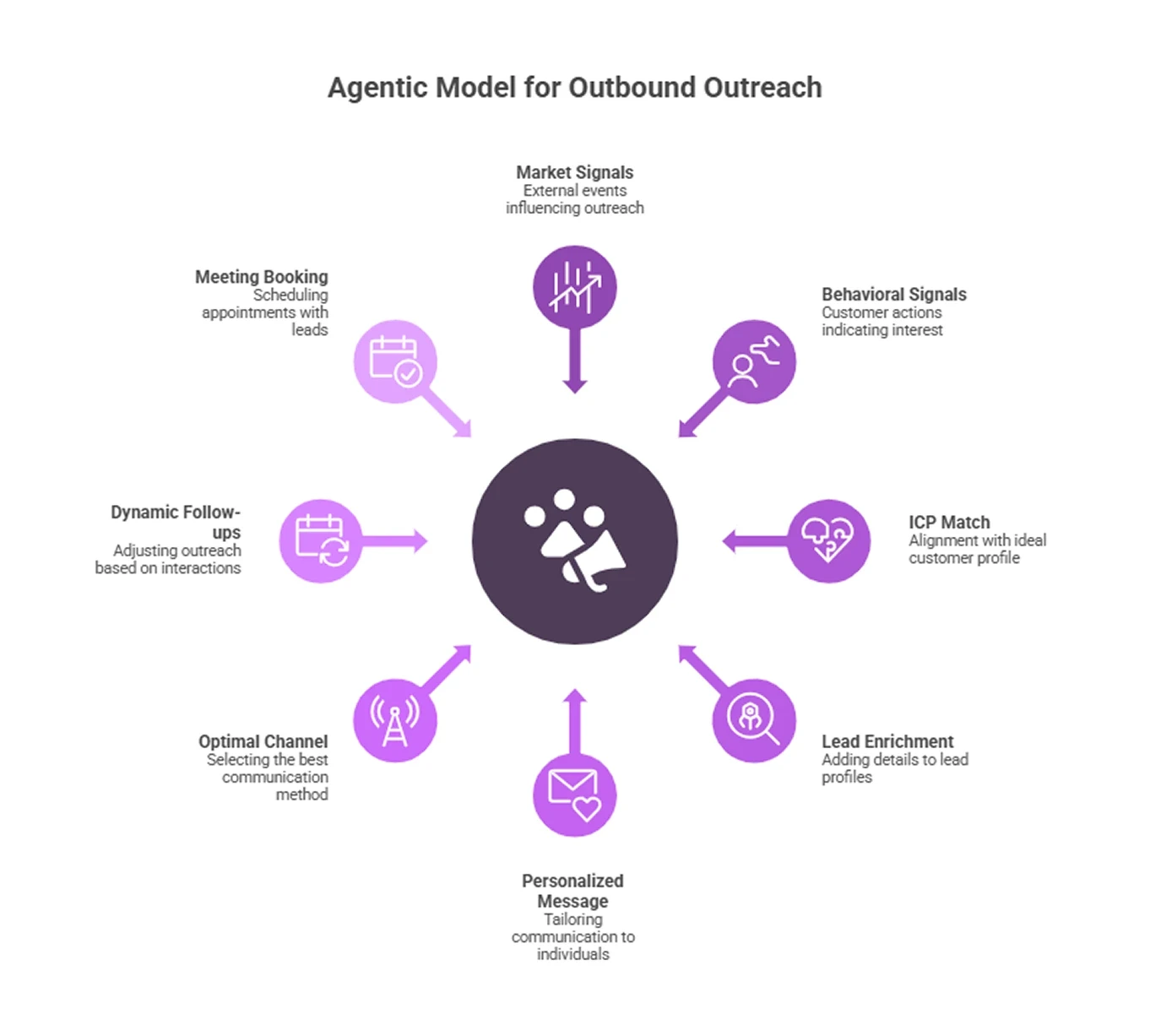
Autonomous sales workflows remove manual initiation from outbound sales. Instead of reps triggering actions, agentic systems run the entire process independently from signal detection to meeting booking.
Example: Agentic Outbound Sales Workflow
In an agentic model, outbound begins with signals, not human action.
Autonomous Workflow Sequence
Market or behavioral signal detected.
ICP match evaluated automatically
Lead enriched in real time
Personalized message generated
Outreach sent via optimal channel
Follow-ups adapt dynamically
Meeting booked or lead recycled
No rep initiation is required at any stage.
Why Autonomous Sales Workflows Work
Continuous Timing Optimization: AI reacts the moment intent appears, not hours or days later.
Context-Aware Personalization: Messages update automatically as buyer data, behavior, or company context changes.
Zero Follow-Up Leakage: Adaptive follow-ups ensure no prospect is forgotten or mishandled.
Compounding Learning: Each cycle improves targeting, messaging, and prioritization through feedback loops.
Outcome: Sales execution becomes always-on, predictable, and scalable rather than episodic and rep-dependent.
HUMANS DON'T DISAPPEAR. THEIR ROLE EVOLVES.
The Biggest Fear Is Also the Wrong Question
Every conversation about agentic AI in sales eventually surfaces the same anxiety: "Will AI replace salespeople?" This fear dominates strategy discussions, drives resistance to transformation, and paralyzes decision-making in organizations that should be moving quickly.
The question is not: "Will AI replace salespeople?"
The real question is: "Which parts of sales should never depend on humans in the first place?"
This reframing shifts the conversation from defensive fear to strategic opportunity. When we examine sales execution honestly, much of what consumes seller time falls into categories where human involvement creates constraints rather than value repetitive tasks that demand consistency, high-volume activities that require speed, systematic processes that benefit from perfect memory, and continuous monitoring that exceeds human capacity.
These are not the activities where top sales professionals create their greatest impact. They are the activities that prevent top sales professionals from focusing on work only humans can do.
The Role Shift in Agentic Sales
Traditional Sales Role | Agentic Sales Role |
Manual executor | System supervisor |
Activity generator | Outcome owner |
Script follower | Strategy editor |
CRM updater | Design authority |
Humans remain essential but at a higher leverage point in the system.
Humans as Governors, Not Bottlenecks
In agentic sales systems, humans do not micromanage execution. They govern it.
Human Responsibilities
Define guardrails and policies
Set objectives and success criteria
Audit AI decisions and outcomes
Override when edge cases arise
Improve system design over time
Agent Responsibilities
Execute outreach at scale
Adapt messaging in real time
Qualify and route leads
Manage follow-ups continuously
Agents execute. Humans decide what execution should optimize for.
This Is Not Replacement. It Is Elevation.
Agentic AI removes friction, not judgment. It replaces manual effort not strategic ownership.
Sales teams become:
More strategic
More scalable
More accountable for outcomes
Human value shifts from doing the work to designing the system that does the work.
THE METRICS THAT MATTER IN AN AGENTIC SALES WORLD
Why Traditional Sales Metrics Break Down
Most sales metrics were designed to measure human activity, not system performance. Calls made, emails sent, meetings booked these metrics assume humans are the primary execution engine. In an agentic revenue system, that assumption no longer holds.
As execution shifts to autonomous agents, leaders must adopt system-level metrics that measure responsiveness, learning, and outcome efficiency.
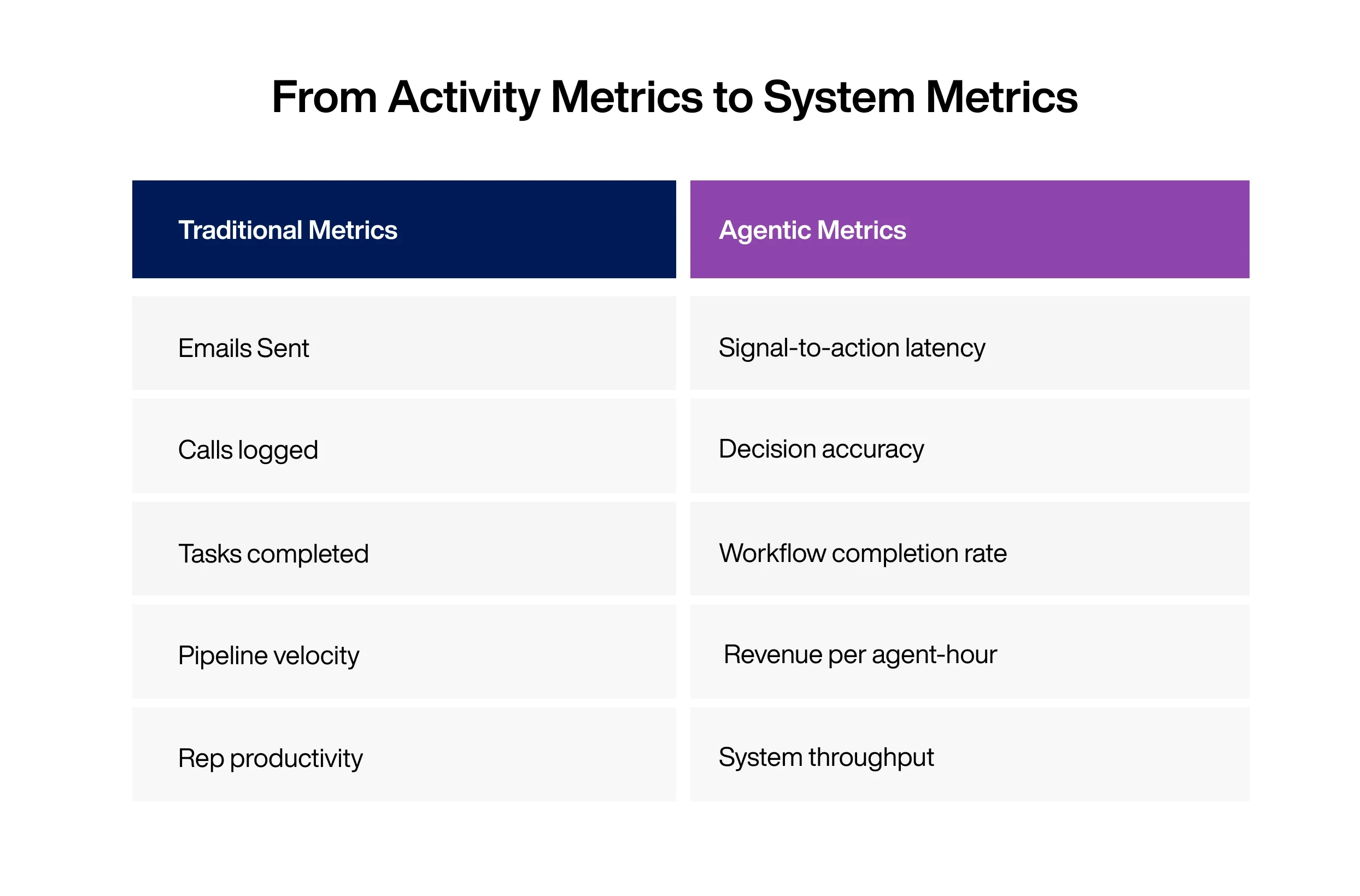
The Most Important Metric: Latency
In agentic sales, speed of response is a competitive moat.
The organizations that win are those that:
Detect intent earliest
Act fastest
Learn continuously
Latency compounds just like revenue does positively or negatively.
GOVERNANCE, TRUST, AND COMPLIANCE BY DESIGN
Why Governance Cannot Be an Afterthought
Sales is one of the most regulated AI domains:
Consent laws (TCPA, GDPR)
Data privacy
Bias and fairness
Explainability of decisions
In agentic systems, governance must be embedded, not layered on.
Jeeva AI (2026) emphasizes that AI systems operating autonomously require compliance-by-design, especially when customer-facing decisions are executed without human initiation.
Governance Layers in Agentic Sales
Layer | Governance Control |
Data | Consent tracking, lineage, freshness |
Reasoning | Explainable decision logic |
Execution | Audit logs and traceability |
Outcomes | Human override and escalation |
The Principle of Minimal Liability
Agentic sales systems should be designed to:
Limit exposure by default
Escalate edge cases to humans
Log every decision transparently
Trust is not earned through disclaimers.It is earned through system design.
THE AGENTIC SALES TECHNOLOGY STACK
Why Tools Alone No Longer Win
Modern sales stacks are bloated with point solutions:
Prospecting tools
Sequencing tools
Analytics tools
CRM extensions
This fragmentation introduces delays, inconsistencies, and blind spots. Agentic sales requires orchestration-first architecture.
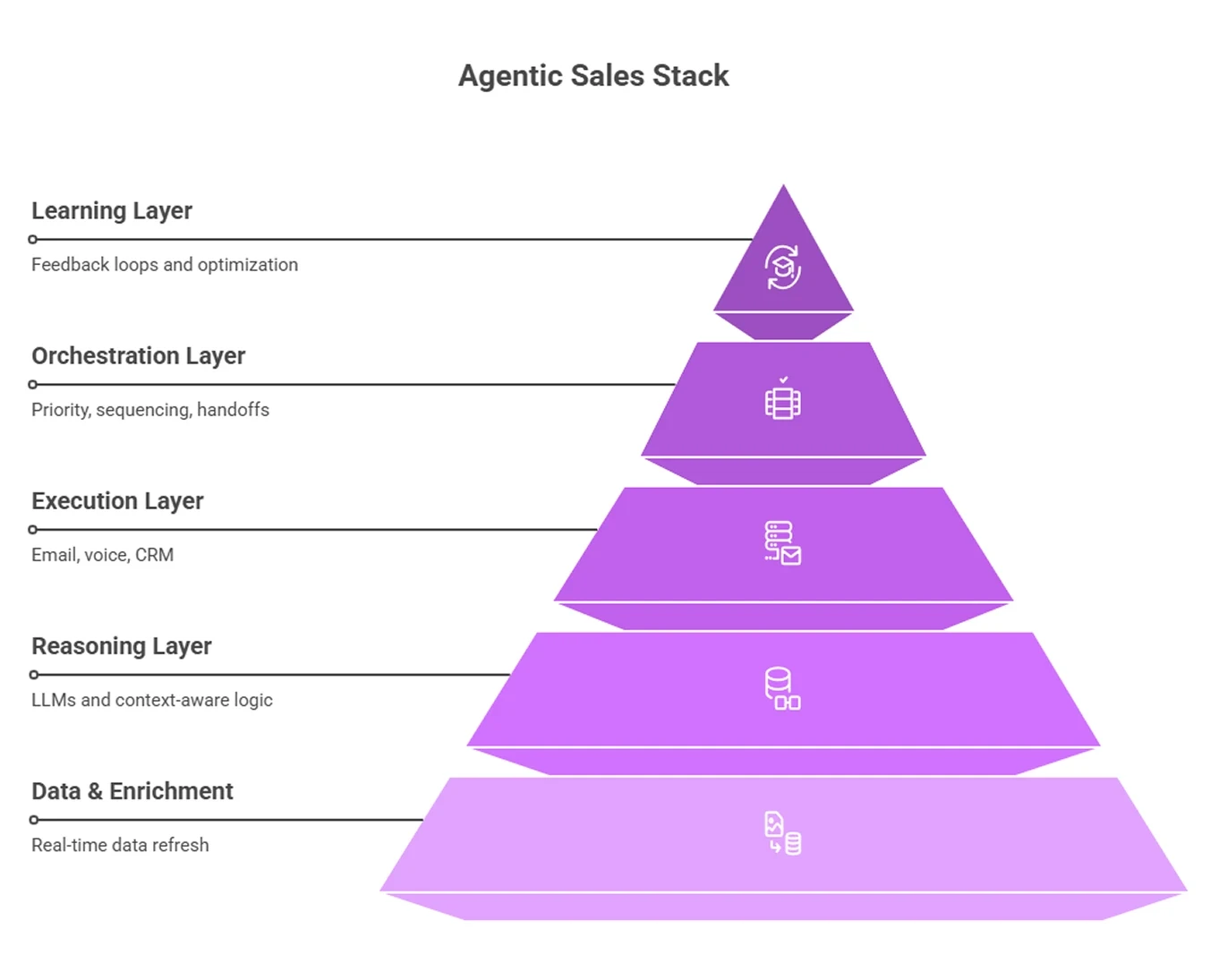
The competitive advantage lies not in which tools you use but in how intelligently they are coordinated.
BUILD, BUY, OR ORCHESTRATE?
The Strategic Decision Every Revenue Leader Must Make
As agentic sales becomes mainstream, organizations face three choices:
Approach | Strength | Risk |
Buy tools | Speed to start | Fragmentation |
Build agents | Differentiation | Complexity |
Orchestrate systems | Compounding advantage | Design effort |
Jeeva AI predicts that by 2027, the majority of enterprise AI initiatives will shift away from tool-centric deployments toward orchestrated agent platforms.
Why Orchestration Wins
Orchestration allows organizations to:
Integrate best-in-class components
Maintain control over logic and data
Adapt as models and channels evolve
In agentic sales, architecture matters more than vendors.
THE AGENTIC SALES MATURITY MODEL
How Organizations Progress
Agentic sales adoption follows a clear maturity curve.
Level | Description |
Level 1 | AI-assisted automation |
Level 2 | Semi-autonomous workflows |
Level 3 | Agent-led execution |
Level 4 | Self-optimizing revenue systems |
Most organizations today sit between Levels 1 and 2.The leap to Level 3 is not driven by better models but by better system design.
The Inflection Point
The moment agentic systems:
Own execution
Optimize themselves
Learn continuously
Sales stops being a department and becomes infrastructure.At that point, competitive advantage compounds quietly and relentlessly.
THE ECONOMIC IMPACT OF AGENTIC SALES
Why Agentic Systems Change the Unit Economics of Revenue
Agentic sales does not merely improve productivity. It changes the cost structure of revenue generation.
Traditional sales economics are constrained by:
Human availability
Linear scaling
Activity-based throughput
Agentic systems remove these constraints.
Measured Impact from Early Adopters
Research and enterprise benchmarks indicate consistent gains across core revenue metrics:
Area | Impact Range |
Rep productivity | +40–60% |
Lead-to-meeting conversion | +25–40% |
Sales cycle duration | −25–35% |
Customer acquisition cost (CAC) | −20–35% |
Revenue per seller | +30–50% |
Why These Gains Compound
Unlike headcount, agentic systems:
Operate continuously
Improve with every interaction
Scale without proportional cost increases
Agentic sales introduces non-linear returns into revenue operations.
THE 90–180 DAY AGENTIC SALES ROADMAP
Why Speed Matters More Than Perfection
Organizations that wait for “perfect” AI strategy lose ground to those that learn faster.
Agentic advantage compounds through:
Data feedback
System learning
Execution velocity
Phase 1: Foundation (0–30 Days)
Objective: Identify leverage, not perfection.
Map repeatable revenue workflows
Identify latency bottlenecks
Define agent roles and ownership
Establish governance principles
Outcome: Clear system boundaries and priorities.
Phase 2: Deployment (30–90 Days)
Objective: Shift execution away from humans.
Deploy core agents (prospecting, enrichment, outreach)
Integrate CRM, data, and channels
Introduce orchestration logic
Begin agent-led execution on selected workflows
Outcome: Autonomous execution in controlled environments.
Phase 3: Orchestration & Optimization (90–180 Days)
Objective: Let the system learn.
Expand agent scope across GTM
Optimize decision logic using outcomes
Introduce performance-based routing
Measure system-level metrics
Outcome: A functioning Agentic Revenue System.
THE STRATEGIC RISK OF WAITING
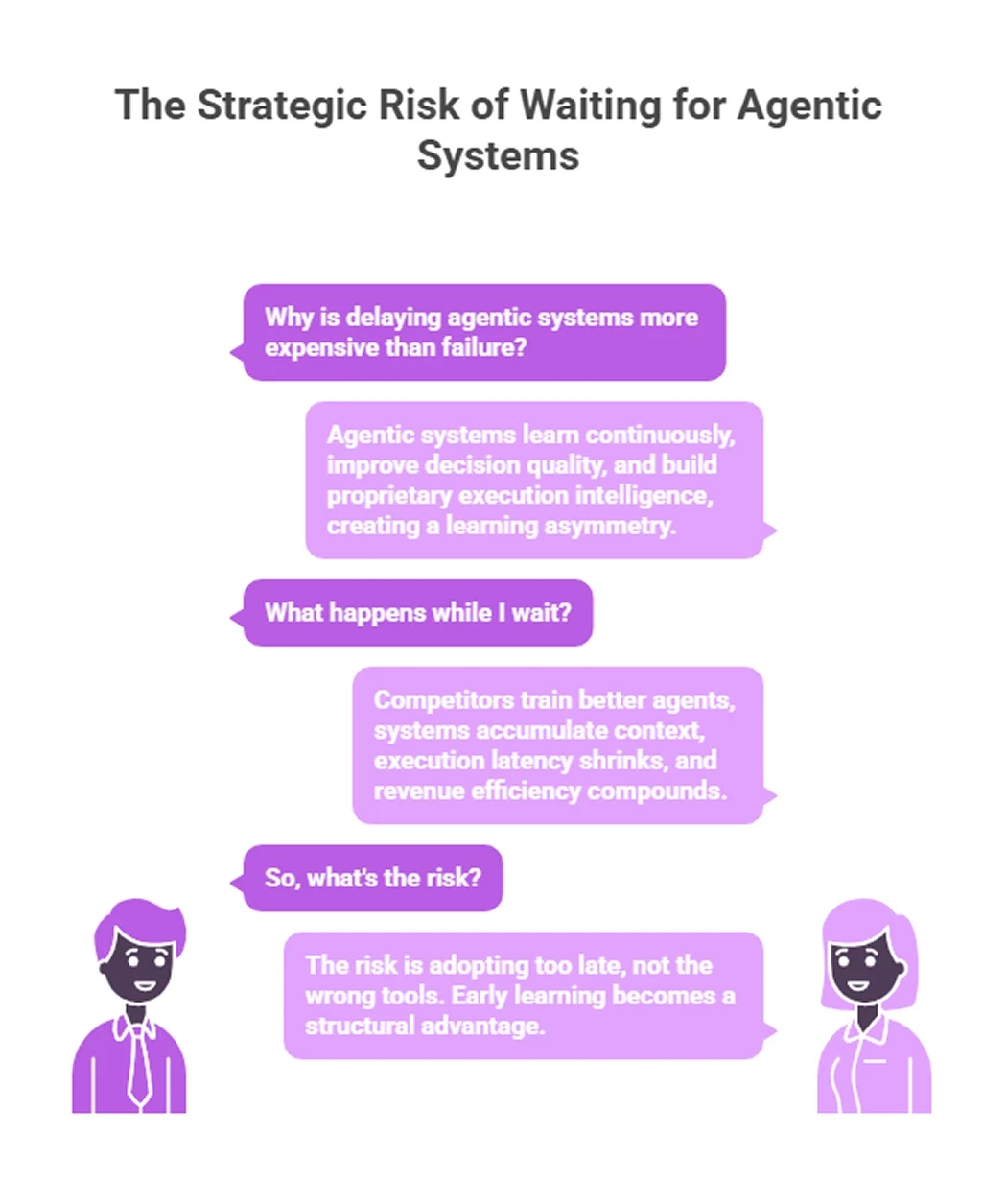
Why Delay Is More Expensive Than Failure
In traditional technology shifts, late adopters could catch up with capital and hiring. Agentic systems behave differently.
They:
Learn continuously
Improve decision quality over time
Build proprietary execution intelligence
This creates learning asymmetry.
What Happens While You Wait
While organizations delay:
Competitors train better agents
Systems accumulate context
Execution latency shrinks
Revenue efficiency compounds quietly
In agentic markets, early learning becomes structural advantage.The risk is not adopting the wrong tools. The risk is adopting too late.
CONCLUSION: THE AGENTIC REVENUE SHIFT IS ALREADY UNDERWAY
Sales Is No Longer a Department. It Is Becoming an Autonomous System.
The transformation described in this playbook is not theoretical speculation about a distant future. The Agentic Revenue Shift is happening now, driven by organizations that have recognized the obsolescence of human-speed execution and committed to fundamental system redesign.
In this new reality, the operational characteristics of sales have fundamentally changed:
Execution happens continuously. Revenue workflows operate 24/7, monitoring signals constantly, responding to opportunities within minutes, and maintaining persistent engagement across all markets without interruption.
Decisions are made at machine speed. The time between signal detection and action has collapsed from hours or days to seconds. Qualification happens in real-time. Outreach timing is optimized dynamically. The latency that constrained human-driven sales has been eliminated.
Humans govern outcomes, not tasks. Sales professionals no longer execute repetitive workflows. They define success criteria, set strategic priorities, design agent behaviors, handle exceptions, and focus on high-judgment activities where human creativity creates irreplaceable value.
Who Will Win
The organizations that dominate the next era of revenue leadership will be those that commit to four fundamental shifts:
Redesign Revenue from First Principles: They don't optimize existing workflows—they rebuild revenue operations from the ground up around autonomous execution. They question every assumption about how sales should be structured and are willing to abandon processes designed for constraints that no longer exist.
Embrace Agentic Execution Early: They move quickly, accept imperfect first implementations, and commit to rapid iteration. They understand that competitive advantage goes to those who start climbing the learning curve first, not those who wait for perfect solutions.
Build Systems That Learn Faster Than Competitors: They instrument everything, analyze outcomes rigorously, and create feedback loops that make their systems smarter with every interaction. They recognize that today's performance is merely the baseline what matters is the rate of improvement over time.
Treat AI as Infrastructure, Not Experimentation: They move AI from pilot programs into core revenue operations. They commit real resources, rebuild organizational structures around autonomous execution, and hold systems accountable for outcomes rather than treating them as interesting experiments.
The Strategic Choice
The question is no longer whether sales becomes agentic. That trajectory is determined. The question is who designs it first and who designs it best.
The performance gap between agentic-first organizations and traditional sales teams will widen with every quarter as learning compounds, as autonomous systems improve their decision-making, and as early movers build advantages that become structurally difficult to replicate.
Two Paths Forward
Path One: Incremental Optimization
Continue investing in tools that make existing workflows faster. Implement AI features that help reps work more efficiently. Celebrate productivity gains while competitors build fundamentally different systems where productivity becomes irrelevant because execution capacity is no longer the constraint.
Path Two: System Redesign
Commit to rebuilding revenue operations around autonomous execution. Accept the disruption, invest in the transition, and focus on becoming the organization that defines what agentic revenue systems look like in your market. Build systems that learn continuously while competitors optimize yesterday's model.
The Compounding Advantage
Those who commit to system redesign will compound quietly building systems that get smarter each month, pulling further ahead in performance, and creating moats that deepen over time.
Those who don't will continue reporting productivity improvements from AI tools, celebrating incremental gains, never realizing that productivity was the wrong optimization target all along. They will wonder when the performance gap became unbridgeable.
The Time Is Now
The Agentic Revenue Shift has begun. Early movers are already building systems that will define competitive advantage for the next decade. The window for establishing leadership in this transition is measured in quarters, not years.
The strategic question facing every revenue leader is not whether to make this shift, it's whether to lead it or follow it. The organizations that choose to lead will write the playbooks that others study. The organizations that choose to follow will spend the next decade trying to close a gap that widens with every passing month.
The choice is yours. The time is now.