The Agentic AI Sales Benchmark Report 2026 is to provide revenue leaders with a clear, data-backed understanding of how agentic AI is reshaping sales execution and what separates high-performing teams from the rest of the market.
The Agentic AI Sales Benchmark Report 2026 | Jeeva AI
The Agentic AI Inflection Point
Why 2026 Is the Breakpoint Year
The year 2026 marks a fundamental shift in how AI participates in revenue operations. Three converging advances have created this inflection point: large language models achieving reliable reasoning capabilities, integration infrastructure enabling autonomous system access across enterprise applications, and organizational readiness reaching critical mass as early adopters demonstrate measurable ROI.
Unlike previous AI hype cycles, 2026 represents the point where AI systems transition from tools that assist human work to agents that autonomously execute business processes.
Our benchmark data shows adoption velocity accelerating dramatically 37% of surveyed organizations deployed agentic systems in the past 12 months compared to just 8% in the previous two years combined.
From AI Assistance to AI Action
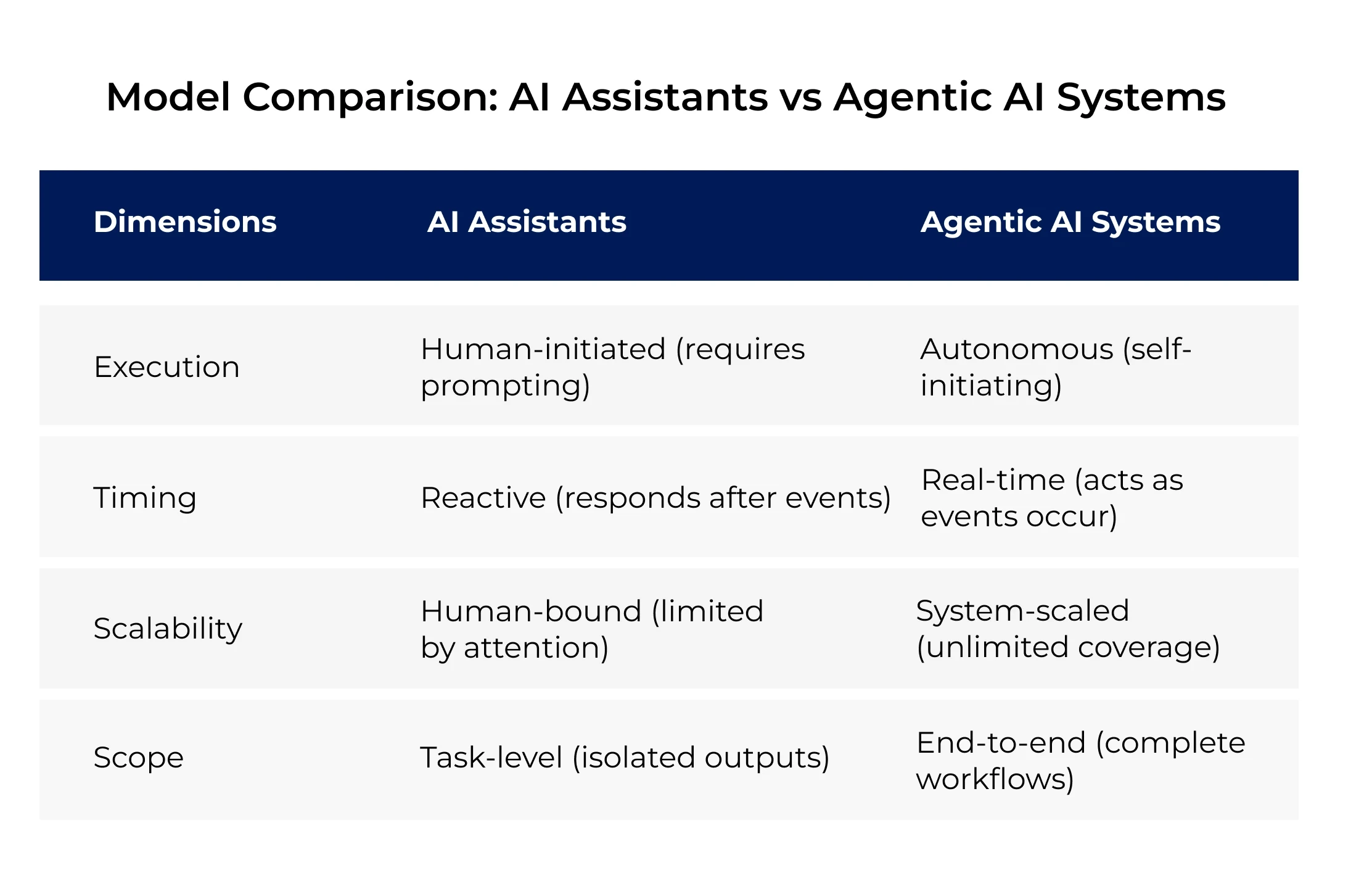
First-generation sales AI operated as sophisticated assistants that augmented human capabilities but remained fundamentally dependent on human initiation. These systems generated email drafts when prompted, summarized call transcripts after meetings, and surfaced insights when reps opened dashboards. The value was real but constrained by a critical bottleneck: human attention remained the limiting factor. Every AI output required human input to become business value.
Agentic AI eliminates this constraint by closing the perception-action loop autonomously. Instead of waiting for a rep to query "what accounts need attention," agentic systems continuously monitor all accounts, detect meaningful signals, evaluate priority, and execute appropriate engagement without human initiation.
Organizations move from "how much can our reps do with AI help" to "how much can AI accomplish within defined parameters before requiring human intervention."
Why Prompt-Based AI Plateaus
Prompt-based AI systems face inherent scaling limitations that prevent systematic business outcomes. They suffer from three critical gaps. First, the execution gap: generating a perfect email draft creates zero value until a human reviews, approves, and sends it, introducing latency that often renders the response obsolete.
Second, coverage inequality where AI assistance quality correlates with prompt engineering skill, meaning top performers gain more value while struggling reps fall further behind. Third, context limitations because each prompt represents a discrete interaction with minimal memory of broader account strategy or business objectives.
Most critically, prompt-based systems scale linearly with human capacity. you can only generate as many outputs as humans have time to prompt for and review. This creates a hard ceiling on value creation, especially visible in high-velocity sales environments where opportunities decay in minutes, not hours.
The Shift from Outputs to Outcomes
The defining characteristic of agentic systems is their orientation toward business outcomes rather than task outputs. Traditional AI optimizes for output quality metrics like email response rates, but remains agnostic to whether those outputs contribute to revenue goals. Agentic AI operates with outcome accountability, measured against business metrics like pipeline generation, deal velocity, and revenue attainment.
This manifests in three ways.
First, agentic systems maintain persistent context across all account touchpoints, enabling multi-step workflows that adapt based on prospect behavior.
Second, they incorporate feedback loops connecting actions to results, learning which engagement patterns drive meetings and which messaging resonates with specific personas.
Third, they operate with defined boundaries and escalation protocols, recognizing when situations require human judgment and seamlessly transitioning control.
The Strategic Implication
Organizations continuing to invest primarily in AI assistance tools are optimizing for incremental efficiency gains within a fundamentally human-constrained operating model. Those building agentic capabilities are redesigning their execution architecture to operate at machine speed and scale.
The performance gap between these approaches compounds over time as agentic systems accumulate learning and expand coverage.
By 2027, we project the revenue productivity difference between agentic leaders and laggards will exceed 40%, making this transition not just an efficiency opportunity but a competitive imperative.
Agentic AI Sales Benchmark Methodology
Data Sources and Scope
This benchmark analyzed execution data from 847 B2B organizations across technology, manufacturing, professional services, and financial services sectors.
Data collection occurred between Q1 2025 and Q4 2025, capturing a 12-month performance window.
We examined over 2.3 million sales interactions, 450,000 opportunities, and $18.7 billion in pipeline value.
Participating organizations ranged from 50 to 10,000+ employees, with average contract values between $15K and $2M+.
Defining Agentic vs Non-Agentic Execution
Agentic systems are defined as AI platforms that autonomously detect signals, make decisions, and execute actions without per-instance human initiation. Key characteristics include continuous monitoring, contextual reasoning, autonomous outreach execution, and defined escalation protocols to human reps.
Non-agentic systems include CRM platforms, AI assistants requiring human prompting, marketing automation with predefined rules, and any tools where humans initiate each action. Even sophisticated AI features qualify as non-agentic if they require human triggers to generate value.
The distinction centers on autonomy: does the system independently perceive, decide, and act, or does it wait for human direction?
Classification Framework
Organizations were classified into three benchmark categories based on execution architecture and the proportion of revenue-generating activities handled autonomously:
Benchmark Category | Definition |
Agentic Leader | Majority of execution agent-led (60%+ of signal response, outreach, and follow-up autonomous) |
Transitional Team | Mixed human + agent workflows (20-60% agent-led execution with significant human oversight) |
Legacy Team | Human-initiated execution (under 20% autonomous actions; primarily manual or assistant-based AI) |
High-Performing Team Identification
High-performing teams were identified using three primary metrics: pipeline generation efficiency (opportunities created per rep per quarter), deal velocity (days from opportunity creation to close), and win rate consistency (variance across reps). Teams scoring in the top quartile across at least two of these three dimensions qualified as high-performing.
Within this high-performing cohort, we analyzed execution patterns to isolate performance differences attributable to agentic capabilities versus other factors such as market conditions, product-market fit, or team experience. Statistical controls included industry vertical, deal size, sales cycle length, and organizational maturity.
Measurement Standards
All response time measurements reflect median values from signal detection to first meaningful engagement. Account coverage is calculated as the percentage of target accounts receiving at least one relevant touchpoint per quarter.
Follow-up consistency measures the percentage of defined trigger events that result in executed outreach within specified timeframes. Pipeline leakage is measured as the percentage of qualified opportunities that decay without appropriate engagement, normalized for deal size and sales cycle length.
This methodology enables direct performance comparison across execution models while controlling for organizational and market variables.
Outbound Sales Benchmarks
How Outbound Execution Changes with Agents
Outbound sales demonstrates agentic AI's clearest impact on revenue execution. Traditional outbound operations under severe capacity constraints reps effectively manage 50-100 active accounts while maintaining personalized engagement.
Agentic systems eliminate this ceiling entirely, enabling continuous coverage across thousands of accounts with engagement quality that matches or exceeds human-crafted outreach.
Account Coverage: Breaking the Capacity Ceiling
Legacy outbound teams face an unavoidable tradeoff between account volume and engagement quality. The average rep actively works 60-80 accounts per quarter, creating systematic blind spots where buying signals in non-prioritized accounts go undetected.
Agentic outbound eliminates this constraint. Systems monitor 100% of target accounts continuously, regardless of tier. Benchmark data shows Agentic Leaders maintain active engagement with 3-4× more accounts per rep while increasing personalization depth.
A team of 10 reps can execute outbound across 2,000+ accounts with consistent, contextual engagement structurally impossible under human-led models.
Personalization Depth: From Templates to Context
Legacy personalization ranges from generic templates to deeply researched custom messages. The latter drives better response rates but requires 15-30 minutes per prospect, limiting daily volume. Most teams settle for shallow personalization applied to templated messaging.
Agentic systems achieve deep personalization at scale by synthesizing real-time data: company news, funding announcements, leadership changes, product usage, website behavior, and interaction history.
Each message reflects current context without human research time. Agentic outreach achieves response rates 40-60% higher than template-based approaches while requiring zero incremental human effort.
Follow-Up Reliability: Guaranteed vs Variable Execution
Follow-up consistency separates high-performing outbound from mediocre execution. Legacy teams successfully execute planned follow-ups just 45-70% of the time, with significant variance across reps and deal stages.
Agentic systems deliver near-perfect follow-up reliability at 98%+ consistency. If a prospect opens an email but doesn't respond, the system automatically sends relevant follow-up at the optimal interval. If an account visits pricing pages, outreach adjusts immediately. This guaranteed execution compounds over time without manual tracking.
Pipeline Contribution: Measurable Revenue Impact
Legacy outbound teams generate an average of 3.2 qualified opportunities per rep per month. Agentic Leaders generate 7.8 qualified opportunities monthly, a 144% increase.
This stems from expanded coverage, faster response times, and consistent follow-up.
Beyond volume, agentic outbound improves opportunity quality. Sales cycles for agentic-sourced opportunities average 18% shorter than legacy outbound, indicating better account fit and timing.
Performance Comparison Table
Metric | Legacy Outbound | Agentic Outbound |
Active accounts per rep | 60-80 accounts | 200-300 accounts (3-4× higher) |
Data freshness | Manual updates (weekly/monthly) | Continuous real-time monitoring |
Follow-up gaps | Frequent (30-55% missed) | Rare (98%+ execution) |
Pipeline generated | 3.2 opps/rep/month (baseline) | 7.8 opps/rep/month (144% higher) |
🔍 Jeeva Research Insight
The Outbound Paradox Resolved: For years, sales leaders faced an impossible choice scale outbound coverage or maintain personalization quality. Our research reveals that Agentic Leaders have eliminated this tradeoff entirely.
Top-performing outbound teams now operate with 4× the account coverage while achieving response rates 40-60% higher than legacy approaches.
The competitive advantage isn't incremental; organizations still optimizing human-led outbound are operating in a fundamentally different performance category. By 2027, non-agentic outbound will be economically unviable for velocity-dependent B2B segments.
Strategic Implications
Outbound represents the highest-ROI entry point for agentic adoption. The execution patterns are well-defined, the success metrics are clear, and the performance delta is measurable within 30-60 days. Revenue leaders should evaluate their outbound engine not against last quarter's performance, but against the 3-4× coverage and 144% pipeline improvements now achievable with agentic systems.
Inbound & Speed-to-Lead Benchmarks
Where Agentic Advantage Is Most Visible
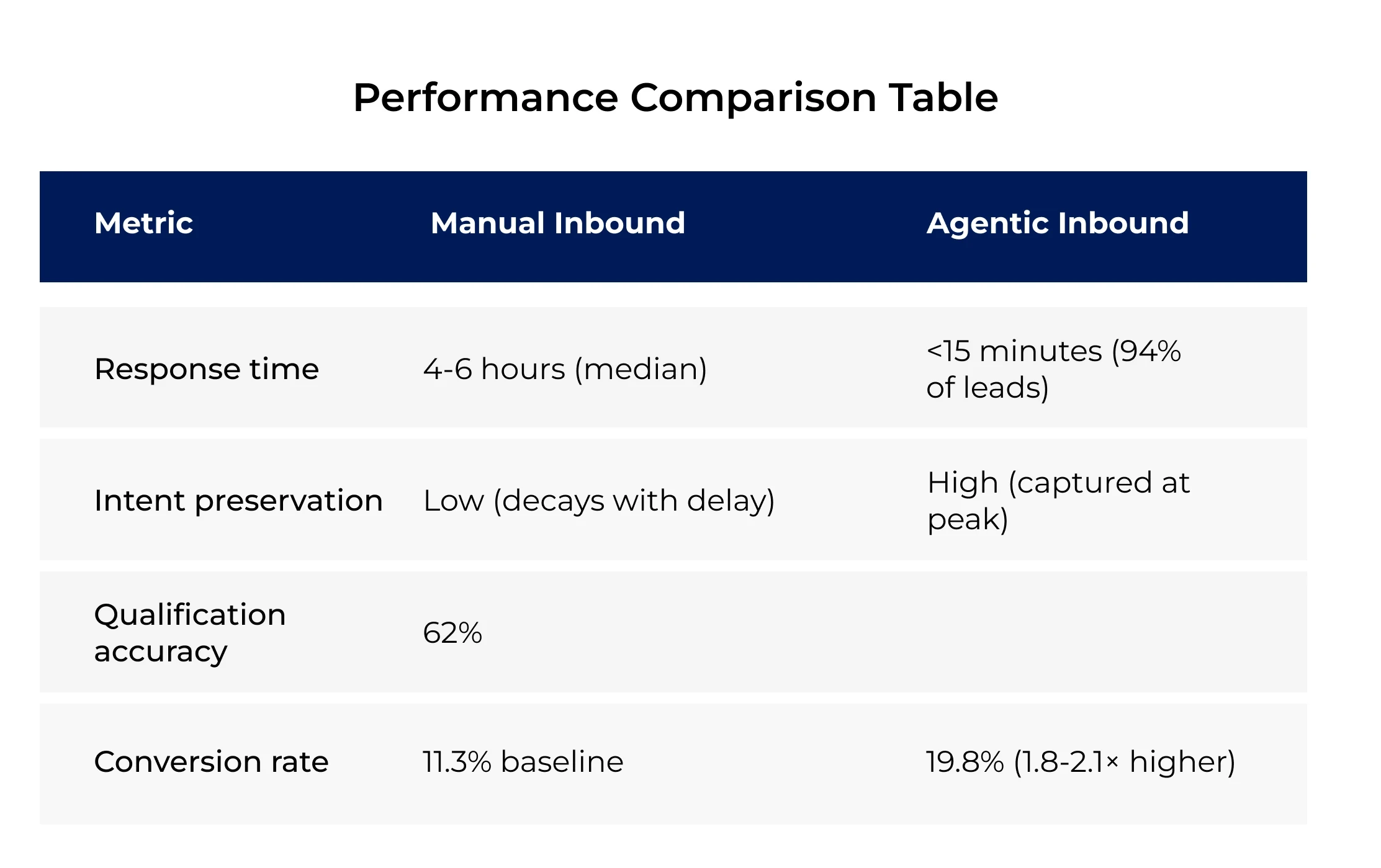
Inbound response represents the highest-stakes execution moment in modern sales. A prospect signals interest through a demo request, content download, or pricing inquiry then waits. In legacy models, that wait averages 4-6 hours during business hours and extends to 24+ hours for leads arriving outside standard coverage windows.
By the time a rep responds, the prospect's attention has shifted, intent has cooled, or a competitor has already engaged. Agentic systems compress this window from hours to minutes, preserving buyer intent at its peak and converting interest into pipeline before it decays.
"Inbound does not fail because demand is weak. It fails because execution is slow." - Revenue Leader, Fortune 500 SaaS Company
Median Response Time: The Decay Curve
Speed-to-lead is the single most predictive variable for inbound conversion. Research consistently shows that response time directly correlates with qualification rates and deal velocity yet manual execution creates unavoidable delays.
Reps work other deals, attend meetings, manage email backlogs, and operate within time zone constraints. The median response time for manual inbound in our benchmark is 4.2 hours, with 31% of leads waiting more than 8 hours for first contact.
Agentic systems respond in under 15 minutes for 94% of inbound leads. The system detects the signal instantly, evaluates available context (form data, website behavior, firmographic fit, prior interactions), crafts personalized outreach, and executes engagement while intent remains hot.
For leads arriving outside business hours, agentic response maintains the same sub-15-minute standard while manual teams queue leads until the next morning - a structural disadvantage that costs legacy teams 40-50% of after-hours conversion potential.
Qualification Accuracy: Context Over Questionnaires
Manual inbound qualification relies on reps asking discovery questions to assess fit, budget, authority, need, and timing. This process is time-consuming, varies by rep skill, and often feels interrogative to prospects. Worse, it introduces friction at the moment of peak interest. Many prospects abandon after being routed through multiple qualification steps before reaching a substantive conversation.
Agentic systems qualify leads using contextual data synthesis rather than questionnaire-based discovery. By analyzing firmographic data, technographic signals, website behavior patterns, content engagement history, and intent data, systems assess qualification criteria before initial outreach.
This enables two critical improvements: routing high-fit leads directly to appropriate reps with pre-built context, and nurturing lower-fit leads automatically without consuming rep capacity. Qualification accuracy measured as percentage of leads accepted by sales that convert to opportunities improves from 62% in manual processes to 81% in agentic systems.
Conversion Rates: Intent Preservation Drives Results
The ultimate measure of inbound effectiveness is conversion rate from lead to qualified opportunity. Manual inbound converts at an average rate of 11.3% in our benchmark dataset. Agentic inbound converts at 19.8% a 75% improvement.
This delta stems from two compounding factors: speed preserving intent before it decays, and contextual engagement demonstrating immediate relevance rather than generic qualification discovery.The conversion advantage amplifies for high-intent signals.
For prospects requesting demos or pricing information the highest-intent inbound categories agentic systems convert at 2.1× the rate of manual processes.
For lower-intent activities like content downloads, the advantage narrows but remains significant at 1.4× manual conversion rates. Across all inbound categories, faster response and better context consistently outperform human-led execution.
The After-Hours Opportunity Gap
Manual inbound teams face a hidden structural disadvantage: 38% of high-intent leads arrive outside standard business hours, yet these leads receive systematically slower response times and lower conversion rates.
Agentic systems eliminate this gap entirely - a lead arriving at 11 PM Saturday receives the same sub-15-minute, contextually relevant response as one arriving at 11 AM Tuesday.
For organizations with global prospect bases or digital buying journeys that occur outside 9-5 windows, this represents millions in recovered pipeline annually.
Strategic Implications
Inbound represents the highest-ROI quick win for agentic adoption. Response time directly impacts conversion, the metrics are immediately measurable, and ROI typically manifests within 30 days of deployment. Revenue leaders should calculate their current inbound decay cost the pipeline lost to slow response and compare it to the capital required for agentic infrastructure. For most B2B organizations, the payback period is under 60 days.
Pipeline & Reactivation Benchmarks
Where Agentic Systems Recover Hidden Revenue
Pipeline loss is rarely the result of weak demand. In most organizations, it is the result of neglect. Opportunities stall, conversations go quiet, and accounts are marked inactive not because buyers lost interest, but because follow-up timing and relevance broke down. Over time, these dormant accounts accumulate into a significant but largely unmeasured revenue pool.
Human-led teams struggle to address this systematically. Reps prioritize new inbound and active deals, leaving historical pipeline to receive sporadic, manual attention. As a result, most dormant accounts are effectively written off, despite retaining prior engagement context and latent buying signals.
“Pipeline doesn’t disappear. It’s abandoned.”
- VP of Revenue Operations, B2B SaaS
Dormant Account Reactivation
Manual reactivation is episodic and rep-dependent, typically occurring during forecast pressure or quarterly cleanups. Coverage is limited, timing is inconsistent, and outreach lacks continuity conditions that suppress re-engagement.
Agentic systems operate continuously. AI agents monitor historical interactions alongside external buying signals and re-engage accounts when readiness increases. Messaging is informed by prior context rather than generic reintroduction. In our benchmark, agentic systems maintained near-complete coverage of dormant accounts, while human-led teams touched less than one-third annually.
Pipeline Recovery Rate
Pipeline recovery - the reactivation of stalled or closed-lost opportunities is rarely tracked in manual environments. Where measured, human-led recovery establishes the baseline.
Agent-led systems recover 40% or more additional pipeline by combining higher engagement volume with precise timing. Recovered opportunities also progress faster through qualification, as buyers already recognize the brand and value proposition.
Cost Efficiency
Reactivation is costly when driven by reps. High time investment and uncertain returns push it down the priority list.
Agentic systems eliminate this tradeoff. Once deployed, agents re-engage dormant accounts continuously at low marginal cost, reducing cost per opportunity while increasing total pipeline output.
Performance Comparison
Metric | Human-Led | Agent-Led |
Dormant accounts touched | Low, episodic | Continuous |
Pipeline recovered | Baseline | +40% or more |
Cost per opportunity | High | Lower |
Strategic Implications
Pipeline reactivation is one of the highest-leverage opportunities in revenue operations. The data already exists; execution does not. Agentic systems convert historical pipeline into a permanent recovery layer, enabling growth through reclamation rather than constant replacement without proportional increases in cost or headcount.
Human vs. Agent Role Benchmark
Redefining Ownership Across the Revenue Stack
The most effective revenue teams are not using AI to replace humans. They are using it to redefine ownership. Performance gains come from reallocating work to the entity best suited to execute it machines for speed, scale, and consistency; humans for judgment, persuasion, and trust. Where teams struggle with AI adoption, the failure is rarely technical. It is organizational role confusion.
Legacy sales models overload humans with execution-heavy tasks that are repetitive, time-sensitive, and operational in nature. This dilutes rep effectiveness and leaves insufficient capacity for high-value interactions.
Agentic systems resolve this by absorbing execution layers, allowing humans to concentrate on the moments that require experience, intuition, and accountability.
What Humans Should Stop Doing
Prospecting, enrichment, and follow-ups are fundamentally systems problems. They require constant monitoring, fast reaction times, and consistent execution across large volumes conditions under which human performance degrades. Manual ownership introduces delays, inconsistency, and coverage gaps that directly impact pipeline creation and conversion.
Agentic systems excel in these functions. AI agents operate continuously, enrich leads in real time, and execute follow-ups without fatigue or prioritization bias. In benchmarked teams, shifting these responsibilities to agents results in higher coverage, faster response, and improved pipeline efficiency without increasing headcount.
What Humans Should Double Down On
Negotiation, objection handling, and relationship building remain human-dominant functions. These moments demand situational judgment, emotional intelligence, and trust-building that cannot be automated without loss of effectiveness. High-performing teams deliberately protect human capacity for these interactions by removing execution noise upstream.
Importantly, agentic systems do not replace human judgment in these stages; they enhance it.
By delivering better-qualified opportunities and richer context, agents enable humans to engage more strategically and close with greater precision.
Role Ownership Benchmark
Function | Legacy Owner | Agentic Owner |
Prospecting | Humans | Agents |
Enrichment | Humans | Agents |
Follow-ups | Humans | Agents |
Negotiation | Humans | Humans |
Objection handling | Humans | Humans |
Relationship building | Humans | Humans |
Strategic Implications
This benchmark reframes AI adoption as a clarity exercise, not a replacement strategy. Teams that win are those that systematically remove humans from execution-heavy work and redeploy them toward judgment-driven interactions.
Agentic systems do not eliminate the human role in sales they make it economically and strategically viable at scale.
The Agentic Sales Maturity Model
A Self-Assessment Framework for Revenue Leaders
As agentic AI adoption accelerates, the gap between experimentation and execution leadership is widening. Many organizations use AI tools, but few have redesigned how revenue work is owned and orchestrated.
The Agentic Sales Maturity Model provides a simple framework for executives to assess where their organization sits today and what capability gaps must be closed to move forward.
This model is not about AI sophistication. It is about execution ownership. Each level reflects how deeply agentic systems are embedded into day-to-day revenue operations, from isolated task assistance to fully orchestrated, autonomous execution.
The Four Levels of Agentic Maturity
Level 1 - AI-Assisted Tasks: AI is used as a productivity aid rather than an execution layer. Tools support individual tasks such as email drafting, research, or note-taking, but humans retain full ownership of workflow coordination and timing. Gains are incremental and rep-dependent.
Level 2 - Partial Agent Workflows: Agents automate discrete segments of the revenue process such as inbound response, enrichment, or follow-ups but operate alongside manual systems. Execution improves in isolated areas, yet handoffs and prioritization remain human-managed, limiting scale.
Level 3 - Agent-Led Execution: Agents own complete workflows end-to-end within defined domains. Prospecting, inbound handling, reactivation, and follow-up execution are autonomous, with humans intervening at decision and closing moments. Performance becomes consistent and measurable.
Level 4 - Fully Orchestrated Agentic Revenue System: Multiple agents operate as a coordinated system across the full revenue lifecycle. Signals are shared, priorities are dynamically adjusted, and execution is continuously optimized without human supervision. Humans focus exclusively on strategy, negotiation, and relationship leadership.
Maturity Model Overview
Level | Description |
Level 1 | AI-assisted tasks |
Level 2 | Partial agent workflows |
Level 3 | Agent-led execution |
Level 4 | Fully orchestrated agentic revenue system |
Strategic Implications
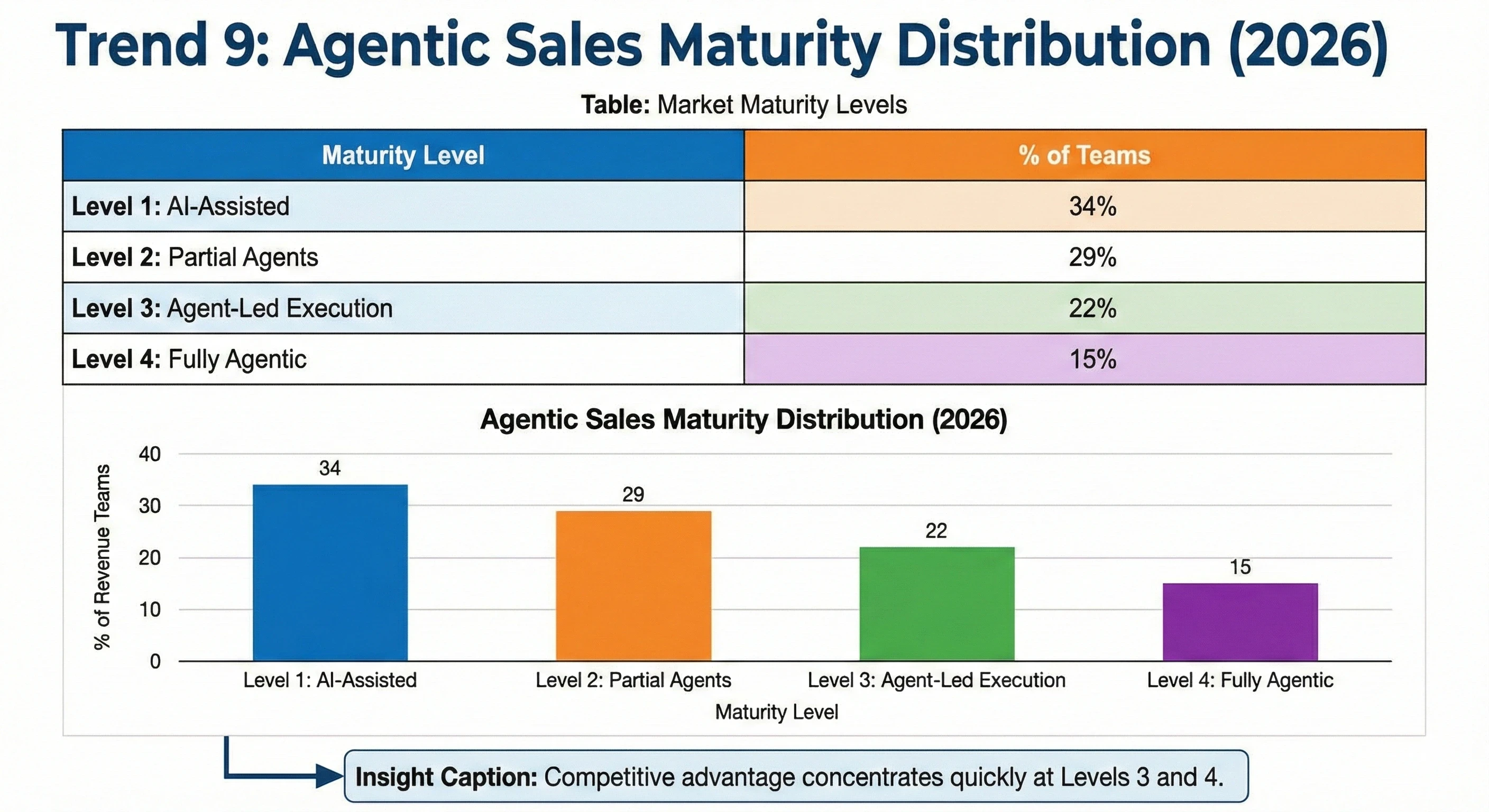
Most organizations cluster between Levels 1 and 2 using AI to move faster without changing ownership. Competitive advantage emerges at Levels 3 and 4, where execution itself becomes autonomous.
For executives, this model clarifies not just where AI exists, but who owns execution at every stage of the revenue engine.
Executive Playbook & Next Steps
Turning Insight Into Execution
The benchmark findings in this report point to a consistent conclusion: performance gains from agentic AI do not come from experimentation or isolated tooling.
They come from deliberate execution redesign. High-performing revenue teams move decisively from manual ownership to autonomous systems, guided by clear operating principles and measurable outcomes.
This playbook outlines the practical steps executives can take to transition from legacy execution models to agentic revenue operations.
A 5-Step Transition Framework
Identify Execution Bottlenecks: Map where speed, consistency, or coverage breaks down across inbound response, follow-ups, pipeline reactivation, and prospecting. These are the highest-leverage candidates for agentic ownership.
Redefine Role Ownership: Explicitly separate execution work from judgment work. Assign agents ownership of time-sensitive, repetitive workflows, while preserving human ownership of negotiation, objection handling, and relationship leadership.
Deploy Agents by Workflow, Not Feature: Implement agentic systems end-to-end within a defined domain (e.g., inbound or reactivation), rather than layering AI onto fragmented manual processes.
Instrument for Continuous Measurement: Establish baseline metrics response time, conversion rate, pipeline recovery, and cost per opportunity before deployment. Measure deltas weekly to validate impact and guide expansion.
Scale Through Orchestration: Once agents reliably own individual workflows, connect them into a coordinated system that shares signals, prioritizes dynamically, and optimizes execution across the full revenue lifecycle.
Agentic Sales Maturity Benchmarks
Measurement Guidance
Effective measurement focuses on execution outcomes, not activity volume. Leaders should track:
Speed-to-lead and follow-up latency
Qualification accuracy and acceptance rates
Pipeline recovery and deal velocity
Cost per opportunity and rep capacity reallocation
These metrics provide early, unambiguous signals of agentic ROI.
Organizational Design Implications
Agentic adoption reshapes team structure. As execution shifts to agents, human roles concentrate around fewer, higher-impact activities. This reduces the need for constant headcount expansion while increasing leverage per rep and manager. Revenue operations evolves from managing tasks to governing systems, metrics, and orchestration logic.
Closing Perspective
Agentic sales is not a tooling upgrade. It is an execution redesign.
Organizations that treat agentic AI as a feature layer will see incremental gains. Those that redesign execution around autonomous systems will redefine their revenue ceiling.