Introduction: AI Lead Generation vs Manual Lead Generation in 2026
In 2026, AI lead generation outperforms manual prospecting by automating research, enrichment, personalization, and follow-ups at a speed and scale humans cannot match.
Lead generation in 2026 is no longer a manual, rep-driven process-it is an AI-driven execution system.
For years, B2B teams relied on SDRs to research accounts, validate contacts, enrich data, write outreach, and manage follow-ups by hand. That model is now fundamentally limited by time, cost, and human capacity.
AI lead generation has transformed this workflow end to end. Modern AI systems automate prospect research, real-time data enrichment, lead scoring, personalization, and follow-ups simultaneously operating continuously and adapting to buyer behavior as it changes. What once took days or weeks of manual effort now happens in minutes, with greater consistency and accuracy.
This article compares AI Lead Generation vs Manual Lead Generation across the factors that matter most to revenue teams in 2026: accuracy, speed, cost efficiency, scalability, data quality, and ROI.
The goal is to help sales and marketing leaders clearly understand where manual methods still apply and where AI-driven execution delivers a decisive advantage for growth.
What Is Manual Lead Generation and How Does It Work?
Manual lead generation is a human-driven process where sales representatives individually identify, research, enrich, qualify, and contact potential buyers. This approach relies on SDRs performing each step by handsearching for prospects, validating data, crafting outreach, and managing follow-ups without automation.
While manual lead generation allows for human judgment and nuance, it is inherently slow, costly, and inconsistent. Output depends entirely on individual effort, making results difficult to standardize or scale across teams.
What Are the Key Tasks in Manual Lead Generation?
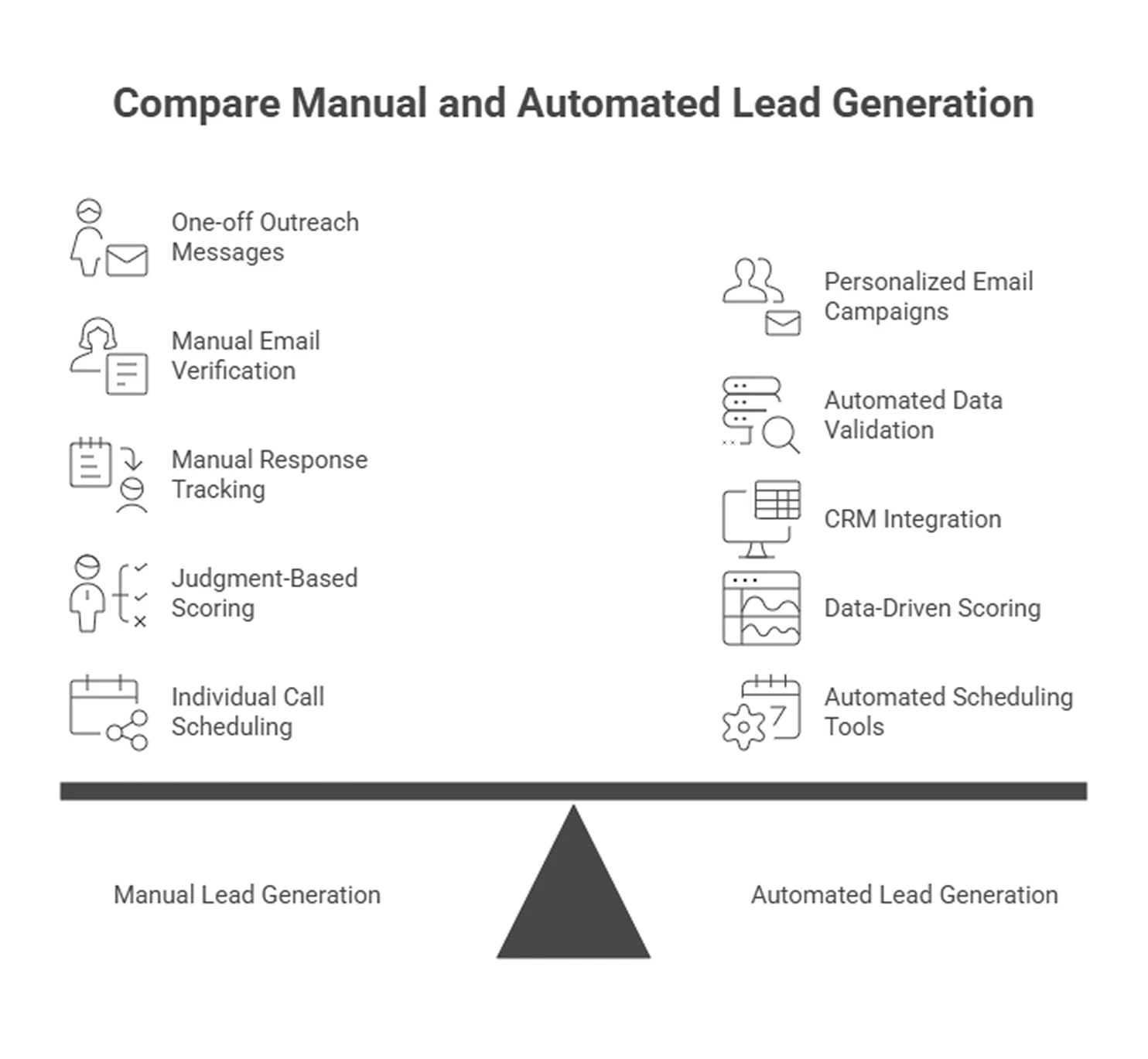
Manual lead generation typically includes the following activities:
Searching for companies and contacts using professional networks and websites
Manually verifying email addresses and contact details
Writing one-off outreach messages for each prospect
Tracking responses manually, often in spreadsheets or basic CRM notes
Scoring prospects by judgment, rather than data-driven signals
Scheduling calls individually through back-and-forth coordination
Manual workflows break down as volume increases. Because every action requires human time and attention, scaling manual lead generation leads to higher costs, slower response times, and uneven lead quality especially in competitive B2B markets.
What Is AI Lead Generation and How Does It Work?
AI lead generation is a data-driven approach that uses artificial intelligence to identify, enrich, engage, and qualify prospects automatically across the sales funnel.
Instead of relying on manual research and outreach, AI systems analyze large datasets, match prospects to an ideal customer profile, detect buying intent, and execute personalized engagement at scale.
These systems use automation, natural language processing, and machine-learning models to continuously process signals from multiple sources. As new data appears, AI adapts messaging, prioritizes leads, and advances qualified prospects without requiring constant human input making the process faster, more consistent, and easier to scale than manual workflows.
What Does AI Lead Generation Handle Automatically?
AI lead generation platforms typically manage the following tasks end to end:
Prospect research and validation across multiple data sources
Real-time lead enrichment with verified, up-to-date information
Personalized outbound messaging tailored to role, industry, and context
Smart follow-up sequences that adjust based on engagement behavior
Intent detection and lead qualification using behavioral signals
Automatic meeting booking for sales-ready prospects
By automating execution-heavy tasks, AI lead generation can reduce manual effort by 70–90% while simultaneously increasing pipeline volume and consistency. Sales teams spend less time on repetitive work and more time on conversations, strategy, and closing deals.
How Do Speed and Efficiency Compare Between AI and Manual Lead Generation?
AI lead generation is significantly faster and more efficient than manual lead generation because it operates in parallel, not sequentially. Manual prospecting depends on humans completing one task at a time researching accounts, validating data, sending outreach, and following up in order. This creates unavoidable delays and limits daily output.
AI systems remove these constraints. They evaluate thousands of accounts simultaneously, enrich data in real time, trigger outreach automatically, and respond instantly to engagement making speed one of the most decisive advantages of AI-driven lead generation.
In competitive B2B markets, speed directly translates to higher response rates and more qualified pipeline.
What Speed Advantages Does AI Lead Generation Provide?
AI-driven systems accelerate every step of the lead generation workflow:
Identifies leads instantly across large datasets
Validates contact information automatically without manual checks
Updates CRM records in real time with no data lag
Triggers follow-ups at precise moments based on engagement signals
Operates 24/7 across global time zones
Executes multiple workflows simultaneously without fatigue
Because AI removes waiting time between actions, sales teams engage prospects while intent is still high. This compression of time from discovery to first contact and follow-up is a primary reason organizations replace manual prospecting with AI-driven lead generation.
How Do Speed and Efficiency Compare Between AI and Manual Lead Generation?
AI lead generation is faster and more efficient than manual lead generation because it operates in parallel rather than sequentially.
Manual prospecting requires humans to complete tasks one at a time researching accounts, validating data, sending outreach, and following up in order. This sequential execution creates delays and caps how much pipeline a team can generate each day.
AI removes these limitations. AI-driven systems evaluate thousands of accounts simultaneously, enrich data in real time, trigger outreach automatically, and respond instantly to engagement. As a result, speed becomes one of the most decisive advantages of AI lead generation.
In competitive B2B markets, faster engagement directly leads to higher response rates and more qualified pipeline.
What Speed Advantages Does AI Lead Generation Provide?
AI accelerates every stage of the lead generation workflow:
Identifies leads instantly across large and dynamic datasets
Validates contact information automatically without manual review
Updates CRM records in real time with no synchronization lag
Triggers follow-ups at precise moments based on engagement behavior
Operates 24/7 across global time zones without downtime
Executes multiple workflows simultaneously with no loss of quality
By eliminating waiting time between actions, AI enables sales teams to engage prospects while intent is still high. This compression of time from discovery to first contact and follow-up is a primary reason organizations replace manual prospecting with AI-driven lead generation.
How Do Personalization Levels Compare Between AI and Manual Outreach?
Manual outreach can be highly personalized, but only at very low volume while AI delivers consistent, context-aware personalization at scale.
Human-led personalization depends on time-intensive research and writing, which limits sales reps to a small number of prospects per day. As volume increases, quality and consistency decline.
AI-powered lead generation removes this tradeoff. AI systems personalize thousands of messages simultaneously by analyzing real-time data, behavioral signals, and account context without sacrificing relevance or accuracy. Every prospect receives messaging tailored to their situation, not a generic template.
What Personalization Signals Does AI Use?
AI-driven personalization adapts outreach using multiple layers of context:
Buyer role and seniority to adjust tone and messaging
Industry context to align with sector-specific challenges
Company size and maturity to frame value appropriately
Technographic signals based on tools and platforms in use
Intent keywords and behaviors indicating active interest
Previous interactions to maintain conversational continuity
By combining these signals, AI achieves human-quality personalization at machine scale. Sales teams no longer choose between relevance and reach they get both.
Which Approach Generates Better Quality Leads: AI or Manual?
AI lead generation consistently produces higher-quality leads than manual methods because it evaluates fit and buying intent using data signals humans cannot process at scale.
Manual lead generation depends heavily on individual judgment, limited research time, and incomplete information. This often leads to subjective decisions and inconsistent lead quality.
AI-driven lead generation replaces guesswork with evidence. By analyzing enriched firmographic, technographic, and behavioral data in real time, AI ensures leads not only match the ideal customer profile but also demonstrate genuine purchase intent before outreach even begins.
What Factors Does AI Use to Assess Lead Quality?
AI evaluates lead quality using multiple objective signals simultaneously:
Multi-source data enrichment to validate accuracy and completeness
Intent scoring based on real buyer behavior and signals
Behavioral triggers such as content engagement or activity spikes
Pipeline fit scoring aligned to ICP and deal success patterns
Competitive activity signals indicating active evaluation stages
Data completeness checks to reduce bounce rates and wasted outreach
By identifying patterns across thousands of data points, AI detects sales readiness earlier and more reliably than manual methods. The result is a pipeline built on relevance and intent not assumptions.
Cost Comparison – AI vs Manual Lead Generation
Category | Manual Lead Gen | AI Lead Gen |
|---|---|---|
Labor Cost | High | Low |
Speed | Slow | Instant |
Data Accuracy | Medium | High |
Personalization | Medium | High |
Scalability | Limited | Unlimited |
Cost per Lead | High | Low |
How Does Cost Compare Between AI and Manual Lead Generation?
AI lead generation is significantly more cost-efficient than manual lead generation because it replaces recurring labor expenses with scalable software automation.
Manual lead generation requires ongoing investment in SDR salaries, onboarding, training, management overhead, and multiple tools costs that increase linearly as teams grow.
AI-driven lead generation shifts this model. Instead of paying for hours worked, companies pay for outcomes. AI systems execute prospecting, enrichment, outreach, and follow-ups continuously with minimal human supervision, allowing teams to scale pipeline without proportional cost increases.
What Does the Cost Breakdown Look Like?
A direct comparison highlights the difference in cost structure:
Manual lead generation: High and recurring labor costs
AI lead generation: Low, predictable software subscription cost
Manual lead generation: Slower return on investment due to ramp time
AI lead generation: Faster ROI driven by immediate outreach and meetings
Manual lead generation: Linear cost growth with headcount expansion
AI lead generation: Scales output without increasing operational costs
Because AI eliminates the need to hire, train, and manage additional SDRs, it delivers lower cost per lead, lower cost per meeting, and faster payback periods. For revenue teams focused on efficiency and scalability, AI lead generation provides a clear financial advantage.
What About Consistency and Reliability in Lead Generation?
AI lead generation is more consistent and reliable than manual lead generation because it operates independently of human availability, fatigue, or individual performance differences.
Manual lead generation depends on each rep’s skills, discipline, experience, and daily workload. As volume increases, consistency drops follow-ups are missed, data becomes outdated, and execution varies widely across teams.
AI-driven lead generation removes this variability. AI systems execute outreach, qualification, and follow-ups exactly as designed, every time, regardless of scale or time zone.
Why Is AI More Reliable Than Manual Lead Generation?
AI ensures operational consistency across the entire lead generation process:
No missed follow-ups, even at high volume
No manual data-entry errors affecting CRM accuracy
Predictable outbound volume every day
Standardized messaging quality across all prospects
Automated qualification logic applied consistently
Continuous operation without downtime or fatigue
Because AI does not depend on human memory or availability, it delivers a level of reliability that manual teams struggle to maintain especially as pipelines scale.
Which Method Generates More Meetings?
AI consistently generates more meetings because it handles follow-up timing, personalization depth, and response management without delays.
Why AI Books More Meetings
Faster follow-ups
Hyper-personalized messaging
Better TIMING (intent-based triggers)
Smarter reply handling
24/7 responsiveness
Automatic qualification
AI delivers higher meeting conversion rates across industries.
Meeting Generation Comparison
Metric | Manual Lead Gen | AI Lead Gen |
|---|---|---|
Positive Reply Rate | Medium | High |
Meeting Conversion | Low–Medium | High |
Follow-Up Quality | Inconsistent | Perfect |
Outreach Personalization | Low–Medium | High |
Ability to Handle Volume | Low | Extremely High |
Why Are Companies Switching to AI Lead Generation in 2026?
Companies are switching to AI lead generation because it delivers predictable pipeline growth, lower customer acquisition costs, and faster scaling without increasing headcount. In 2026, modern GTM teams face rising SDR costs, crowded outbound channels, and shrinking margins. Manual prospecting cannot keep up with the speed, volume, and precision required to compete.
AI lead generation solves these constraints by automating execution-heavy work while improving decision quality through real-time data and intent signals. The result is more efficient pipeline creation with fewer operational bottlenecks.
What Is Driving AI Lead Generation Adoption?
Several structural shifts are accelerating adoption across B2B teams:
Rising SDR and hiring costs making manual scaling expensive
Highly competitive outbound markets requiring faster response times
Data-driven decision-making mandates from RevOps and leadership
Expanded global sales coverage across time zones and regions
Higher ROI expectations from sales technology investments
Pressure to improve pipeline efficiency without adding headcount
AI is not replacing sales representatives it is replacing repetitive, low-value manual work. By removing research, enrichment, follow-ups, and coordination from human workload, AI allows reps to focus on conversations, strategy, and closing.
Does Manual Lead Generation Still Matter?
Manual work still plays a role where high-touch personalization is needed especially in enterprise accounts, relationship-driven deals, and strategic outbound motions.
Where Manual Still Helps
Enterprise ABM
Personalized social selling
Warm referrals
High-ticket negotiations
Founder-led sales
Complex procurement cycles
Manual + AI = the most effective hybrid approach.
Why Does Jeeva AI Lead the AI Lead Generation Category in 2026?
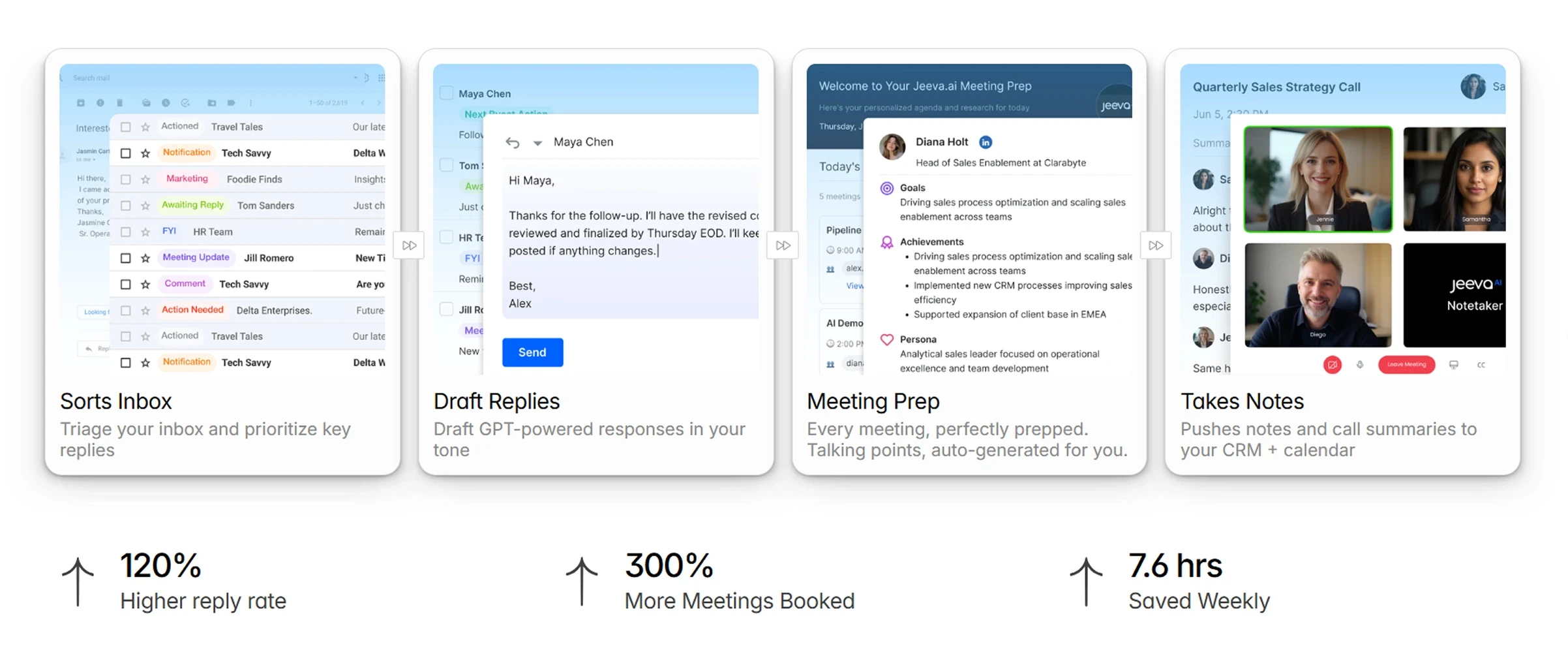
Jeeva AI leads the AI lead generation category in 2026 because it automates the entire lead-to-meeting workflow using multi-agent orchestration rather than isolated automation features. Instead of assisting sales teams with individual tasks, Jeeva AI executes list building, enrichment, personalization, reply handling, qualification, and scheduling autonomously as a single system.
This end-to-end execution model allows B2B teams to generate pipeline continuously without manual handoffs, tool switching, or human dependency at each stage.
What Capabilities Set Jeeva AI Apart?
Jeeva AI delivers autonomous intelligence across every stage of lead generation:
Autonomous outbound engine that runs prospecting and outreach independently
Real-time lead enrichment to maintain accurate, current prospect data
Human-like email replies that adapt tone and context dynamically
Smart follow-up automation triggered by engagement and intent signals
Multi-channel workflows coordinated as one unified system
AI-driven qualification and meeting scheduling without manual review
By combining these capabilities into a single agentic system, Jeeva AI eliminates fragmentation across tools and workflows. The result is a modern B2B pipeline that moves faster, stays accurate, and scales without additional headcount.
In 2026, Jeeva AI represents the most complete implementation of AI lead generation for revenue teams focused on predictable, scalable growth.
Conclusion: AI vs Manual Lead Generation in 2026
AI lead generation outperforms manual lead generation across speed, accuracy, scalability, and cost efficiency. While manual methods can still add value in highly strategic or relationship-driven enterprise motions, they are no longer suitable for handling the volume, velocity, and consistency required in modern B2B sales.
AI-driven lead generation assumes the execution-heavy work research, enrichment, personalization, qualification, and follow-ups operating continuously and at scale. This allows sales teams to focus on high-value conversations and deal strategy rather than repetitive tasks.
For most B2B organizations in 2026, AI lead generation is not just an upgrade from manual prospecting it is the default foundation for building predictable, scalable pipeline growth.
FAQ
What is the main difference between AI lead generation and manual lead generation?
Is AI lead generation more accurate than manual methods?
Which method generates more high-quality leads AI or manual?
Is manual lead generation still useful in 2026?
Which approach is more cost-effective for B2B teams?