Introduction
AI Sales Agents are becoming central to outbound, lead qualification, enrichment, and customer engagement workflows. But with rapid adoption comes confusion many sales leaders still misunderstand what AI agents can and cannot do.
This article breaks down the most common myths about AI Sales Agents and clarifies how modern agentic AI truly works in real sales environments across the US, UK, CA, AUS, and NZ.
Related Reading:
Agentic AI for Lead Qualification → Agentic AI Lead Qualification
Myth 1: “AI Sales Agents Replace Human Reps”
AI Sales Agents are not built to replace salespeople; they automate tasks that drain time research, enrichment, outreach, follow-ups, and qualification. Humans still handle judgment, negotiation, and relationship-building.
What AI Actually Handles?
Repetitive manual tasks
Multi-channel outreach
Lead triage and qualification
CRM updates
Real-time enrichment
Meeting scheduling
Fact: 81% of US sales leaders say AI frees reps to spend more time on closing, not less.
Myth 2: “AI Sales Agents Cannot Personalize Outreach”
This belief comes from early template-based tools. Modern AI sales agents personalize outreach using real-time data, intent signals, and role-specific context not static templates.
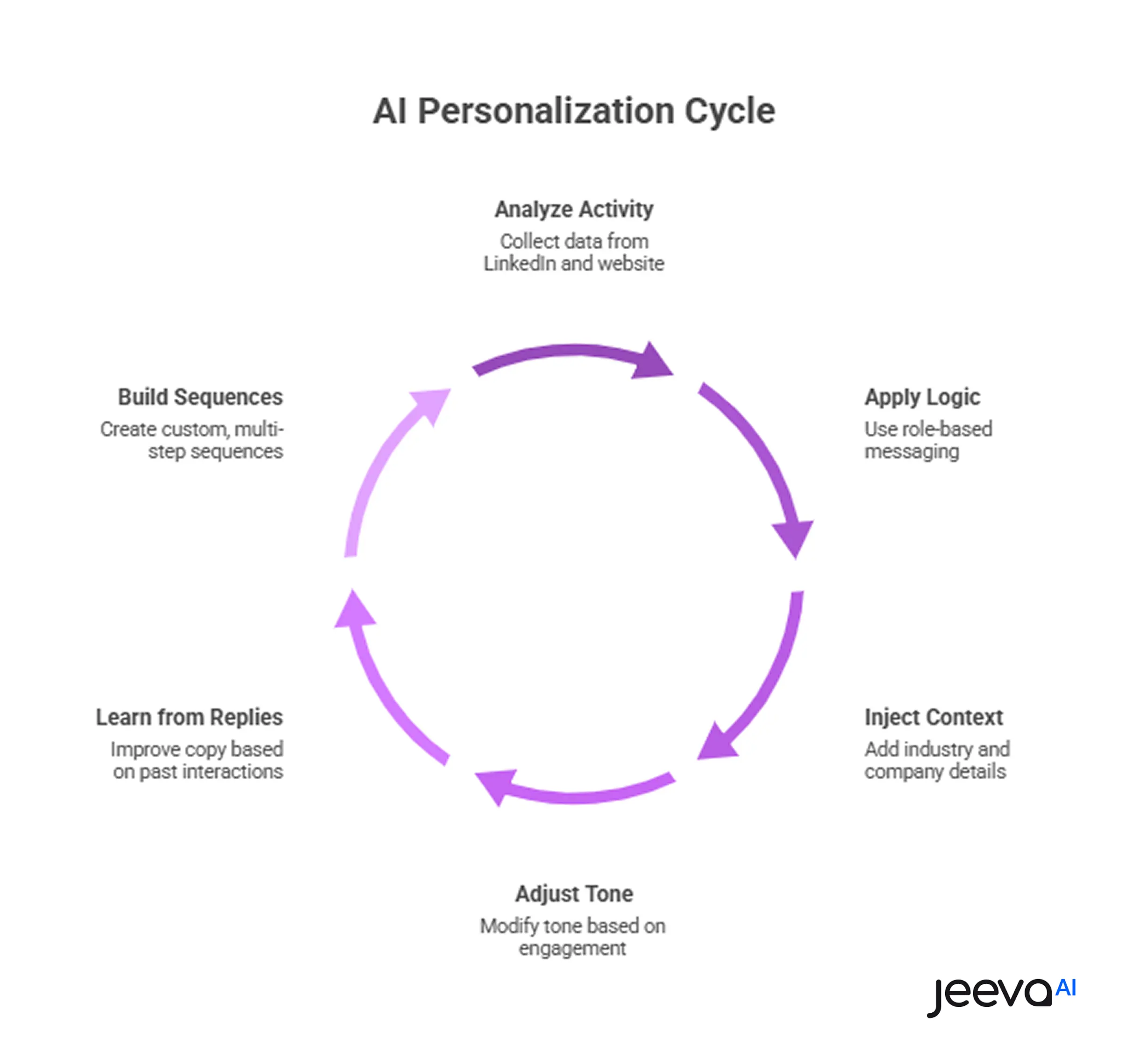
How AI Personalizes at Scale?
Analyzes LinkedIn and website activity
Applies role-based messaging logic
Injects industry and company context
Adjusts tone based on engagement behavior
Learns from past replies to improve copy
Builds custom, multi-step sequences
AI personalization feels human because it is data-driven, contextual, and continuously learning.
Myth 3: “AI Agents Make Too Many Errors to Trust”
This issue is common with single-model tools. Modern agentic AI systems rely on multiple agents, verification layers, and governance rules to ensure accuracy.
Why Modern AI Is More Reliable?
Cross-checks multiple data sources
Validates enrichment before outreach
Enforces compliance filters (e.g., CCPA)
Uses scoring models, not assumptions
Follows rule-based workflows
Escalates edge cases to humans
Fact: Multi-agent systems reduce factual errors by up to 63%, making them enterprise-ready and trustworthy.
Myth 4: “AI Sales Agents Are Only for Large Enterprises”
AI sales agents are no longer limited to enterprises. Modern platforms offer no-code setup, usage-based pricing, and ready-made workflows making them practical for SMBs, mid-market teams, and solo founders.
Why AI Works for All Business Sizes
Usage-based, scalable pricing
No engineering or data teams required
Plug-and-play CRM integrations
Prebuilt ICP, outreach, and scoring templates
Automates work small teams can’t staff
AI levels the playing field by giving smaller teams enterprise-grade execution.
Myth 5: “AI Cannot Understand Buyer Intent”
AI detects intent faster and more accurately than humans by analyzing thousands of behavioral and contextual signals in real time.
Intent Signals AI Tracks
Pricing and comparison page views
Repeat website visits
High-intent content consumption
Email engagement patterns
Social interactions
Competitor research behavior
This allows teams to prioritize leads based on readiness, not guesswork.
Myth 6: “AI Outreach Feels Robotic”
That was true for early tools. Modern agentic AI generates context-aware, human-sounding messages that adapt as conversations evolve.
Why AI Outreach Feels Natural Today?
Writes unique messages per prospect
Adjusts tone to role and behavior
Learns from previous replies
Uses specific, relevant references
Avoids repetition across sequences
Adapts to regional communication styles
The result is outreach that feels thoughtful, timely, and genuinely human.
Myth 7: “AI Agents Are Hard to Integrate With CRMs”
This myth comes from older automation tools that required custom engineering. Modern AI sales agents are built with native CRM integrations, making setup fast and maintenance minimal.
CRMs Most AI Agents Integrate With
HubSpot
Salesforce
Pipedrive
Zoho
Close
Custom APIs
Today’s AI agents sync data bi-directionally, update fields automatically, log activities, and trigger workflows in real time. Integration is typically plug-and-play, not a technical project.
Myth 8: “AI Cannot Qualify Leads Accurately”
This myth assumes AI relies on guesses. In reality, AI lead qualification is more consistent and accurate than manual scoring because it evaluates every lead using the same data-driven logic.
What AI Uses to Qualify Leads?
Firmographic fit (industry, size, region)
Technographic alignment (tools and stack)
ICP match score
Buying intent signals
Behavioral triggers (web, email, content)
Engagement patterns across channels
AI removes human bias, missed signals, and inconsistent judgment. Every lead is scored objectively, in real time, and updated continuously as behavior changes.
Agentic AI for Lead Qualification → Agentic AI for Lead Qualification: Sales Playbook 2026
Myth 9: “AI Creates Compliance Risks”
This concern comes from early, ungoverned automation tools. Modern AI sales platforms are built compliance-first, with controls designed for CCPA, GDPR, and regional privacy laws.
Compliance Safeguards in AI Agents
Data minimization by default
Consent-based outreach filtering
Region-specific rules engines
Privacy and governance controls
Automatic suppression lists
Full activity and audit logs
AI reduces compliance risk by enforcing rules consistently something manual processes often fail to do.
CCPA & State Privacy Laws → CCPA-Compliant Lead Enrichment in the US
Myth 10: “AI Agents Cannot Do Multi-Channel Outreach”
Agentic AI is designed for coordinated, multi-channel execution, not single-channel blasts.
Channels AI Agents Manage
Email outreach
LinkedIn messaging
SMS follow-ups
Website chat conversations
Calendar scheduling
CRM task automation
AI coordinates timing, messaging, and follow-ups across channels, ensuring prospects are engaged where they respond best.
Omnichannel AI Sales Workflows → Multi-Channel Outreach & Automation Engines
What Do Modern AI Sales Agents Actually Do in Real Sales Teams?
Most confusion about AI Sales Agents comes from outdated or limited tools. Today’s agentic AI systems perform full-funnel sales tasks not just email automation.
Core Responsibilities of Modern AI Agents
Prospect research and list building
Real-time lead enrichment
Writing personalized outreach
Managing multi-channel follow-ups
Scoring and qualifying leads
Updating CRM records
Fact: 73% of SaaS teams using AI agents report faster qualification and higher pipeline coverage.
How Do AI Sales Agents Work With Not Against Human Sellers?
AI removes the repetitive work so humans can focus on conversations, strategy, and closing. This collaboration delivers far better performance than either working alone.
What Humans Still Do Better Than AI?
Building trust
Handling objections
Negotiating pricing
Understanding complex situations
Setting strategic direction
Managing enterprise relationships
AI handles the heavy lifting; humans handle the high-value tasks.
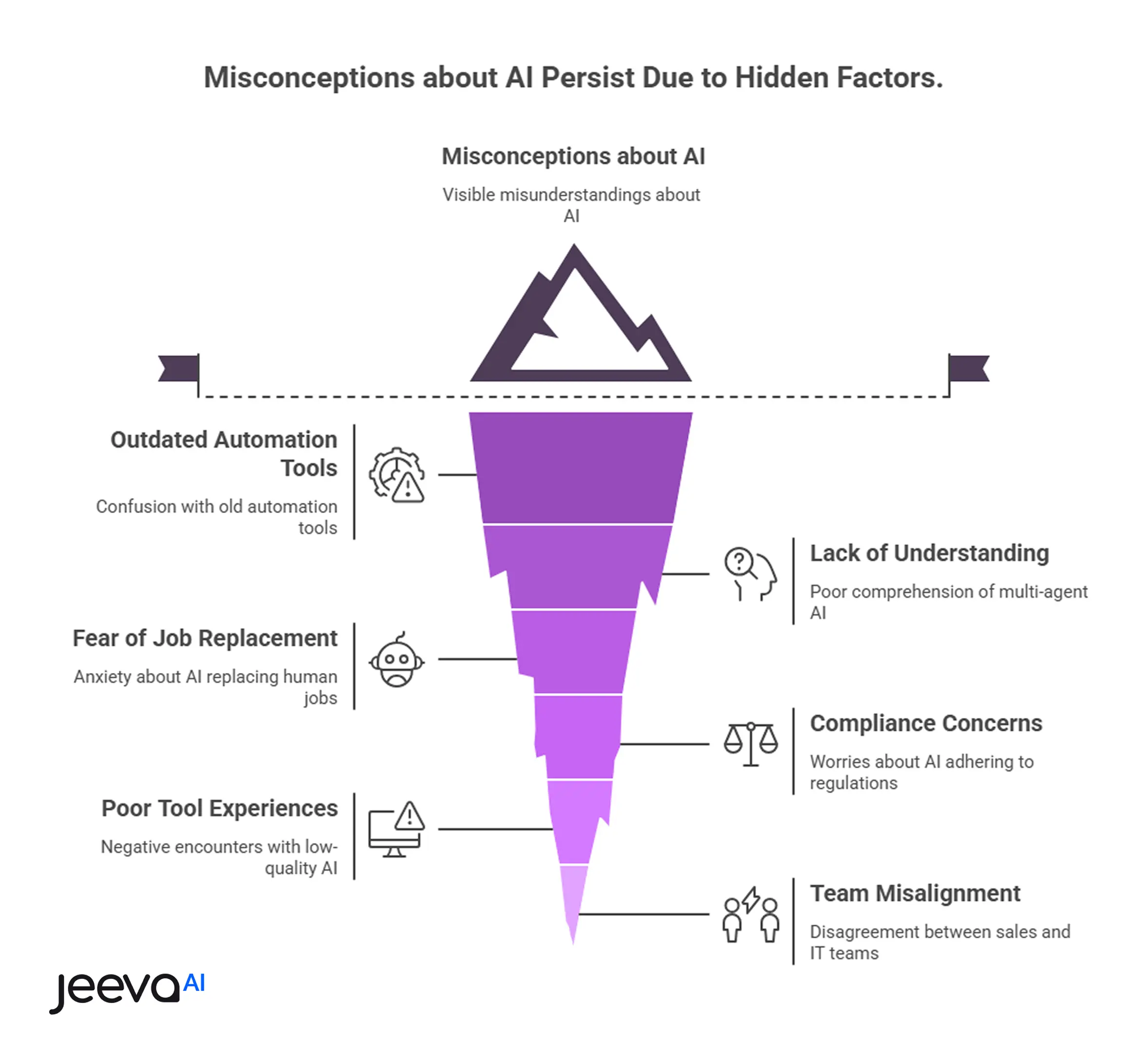
Why Do Myths About AI Sales Agents Still Exist?
Most myths come from early-generation AI tools that were template-based, rigid, or inaccurate. Modern agentic AI is different more autonomous, multi-agent, and context-aware.
Reasons Misconceptions Persist?
Confusion with outdated automation tools
Lack of understanding about multi-agent AI
Fear of job replacement
Concerns about compliance
Poor experiences with low-quality tools
Misalignment between sales and IT teams
These misconceptions disappear once teams test real agentic AI platforms like Jeeva AI.
Conclusion
Most myths about AI Sales Agents come from outdated assumptions. Modern agentic AI is reliable, compliant, multi-channel, and capable of human-grade personalization.
Rather than replacing reps, AI frees teams from repetitive work so they can focus on strategy, conversations, and closing deals.
Platforms like Jeeva AI lead this shift with multi-agent systems that combine enrichment, intent detection, personalized outreach, and qualification into a single automated pipeline.
FAQ
What is the biggest misconception about AI sales agents?
Can AI sales agents personalize outreach effectively?
Are AI sales agents compliant with privacy laws?
Do AI agents work for small and mid-size businesses?
Can AI qualify leads more accurately than humans?