Introduction: How AI Sales Automation Improves Every Stage of the Modern Sales Pipeline?
AI sales automation refers to the use of artificial intelligence to manage and execute key sales pipeline activities with minimal human intervention. Unlike traditional automation tools that rely on static rules, AI-powered systems continuously analyze signals, interpret intent, and adapt actions in real time.
This allows sales pipelines to move faster, stay accurate, and operate consistently across prospecting, outreach, qualification, and deal progression.
For B2B teams, AI sales automation is becoming foundational infrastructure rather than a productivity add-on.
What Is Sales Pipeline Automation?
Sales pipeline automation is the process of using software to control how leads move through defined stages, from initial contact to closed deal. It automates repetitive actions such as lead assignment, follow-ups, stage transitions, and data entry, reducing manual workload for sales teams.
When AI is applied to pipeline automation, the system no longer depends only on predefined rules. Instead, it evaluates behavioral signals, engagement data, and contextual information to determine next actions. This enables pipelines to operate dynamically rather than reactively, improving both speed and accuracy.
Modern sales pipeline automation is increasingly powered by an AI sales agent, which can autonomously handle prospecting, qualification, outreach, and follow-ups while adapting actions based on real-time buyer signals.
Why Does Sales Pipeline Automation Matter for B2B SaaS Teams?
B2B SaaS pipelines typically involve long sales cycles, multiple stakeholders, and high lead volumes. Manual pipeline management often results in delayed responses, inconsistent follow-ups, and inaccurate CRM data. These inefficiencies compound as teams scale.
Sales pipeline automation matters because it standardizes execution across the entire funnel. AI-driven systems ensure that no lead is ignored, every follow-up is timely, and data remains up to date. For SaaS teams, this improves pipeline velocity, forecasting reliability, and revenue predictability without increasing headcount.
To keep pipeline data accurate and up to date, many B2B teams rely on CRM automation for sales, which automatically logs activities, updates records, and advances deals based on real engagement signals.
What Are the Core Components of an AI Sales Automation System?
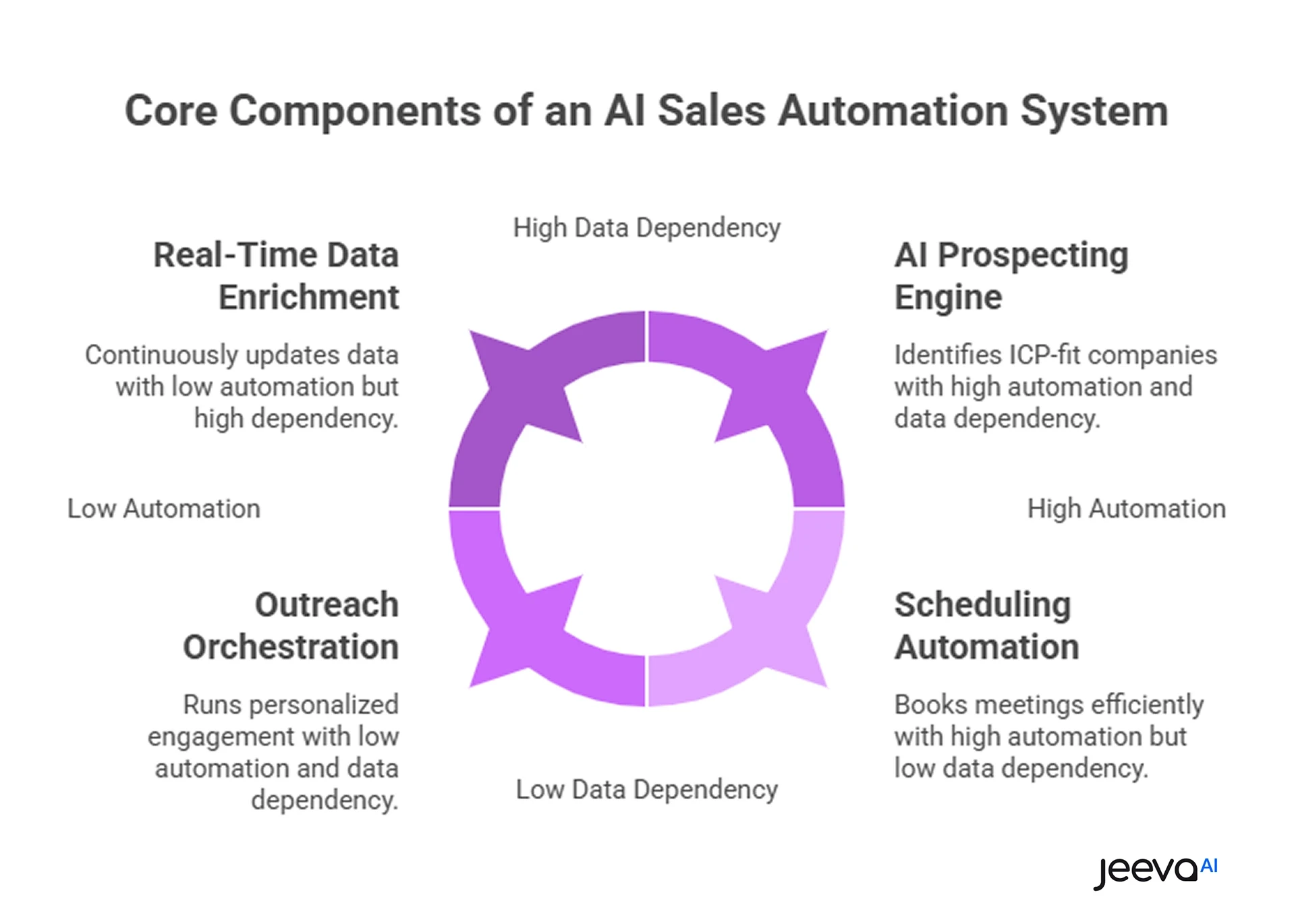
An AI sales automation system is composed of multiple intelligent components that work together to function like an AI Sales Agent, not a single standalone tool. Each component handles a specific part of the sales workflow while sharing context across the entire pipeline.
This coordination allows sales teams to automate execution end to end, rather than optimizing isolated tasks. As buyer behavior, intent, or data changes, the system adapts automatically without manual intervention.
Core Components of an AI Sales Automation System
AI Prospecting Engine: Identifies ICP-fit companies and decision-makers at scale
Real-Time Data Enrichment: Continuously updates contact, firmographic, and technographic data
Outreach Orchestration: Runs personalized, multi-channel engagement across email, LinkedIn, and chat
Conversation & Reply Handling: Interprets responses, intent, and sentiment automatically
Scheduling Automation: Books meetings without back-and-forth
CRM Intelligence Layer: Updates records, scores leads, and maintains pipeline hygiene
Together, these components create a living sales system that behaves like a full-time AI Sales Agent adaptive, contextual, and always-on.
How Does AI Transform Each Stage of the Sales Pipeline?
AI transforms the sales pipeline by replacing manual, stage-based execution with continuous, data-driven decision-making from prospecting through post-sale growth.
Unlike traditional pipelines that rely on static stages, manual updates, and subjective judgment, AI-driven pipelines adapt in real time based on buyer behavior, intent signals, and engagement patterns ensuring momentum is never lost between stages.
How Does AI Improve Prospecting and Lead Generation?
AI reshapes the top of the funnel by identifying high-potential accounts before competitors act. Intelligent systems monitor signals such as hiring trends, revenue shifts, funding activity, and technology adoption to surface early buying intent.
Instead of static contact lists, AI continuously enriches prospect data from multiple sources, giving sales teams up-to-date visibility into decision-makers, priorities, and pain points.
Result: Higher-quality pipeline with less wasted outreach.
How Does AI Enhance Discovery and Needs Assessment?
During live sales conversations, AI-powered intelligence surfaces relevant talking points, competitive context, and objection-handling guidance in real time.
After each call, AI automatically captures notes, updates deal stages, and recommends next steps eliminating hours of manual admin work while maintaining consistent data quality.
Result: Better conversations with zero note-taking overhead.
How Does AI Optimize Proposals and Negotiation?
AI analyzes historical deal data to identify patterns that lead to wins. Using this insight, it generates customized proposals aligned with pricing, messaging, and terms proven to resonate with similar buyers.
At the same time, AI flags risk signals such as stalled engagement, missing stakeholders, or competitive mentions, enabling proactive intervention.
Result: Fewer stalled deals and faster deal cycles.
How Does AI Improve Closing and Post-Sale Growth?
As deals near close, AI assigns probability scores using engagement depth, stakeholder involvement, and past win patterns improving forecast accuracy.
Post-sale, AI continues working by identifying expansion and cross-sell opportunities through product usage, support activity, and contract milestones.
Result: More predictable revenue and account growth.
How Does AI Enhance Each Stage of the Sales Pipeline?
AI enhances the sales pipeline by operating continuously across stages rather than triggering actions only when rules are met. It observes engagement patterns, updates data in real time, and prioritizes leads dynamically. This allows sales workflows to adapt automatically as prospects move through the funnel.
Instead of sales reps managing dozens of manual tasks, AI systems coordinate execution in the background. This creates a more resilient pipeline that responds instantly to buyer behavior and market signals.
Prospecting and Lead Generation Using Agentic AI
Agentic AI systems automate prospecting by continuously identifying ideal customer profiles and monitoring intent signals. Unlike static lead lists, these systems adjust targeting criteria based on engagement trends and market changes.
This enables sales teams to source higher-quality leads without repeated manual research. Over time, agentic AI improves prospect relevance by learning which profiles convert most effectively.
At the top of the pipeline, AI lead generation enables teams to continuously identify and prioritize high-intent prospects without manual list building.
Lead Enrichment and Data Verification at Scale
AI-powered enrichment tools continuously append and verify lead data, including job roles, company size, and contact details. This prevents data decay, which is a common issue in fast-moving B2B markets.
Real-time enrichment ensures that outreach is based on accurate, current information. As a result, personalization improves and bounce rates decline across the pipeline.
Accurate pipeline execution depends on real-time lead enrichment, which keeps contact, company, and intent data continuously updated as prospects move through stages.
Automated Outreach Across Email, LinkedIn, and CRM
AI-driven outreach systems manage messaging across multiple channels while maintaining consistent timing and personalization. They adjust follow-up cadence based on opens, replies, and inactivity signals.
This removes the need for reps to manually track engagement while ensuring that prospects receive timely and relevant communication throughout the buying journey.
Outreach execution improves significantly with AI outbound sales, where messaging, follow-ups, and channel selection are dynamically adjusted based on engagement behavior.
AI-Based Calendar Scheduling and Meeting Booking
AI scheduling agents automatically handle meeting coordination by identifying availability, sending booking links, and confirming appointments. If meetings are ignored or rescheduled, the system follows up without human involvement.
This reduces friction between interest and conversation, improving conversion rates from engagement to booked meetings.
To reduce friction between interest and conversation, many teams rely on AI meeting scheduling to automatically book, confirm, and reschedule sales meetings.
CRM Hygiene and Deal Progression Automation
AI systems play a critical role in maintaining CRM accuracy by removing the need for manual data entry and subjective updates. Every interaction emails, replies, meetings, and engagement signals is automatically logged and reflected in the pipeline.
Deals progress through stages based on verified activity rather than rep interpretation, reducing inconsistencies across teams. This ensures that pipeline visibility remains accurate even as lead volume and deal complexity increase.
As a result, forecasting improves, RevOps reporting becomes more reliable, and sales leaders gain a real-time view of pipeline health without chasing updates.
How Is AI Sales Automation Different from Traditional Sales Tools?
Traditional sales tools rely on predefined rules and manual oversight to execute workflows such as follow-ups, lead scoring, and CRM updates. These systems work only when conditions are explicitly programmed and regularly maintained by sales teams.
AI sales automation differs because it continuously evaluates real-time engagement signals, contextual data, and buyer behavior to determine next actions autonomously. Instead of waiting for human input or static triggers, AI adapts execution dynamically as the pipeline evolves.
The result is higher autonomy, fewer execution gaps, and pipelines that progress based on actual buyer intent rather than predefined assumptions.
Comparison Table: Traditional Sales vs AI Sales
Capability | Traditional Sales Tools | AI Sales Automation |
|---|---|---|
Workflow logic | Rule-based | Context-aware |
Lead prioritization | Static scoring | Dynamic signals |
Outreach execution | Manual sequences | Autonomous |
CRM updates | Manual | Continuous |
Scalability | Headcount-dependent | System-driven |
When Should Companies Move from Sales Automation to AI Sales Automation?
Companies should move to AI sales automation when traditional sales automation starts limiting speed, accuracy, and scalability. Basic automation works well for simple, repeatable tasks, but it breaks down as pipelines grow more complex and buyer behavior becomes harder to predict.
At this stage, static rules and manual oversight create friction instead of efficiency.
Clear Signs It’s Time to Upgrade
Follow-ups are inconsistent or missed across channels
CRM data becomes outdated or unreliable
Leads fall through handoffs between SDRs, AEs, and RevOps
Pipeline visibility declines as volume increases
Personalization drops as outreach scales
AI-driven systems are especially valuable when lead volume rises, deal cycles lengthen, or teams operate across email, LinkedIn, chat, and inbound channels simultaneously. Unlike rule-based automation, AI adapts in real time adjusting messaging, prioritization, and next steps automatically.
Bottom line: When growth demands adaptability instead of fixed rules, moving from sales automation to AI sales automation becomes a strategic necessity, not an upgrade.
What Results Can B2B Sales Teams Expect from AI Pipeline Automation?
B2B sales teams using AI pipeline automation typically see faster execution across every stage of the funnel. AI responds instantly to buyer actions, reducing delays that often cause leads to go cold. Engagement improves because follow-ups, qualification, and routing happen at the right time with consistent accuracy.
Manual workload drops as repetitive tasks like data updates, scoring, and reminders are handled autonomously. Pipeline movement becomes more predictable, with fewer stalled deals and missed handoffs. Over time, cleaner data and continuous execution improve forecast accuracy and overall revenue reliability across most B2B environments.
What Are the Best Practices for Implementing AI Sales Automation?
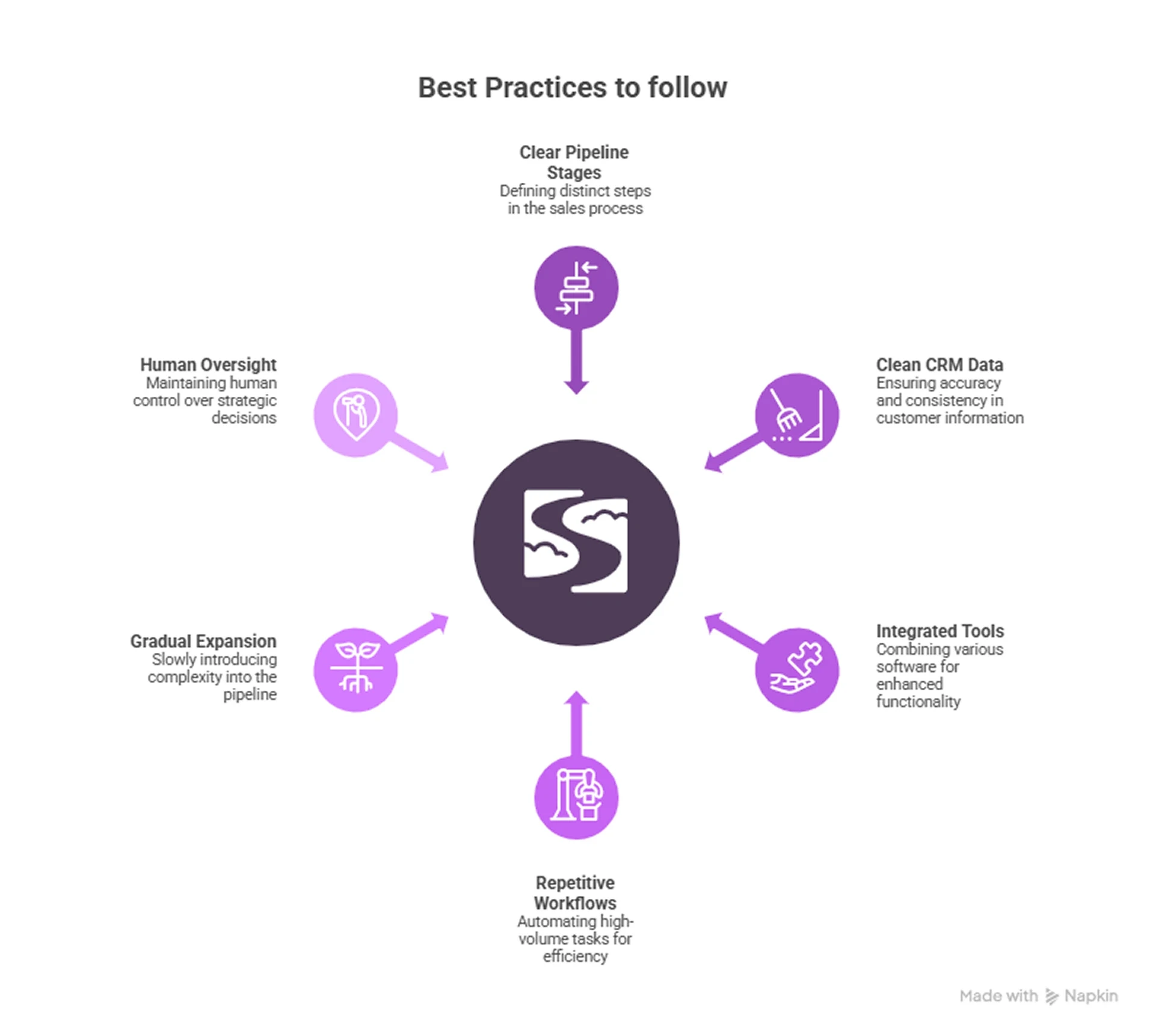
Successful AI sales automation starts with process clarity and data readiness. Teams should clearly define pipeline stages, ownership, and success metrics before introducing AI. Clean, well-structured CRM data is essential, because AI decisions are only as good as the data they learn from.
Integration with enrichment, email, and engagement tools ensures AI has full context across the funnel. It is best to begin with repetitive, high-volume workflows where automation delivers immediate impact. As confidence grows, AI can expand into qualification, personalization, and conversation handling.
Human teams should remain focused on strategy, governance, and edge cases.
Best Practices to Follow:
Define clear pipeline stages and KPIs
Clean and standardize CRM data first
Integrate enrichment and engagement tools
Start with repetitive, high-volume workflows
Expand gradually into complex stages
Keep humans in strategic oversight roles
When implemented this way, AI sales automation delivers predictable gains without disrupting existing GTM operations.
How Does Jeeva AI’s All-in-One Agentic Architecture Work?
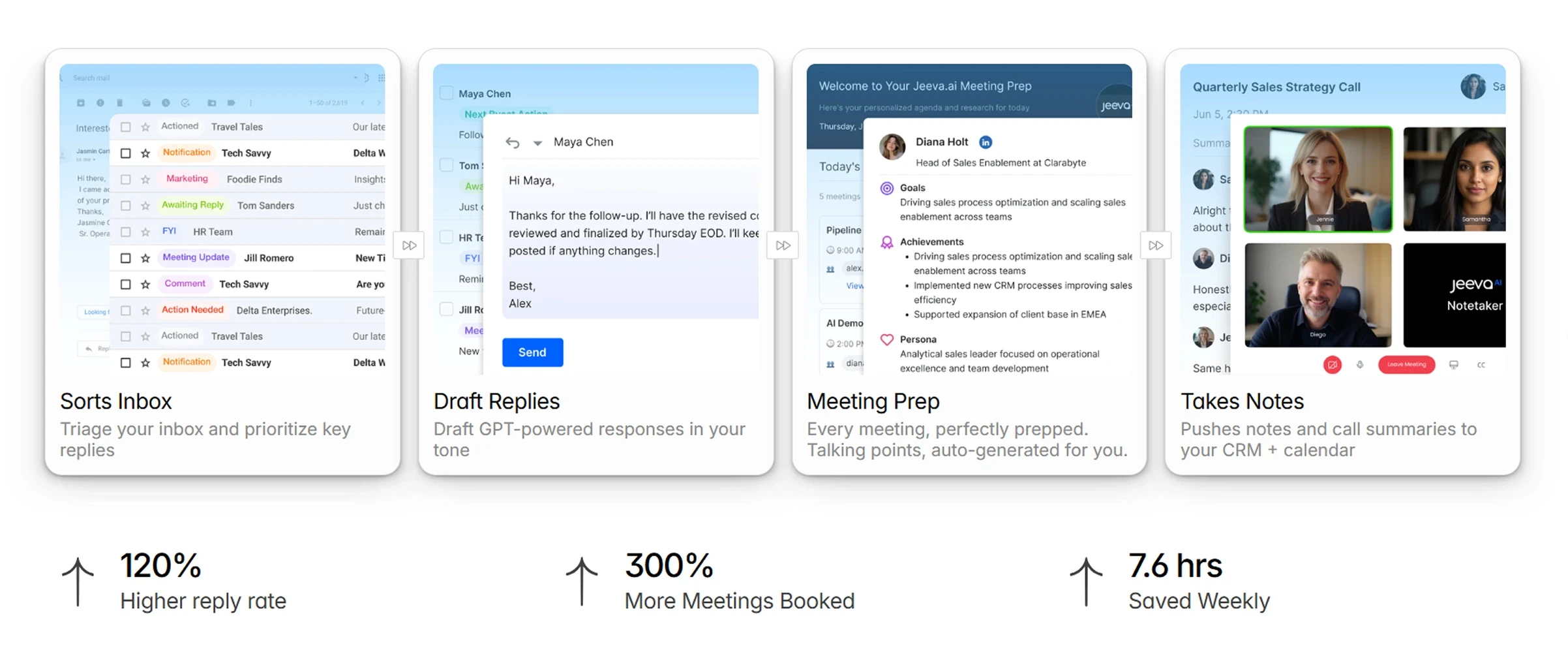
Jeeva AI is built as a unified, multi-agent system that runs the full GTM motion autonomously. Each agent has a defined role and collaborates in real time to remove handoffs, delays, and data gaps. This architecture lets teams manage outbound, inbound, enrichment, scheduling, and intelligence capture from a single platform.
Every action is context-aware, compliance-ready, and CRM-synced. The outcome is continuous pipeline execution without manual orchestration.
Core Agents in the Architecture
Outbound Agent: Runs personalized, multi-channel outreach sequences
Inbound Concierge: Qualifies inbound leads instantly and routes them correctly
Enrichment Agent: Keeps contact and company data fresh in real time
Calendar Agent: Automates meeting scheduling without back-and-forth
Notes Agent: Captures, summarizes, and logs meeting intelligence
Explore Full Solutions: Sales | Marketing | RevOps
Side-by-Side Comparison Table
Feature | Traditional Automation | Agentic AI (Jeeva AI) |
Logic | Predefined static rules | Dynamic, real-time decision-making |
Goal | Task completion | Pipeline/revenue outcomes |
Adaptability | Low – needs manual updates | High – adapts instantly to new data |
Learning | Manual A/B testing | Continuous self-learning |
Recovery | Limited, manual rerouting | Automatic enrichment + retry |
Multi-Channel Orchestration | Basic, fixed order | Adaptive across email, LinkedIn, voice, calendar |
Personalization | Token-based merge fields | Contextual, data-driven personalization |
Conclusion
AI sales pipeline automation shifts sales execution from manual effort to autonomous operation. By enhancing prospecting, enrichment, outreach, scheduling, and CRM management, AI enables B2B teams to move deals faster, maintain cleaner data, and scale revenue operations efficiently.
As sales complexity increases, AI-driven pipeline automation is becoming foundational infrastructure rather than an optional enhancement.
FAQ
What is AI sales pipeline automation?
How is AI pipeline automation different from sales automation?
Can AI sales automation replace SDRs?
Is AI pipeline automation suitable for small teams?
Does AI sales pipeline automation work with complex, multi-stakeholder deals?