Introduction to AI Sales Agent
Choosing an AI Sales Agent is no longer about whether AI works, it’s about which platform delivers the highest performance, reliability, and ROI. Companies now use structured evaluation frameworks to analyze how well an agent can research, enrich, personalize, follow up, qualify, and schedule meetings autonomously. The goal is to find an AI agent that behaves like a consistent, intelligent digital SDR.
This article outlines the decision-making framework modern teams use to select the right AI Sales Agent in 2026.
What Do Companies Look for When Evaluating AI Sales Agents?
Companies start by assessing the agent’s ability to autonomously perform real sales tasks not just write emails. The evaluation covers adaptability, accuracy, compliance, personalization depth, and integration with the existing revenue stack.
Core Evaluation Criteria
Accuracy of data and outreach
Ability to understand replies
Consistency in multi-channel workflows
Quality of personalization
Real-time enrichment and intent scoring
Integration flexibility with CRM and tools
Organizations seek AI agents that perform reliably in real sales environments not just demos.
Why Is Accuracy the Number one Evaluation Factor?
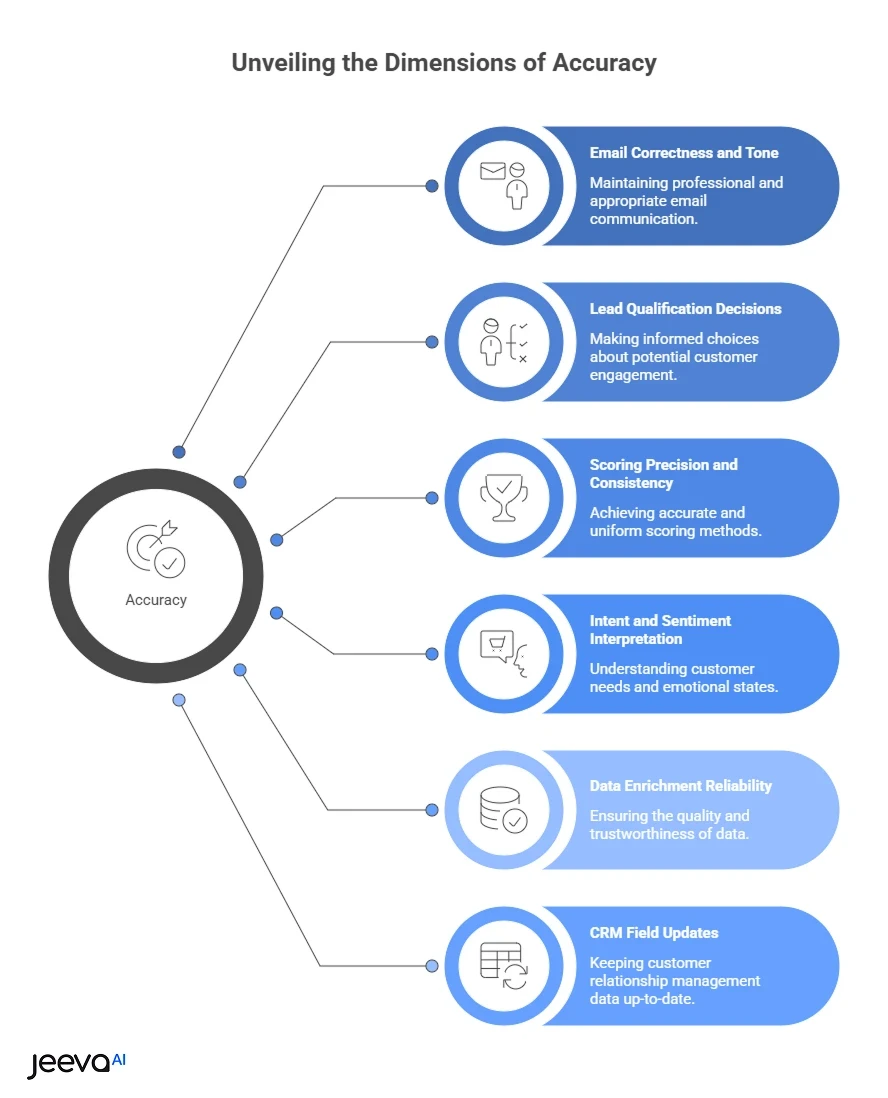
Accuracy is the foundation of trust in any AI sales agent. If the AI sends incorrect messages, misreads intent, or updates the CRM wrongly, it directly harms brand credibility and pipeline quality. Companies evaluate accuracy because even small errors can scale quickly when AI operates autonomously.
High accuracy ensures leads are contacted with the right message, at the right time, with the right context. It also reduces the need for human oversight and rework.
In practice, accuracy determines whether AI is a risk or a reliable growth engine.
Accuracy Must Cover Multiple Areas
Email correctness and tone
Scoring precision and consistency
Intent and sentiment interpretation
CRM field updates
Data enrichment reliability
An accurate AI agent lowers operational risk and increases sales confidence.
How Important Is Personalization Quality in Evaluation?
Personalization quality is a key differentiator between basic automation and true agentic AI. Companies assess how well the AI understands buyer context, not just surface-level fields. Strong personalization increases reply rates, trust, and meeting conversions.
Poor personalization, even if automated, feels generic and reduces engagement. Modern buyers expect relevance in every interaction. As a result, human-level personalization is no longer optional, it is the baseline.
Personalization Elements Companies Check
Role-specific references
Company and industry context
Intent-based messaging
Use of website or behavior signals
Tone alignment with persona
Message variation across sequences
Deep personalization signals intelligence, not automation.
Why Do Companies Evaluate Multi-Channel Capabilities?
Buyers no longer engage on a single channel, and sales teams must follow that behavior. Companies evaluate whether AI agents can operate consistently across email, LinkedIn, chat, SMS, and scheduling.
Multi-channel capability ensures no lead goes cold due to channel mismatch. It also allows AI to adapt follow-ups based on where the buyer responds best.
Platforms that isolate channels create fragmented experiences. Unified, cross-channel AI delivers better engagement and conversion.
Channels Evaluated
Email outbound
Chat-based qualification
SMS follow-ups
Website conversational agents
Calendar scheduling
Companies prefer AI agents that orchestrate all channels into one coherent workflow.
How Do Teams Evaluate Integration Strength?
Integration strength determines whether an AI agent can operate smoothly inside an existing sales stack. Companies look for AI that connects deeply with CRMs, enrichment tools, and communication platforms without breaking workflows. Weak integrations cause data mismatches, missed updates, and manual cleanup. Strong integrations allow AI to read from and write back to systems in real time.
This ensures sales data stays accurate and workflows remain uninterrupted. Integration quality directly affects adoption speed and long-term ROI.
Key Integrations Checked
Salesforce
HubSpot
Pipedrive
Clay
Custom API options
Strong integrations ensure seamless handoff between AI-driven execution and human-led selling.
What Is the Role of the Agentic AI Loop in Evaluation?
The agentic AI loop is critical because it defines how intelligently the system operates. Companies evaluate whether the AI can perceive, reason, and act without relying on rigid rules. A strong loop allows the AI to understand context, not just triggers.
It enables the agent to adapt when buyer behavior changes or when data is incomplete. This capability separates true agentic systems from basic automation. Enterprises prioritize platforms where decision-making improves continuously.
What Happens in the Perception Loop
Detects buyer and engagement signals
Understands email replies contextually
Interprets intent and urgency
Determines qualification status
Plans the next best message
Executes the correct action
The perception loop is the intelligence layer that powers autonomous decision-making.
How Do Companies Measure Multi-Agent Orchestration?
Modern agentic platforms rely on multiple specialized agents working together. Companies evaluate how effectively these agents collaborate across the sales workflow. Poor orchestration leads to delays, duplicated actions, or inconsistent data usage.
Strong orchestration ensures each agent hands off work cleanly and at the right time. This allows workflows to scale without increasing error rates. Multi-agent coordination is essential for predictable, enterprise-grade performance.
Factors Reviewed
Speed of agent-to-agent transitions
Consistency of shared data
Accuracy of handoffs
Ability to adapt workflows
Collaboration across agents
Recovery from edge cases
Better orchestration results in fewer errors and more reliable outcomes at scale.
What Compliance Criteria Do Companies Evaluate?
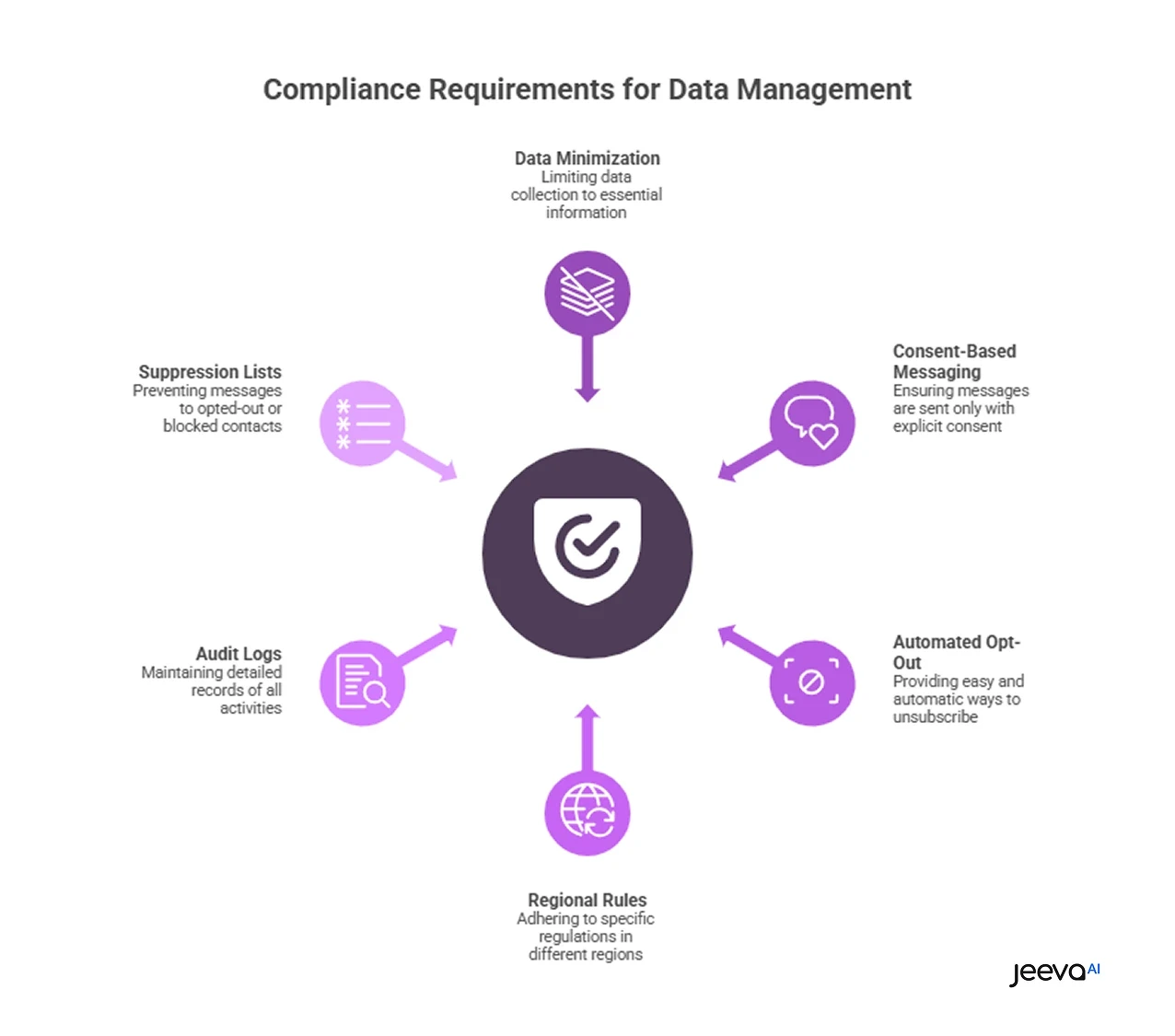
Compliance is a non-negotiable requirement when AI agents operate autonomously at scale. Companies evaluate whether AI platforms can comply with privacy laws such as CCPA, GDPR, CASL, and PECR across regions. They look for built-in safeguards that prevent unauthorized outreach and misuse of personal data.
Strong compliance ensures AI actions remain lawful even as volume increases. It also reduces legal exposure and protects brand reputation. Enterprises prefer AI systems where compliance is enforced automatically, not manually.
Compliance Requirements
Data minimization controls
Consent-based messaging enforcement
Automated opt-out management
Regional sending and routing rules
Detailed audit and activity logs
Suppression list automation
Compliance-first AI reduces risk while enabling safe scale.
Why Is ROI a Critical Evaluation Metric?
ROI determines whether an AI sales agent delivers real business value beyond technical novelty. Companies assess if the platform reduces cost per lead while increasing pipeline output. They evaluate both immediate efficiency gains and long-term revenue impact.
ROI is measured across labor savings, conversion improvements, and pipeline velocity. Platforms that show measurable outcomes gain executive buy-in faster. Without clear ROI, even advanced AI fails to justify adoption.
ROI Factors Measured
Meetings booked per AI agent
Reduction in manual sales hours
Lower outbound cost per lead
Higher email engagement rates
Improved qualification accuracy
Faster pipeline generation
Organizations select AI that delivers revenue impact, not just automation.
How Do Companies Evaluate Response Handling?
Response handling is critical because it determines how accurately AI understands buyers. Companies test whether AI can interpret replies, objections, and conversational nuance correctly. Poor response handling leads to misqualification or missed opportunities.
Strong AI understands timing, intent, and tone across long email threads. It knows when to continue, pause, or escalate to a human. Natural conversation handling builds trust and accelerates deal flow.
Response Handling Tests
Interpreting “not now” responses
Classifying objection types
Detecting genuine buying interest
Managing multi-thread conversations
Handling long reply chains
Escalating complex cases
Teams choose AI agents that communicate naturally, not mechanically.
Which Metrics Matter Most When Evaluating AI Sales Agents?
Companies evaluate AI sales agents using metrics that directly reflect pipeline impact, efficiency, and accuracy. Vanity metrics alone are not enough leaders want proof that AI improves outcomes, not just activity.
The most important metrics show whether the agent reaches the right buyers, engages them meaningfully, and converts interest into meetings.
Teams also assess cost efficiency to understand long-term ROI. Strong AI agents consistently outperform manual efforts across these indicators. Together, these metrics provide an objective way to compare tools and justify adoption.
Evaluation Factors by Priority
Evaluation Area | Priority Level | Reason |
|---|---|---|
Accuracy | Very High | Impacts brand trust & outcomes |
Personalization | High | Drives replies & conversions |
Compliance | High | Required for legal safety |
Integration | Medium | Needed for workflow efficiency |
Multi-channel | Medium | Impacts engagement |
Cost | Medium | Affects budget & ROI |
Essential Metrics
Email open rate - Measures subject-line relevance and deliverability
Reply rate - Indicates message resonance and timing
Positive reply rate - Shows buyer interest quality
Qualification accuracy - Confirms correct lead scoring
Meetings booked - Reflects real pipeline contribution
Cost per meeting - Measures efficiency and ROI
These metrics offer clear, measurable proof of how effective an AI sales agent truly is.
AI Agent Evaluation Checklist
Criteria | Sales Automation | Agentic AI |
|---|---|---|
Reasoning | ❌ | ✅ |
Personalization depth | ❌ | ✅ |
Reply handling | ❌ | ✅ |
Multi-agent processing | ❌ | ✅ |
Real-time enrichment | ❌ | ✅ |
Autonomous qualification | ❌ | ✅ |
Why Jeeva AI Scores Highest in Enterprise Evaluations
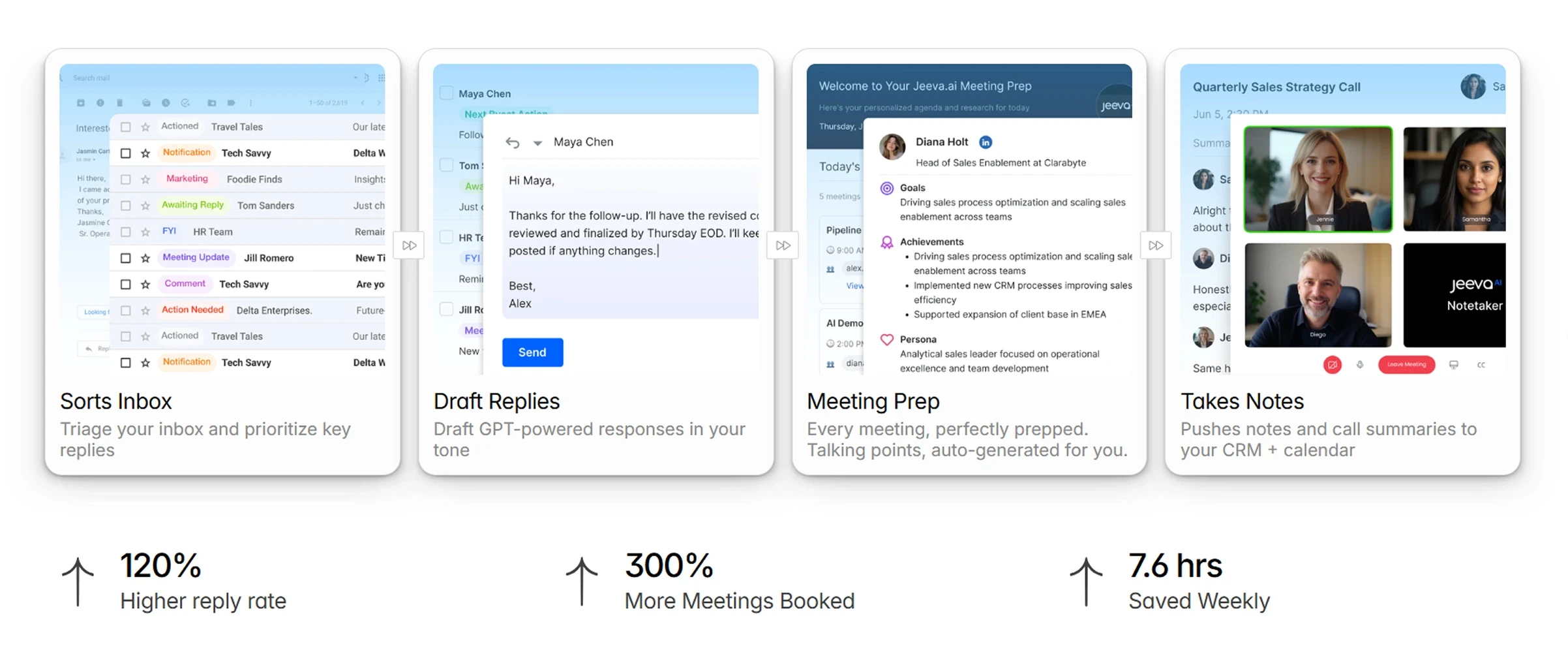
Jeeva AI consistently ranks highest in enterprise evaluations because it delivers true agentic execution, not surface-level automation. Its multi-agent architecture allows different AI agents to collaborate across prospecting, enrichment, outreach, qualification, and scheduling in real time. Enterprises value this because it reduces manual handoffs and operational friction.
Jeeva AI also combines real-time data enrichment with natural, human-like email handling, which improves engagement quality. Strong compliance controls and deep CRM integrations make it suitable for regulated, global environments.
The result is a system that operates like a full sales development team autonomously and reliably.
Jeeva AI Strengths
Multi-agent reasoning and orchestration
Human-like email conversations
Strong CRM and data integrations
Built-in compliance enforcement
24/7 pipeline coverage
Jeeva AI has become the benchmark platform enterprises compare others against in 2026.
Conclusion
Companies evaluate AI Sales Agents on accuracy, personalization depth, compliance readiness, response handling, multi-channel execution, and measurable ROI. Basic automation tools improve efficiency, but they lack adaptability and intelligence.
Agentic AI platforms go further by reasoning through context, acting autonomously, and coordinating end-to-end sales workflows. Platforms that lead such as Jeeva AI combine multi-agent orchestration, real-time data, strong governance, and enterprise reliability.
As GTM teams scale in complexity, agentic AI is becoming foundational sales infrastructure rather than an optional tool.
FAQ
What criteria do companies use to evaluate AI Sales Agents?
How do companies measure the accuracy of an AI Sales Agent?
Why is compliance an important evaluation factor for AI Sales Agents?
What metrics do companies track when evaluating AI Sales Agents?
Why is integration strength part of AI Sales Agent evaluation criteria?