How AI Identifies High-Intent B2B Leads: AI identifies high-intent B2B leads by analyzing digital behavior, enriched data, and engagement patterns to find prospects most ready to buy. Instead of relying on guesswork, AI helps sales teams focus on accounts with real purchase intent.
Introduction : AI Lead Intent Detection
Identifying high-intent B2B leads is one of the hardest parts of sales. Most prospects are not ready to buy, and outreach often gets ignored. But in 2026, AI has changed how teams find the right opportunities.
Today, AI analyzes signals from website visits, email engagement, CRM behavior, search activity, technographics, firmographics, and dozens of micro-interactions instantly highlighting which leads have the strongest intent.
This gives sales teams in the US, UK, Canada, Australia, and New Zealand a clear path to pipeline growth without increasing manual work.
What Is Lead Intent in B2B Sales?
Lead intent in B2B sales refers to the observable actions, behaviors, and signals that indicate a potential buyer’s interest level and readiness to purchase. Unlike firmographic or demographic data, intent focuses on what the buyer is actively doing right now, revealing where they are in the buying journey.
Fact: Around 70% of high-intent actions happen before a prospect contacts a sales rep, which makes early intent detection critical for timely outreach and prioritization.
Intent data helps sales teams move from guessing interest to engaging buyers at the moment of evaluation.
Signs of Lead Intent
Pricing page visits: Signals budget consideration and buying readiness.
Long time on feature pages: Indicates deep evaluation of capabilities.
Case study downloads: Shows proof-seeking and vendor validation.
Demo request behavior: Strong indicator of near-term purchase intent.
Engaging deeply with emails: Replies, clicks, or forwards suggest active interest.
Repeat website visits: Confirms ongoing research and comparison.
Outcome: Lead intent turns pipeline prioritization into a data-driven process, allowing sales teams to focus on prospects who are most likely to convert faster and with higher confidence.
How AI Detects Lead Intent Automatically?
AI detects lead intent by continuously analyzing thousands of buyer interactions across channels and identifying patterns that historically lead to conversions. Unlike manual methods, AI evaluates volume, timing, and combinations of signals in real time allowing sales teams to spot high-intent prospects early.
Cause → Effect: More data analyzed → stronger predictions → higher conversion rates.
This removes guesswork and ensures prioritization is based on data, not assumptions.
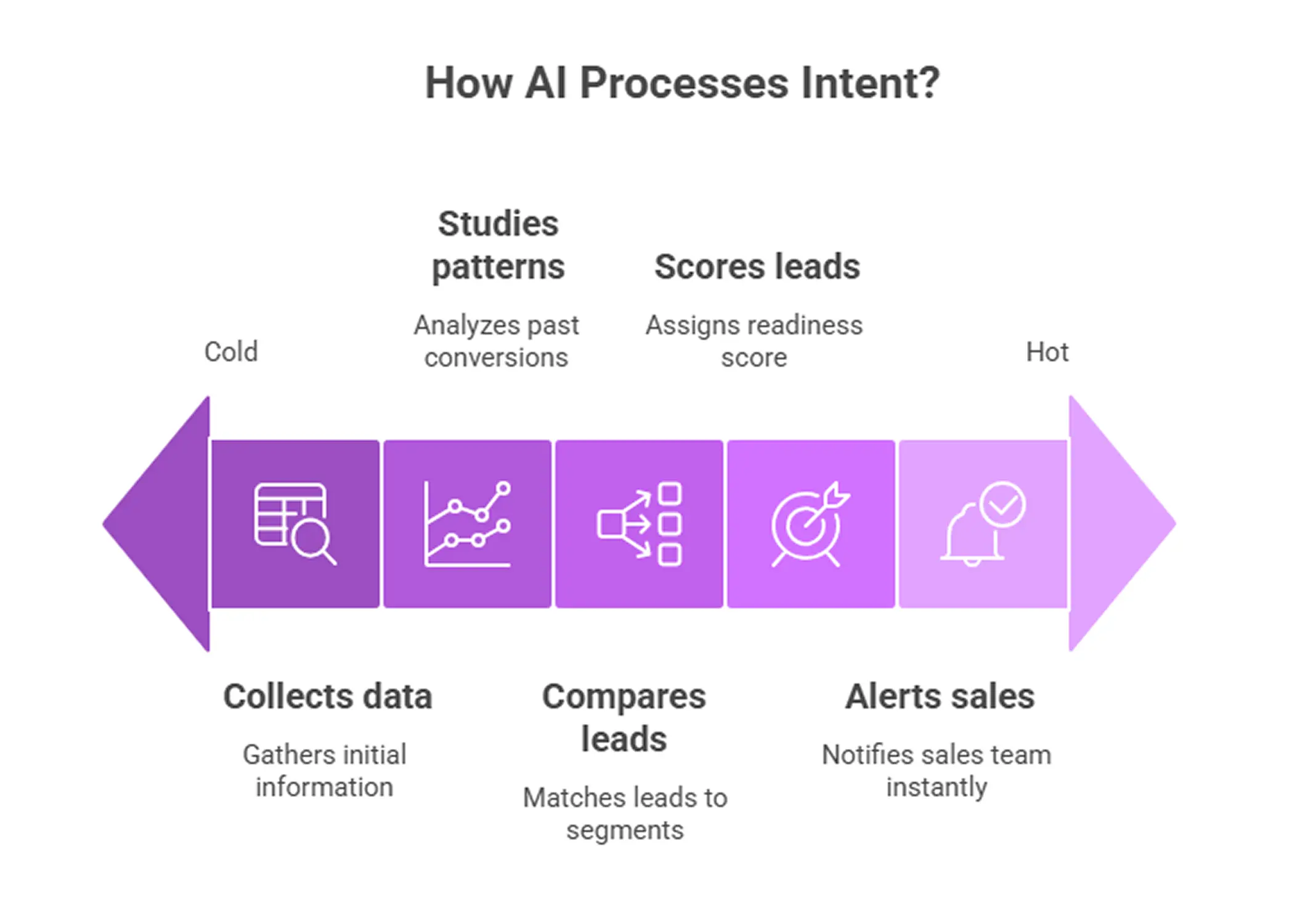
How AI Processes Intent?
Collects behavioral data: Gathers signals from websites, emails, CRM activity, content consumption, and social engagement.
Studies past conversion patterns: Learns which behaviors, sequences, and timing led to closed deals.
Compares leads to high-performing segments: Matches new prospects against profiles that previously converted.
Scores each lead based on readiness: Assigns dynamic intent scores that update as behavior changes.
Alerts sales instantly: Triggers notifications or actions when intent crosses a defined threshold.
Outcome: AI enables sales teams to engage buyers at the moment intent peaks resulting in faster responses, better conversations, and more predictable pipeline growth.
What are Key Data Sources AI Uses to Detect Intent?
AI detects buying intent accurately by combining signals from multiple data systems instead of relying on a single action. Each source adds context about who the buyer is, what they’re doing, and how close they are to a decision. When these signals converge, intent confidence increases significantly.
The strength of AI lies in its ability to connect these data points in real time and act on them immediately.
Main AI Data Inputs:
Website analytics: Tracks pricing visits, feature exploration, repeat sessions, and time spent to identify evaluation behavior.
Email engagement: Analyzes opens, clicks, replies, response speed, and forwards to gauge interest and urgency.
CRM interactions: Monitors stage movement, re-engagement after inactivity, proposal views, and meeting activity.
LinkedIn behavior: Detects profile views, connection activity, message replies, and content engagement.
Firmographic changes: Identifies growth signals like hiring, expansion, or funding that often trigger buying cycles.
Technographic updates: Spots tool adoption, CRM changes, or stack expansion indicating active evaluation.
Recent company events: Captures launches, acquisitions, leadership changes, or market moves that influence purchase timing.
Technographic Prioritization: Technographic Signals to Prioritise Leads in US Enterprise Sales
Outcome: By unifying intent signals across channels, AI builds a reliable, real-time picture of buyer readiness allowing sales teams to prioritize the right accounts, engage at the right moment, and convert intent into pipeline faster.
Website Behavior Signals That Indicate High Intent
Your website is the strongest source of buying-intent data because it captures self-directed buyer research. AI monitors on-site behavior in real time to understand where a prospect is in the decision process and how close they are to purchasing.
Fact: Buyers who visit a pricing page have a 3× higher likelihood to convert than those who don’t.
AI Tracks Behaviors Like:
Viewing pricing or comparison pages: Indicates active evaluation and budget consideration.
Returning multiple times: Signals ongoing research and growing intent.
Watching product demos: Shows hands-on evaluation of capabilities.
Checking documentation or integrations: Suggests technical validation and fit assessment.
High content depth: Long sessions across multiple pages indicate serious interest.
Outcome: Website behavior gives AI clear, early signals of buyer readiness allowing sales teams to engage prospects before competitors and while intent is at its peak.
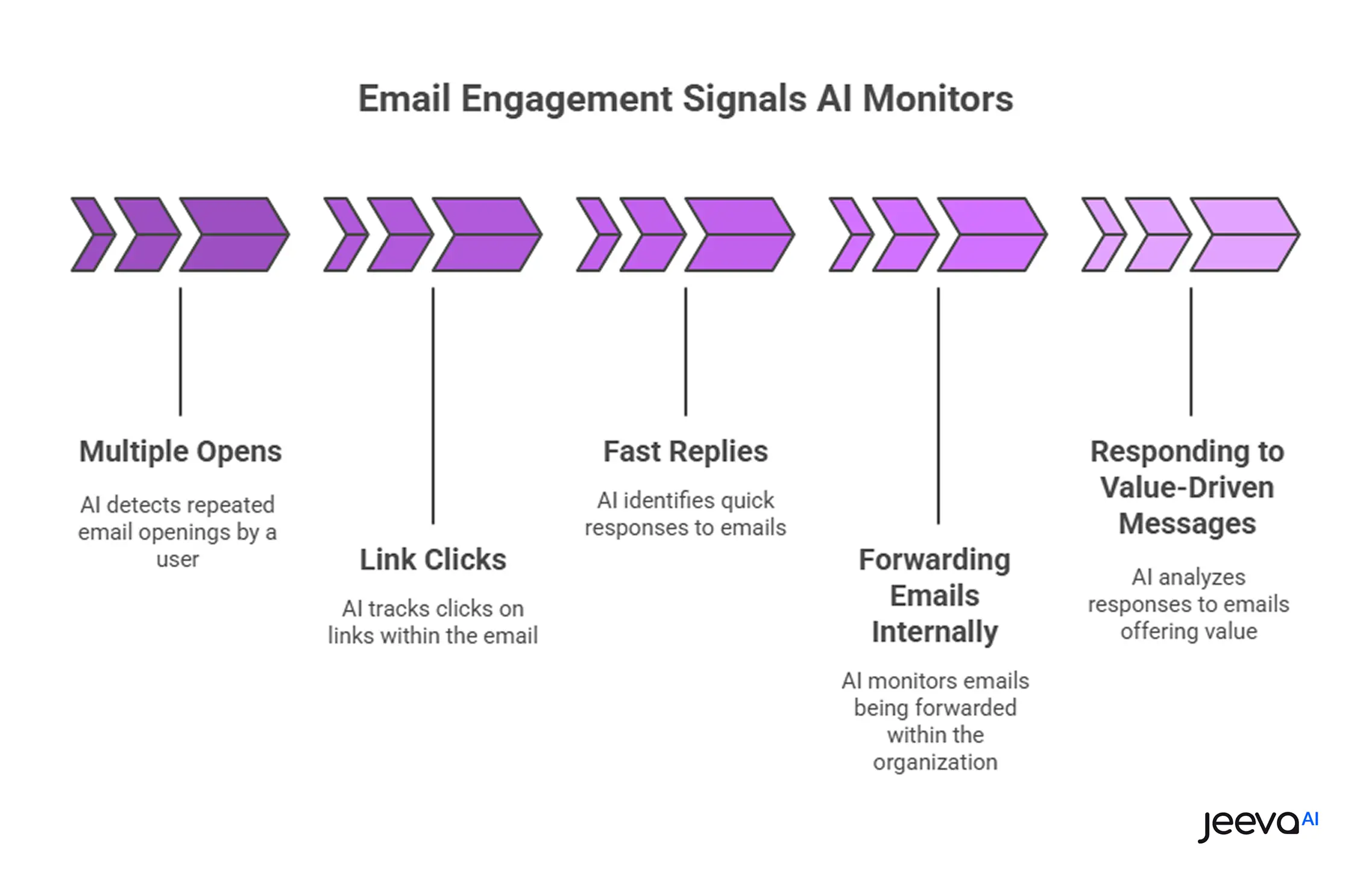
How Email Engagement Signals AI Monitors?
AI evaluates patterns of engagement, not just single actions. By analyzing how prospects interact with emails over time, AI determines interest level, urgency, and buying readiness and updates intent scores in real time.
Signals That Matter
Multiple opens: Indicates sustained interest or internal discussion.
Link clicks: Shows active exploration of product or proof points.
Fast replies: Signals urgency or active evaluation.
Forwarding emails internally: Suggests buying-committee involvement.
Responding to value-driven messages: Confirms relevance of the use case and positioning.
Reference for Email Engagement: AI Cold Email Personalization
Outcome: By focusing on engagement patterns, AI identifies high-intent prospects earlier and prioritizes outreach when buyers are most receptive.
High-Intent Signal Strength Table:
Signal Type | Strength | Examples |
|---|---|---|
High | Strong | Pricing visit, demo request |
Medium | Moderate | Case studies, product pages |
Low | Weak | Blog visit, general info content |
AI Intent Signals vs Traditional Signals
(Shows the difference between how AI detects intent vs what traditional teams look for.)
Category | Traditional Signal | AI-Detected Signal | Strength |
|---|---|---|---|
Website | Page visit | Depth, repeat visits, scroll behavior | High |
Open | Multi-open pattern, link clusters, reply timing | High | |
CRM | Status update | Cross-object engagement + deal velocity | Medium |
Firmographics | Company size | Funding, hiring patterns, leadership changes | High |
Technographics | Tech stack list | Recent tool adoption + replacement signals | Medium |
Social | Likes | Topic interest + post frequency + persona engagement | Low |
Chatbot | Inquiry | Multi-session conversation patterns | High |
Which CRM Activities Indicate Strong Buyer Intent?
CRM activity reflects mid-to-late funnel intent because it captures direct interactions after initial engagement. When these signals appear together or increase in frequency, they strongly indicate that a prospect is moving toward a buying decision.
CRM Intent Clues
Reopening proposals: Signals renewed evaluation or internal review.
Viewing shared materials: Indicates active consideration of pricing, features, or proof.
Scheduling multiple calls: Shows momentum and stakeholder alignment.
Asking pricing questions: Suggests budget discussion and purchase feasibility.
Requesting technical specs: Points to implementation or integration validation.
Outcome: CRM signals help teams prioritize deals that are actively progressing, reducing stalled pipelines and missed follow-ups.
What Firmographic Changes Signal Purchase Intent?
Firmographic changes reveal organizational readiness to buy, often before a prospect explicitly engages sales. AI monitors these changes to surface accounts entering an active buying window.
Firmographic Triggers
Fresh funding: Indicates budget availability and growth initiatives.
Hiring sales or GTM roles: Signals scaling efforts and tooling needs.
New leadership: Often leads to stack evaluation or process changes.
Rapid team expansion: Suggests upcoming demand for systems and automation.
Entering new markets: Triggers requirements for new tools, compliance, or integrations.
Outcome: By acting on firmographic triggers early, sales teams engage accounts at the start of the buying cycle before competitors and while intent is forming.
How Do Technographic Signals Help AI Predict Intent?
Technographic signals reveal what tools a company is using, changing, or replacing, which often signals an immediate business need. AI monitors these changes in real time to identify accounts entering an active buying window often before they engage sales directly.
Technographic Intent Signals
Switching CRMs: Indicates active evaluation and migration planning.
Adopting AI tools: Signals modernization initiatives and budget allocation.
Removing legacy systems: Suggests dissatisfaction and readiness for alternatives.
Adding complementary integrations: Points to expansion or optimization projects.
Updating security tools: Often driven by compliance, risk, or scale changes.
Outcome: Technographic shifts give AI early, high-confidence signals of purchase intent.
How Does AI Track Multi-Channel Intent Across Email, Web, and Social?
AI builds a single, unified intent profile by aggregating signals from every buyer touchpoint. This prevents siloed insights and improves prioritization accuracy.
Fact: Multi-channel tracking increases intent accuracy by 40–50%.
Channels AI Monitors
Website sessions: Depth, frequency, and high-intent pages
Email activity: Opens, clicks, replies, response speed
LinkedIn engagement: Views, replies, and message activity
Social signals: Content interactions and follows
Chatbot interactions: Questions, keywords, and routing
Calendar events: Meeting creation and rescheduling
SMS replies: Urgency and confirmations
Outcome: AI identifies true readiness by correlating behavior across channels not isolated actions.

How Does Predictive Lead Scoring Work in AI Systems?
Predictive lead scoring uses machine learning to estimate conversion probability based on patterns from historical wins and real-time behavior. Scores update continuously as new signals arrive.
Signals Used in Predictive Scoring
Engagement level: Intensity and recency of interactions
Company fit: Firmographics and technographics alignment
Interaction history: Past conversations and materials viewed
Timing signals: Spikes in activity indicating urgency
Funnel position: Stage movement and progression velocity
Outcome: Predictive scoring prioritizes leads most likely to convert now, improving focus, speed, and pipeline accuracy.
AI Intent Detection Tools Compared
Tool | Lead Intent Strength | Data Coverage | Best Use Case |
|---|---|---|---|
Jeeva AI | ⭐⭐⭐⭐⭐ | Behavior + Technographic + Firmographic + CRM | Full-funnel automation & multi-agent intent detection |
Bombora | ⭐⭐⭐⭐ | Company surge data | Account-level intent tracking |
6sense | ⭐⭐⭐⭐ | Behavioral + predictive | Enterprise ABM programs |
Clearbit | ⭐⭐⭐ | Firmographic + website reveal | Enrichment + website identification |
Apollo | ⭐⭐ | Email + basic behavior | Outreach-driven intent scoring |
How Does Agentic AI Improve the Accuracy of Intent Detection?
Agentic AI improves intent accuracy by combining real-time data, multi-agent reasoning, and autonomous action. Unlike static automation that checks isolated signals, agentic systems continuously observe, validate, and correlate behaviors across channels then act immediately when intent spikes.
What Agentic AI Does Better?
Real-time enrichment: Refreshes roles, tech stack, and company changes the moment they occur.
Multi-agent reasoning: Independent agents cross-check signals to reduce false positives.
Personalized outreach: Tailors messages based on current intent, not generic templates.
Automated qualification: Interprets replies, sentiment, and urgency without manual review.
Meeting scheduling: Books meetings instantly when readiness is detected.
CRM automation: Updates fields, stages, and owners in real time to keep data clean.
Outcome: Intent detection becomes continuous, contextual, and action-ready so sales teams engage buyers at the exact moment of readiness.
Why Does Jeeva AI Detect Intent More Accurately Than Other Tools?
Jeeva AI detects intent more accurately because it runs a true multi-agent system that analyzes more signals, across more channels, in real time.
Traditional tools rely on rules or single-model scoring; Jeeva AI orchestrates specialized agents that validate and act on intent together.
Why Jeeva AI Leads the Market?
Real-time data sync: Live updates from CRM, website, email, LinkedIn, and technographics.
Multi-channel signal capture: Unifies email, web, social, chat, calendar, and SMS intent.
Automatic personalization: Adapts messaging instantly based on buyer behavior.
Continuous lead scoring: Scores update dynamically as signals change no batch delays.
Autonomous outreach: Triggers the next-best action without waiting for human input.
Outcome: Jeeva AI turns intent detection into immediate execution delivering higher accuracy, faster engagement, and stronger pipeline performance.
How Does AI Improve Prioritization and Pipeline Quality?
AI improves prioritization by continuously ranking leads based on real-time intent, fit, and engagement, not static rules. Instead of treating all prospects equally, AI highlights who is most likely to convert right now, allowing sales teams to focus effort where it has the highest impact.
By combining signals from website behavior, email engagement, CRM activity, technographics, and firmographics, AI keeps the pipeline clean, current, and conversion-focused.
Pipeline Improvements Enabled by AI
Fewer wasted touches: Outreach is limited to leads showing real buying signals.
Faster deal movement: High-intent prospects advance quickly through stages.
Higher reply rates: Messages align with buyer readiness and context.
Shorter sales cycles: Engagement happens during active evaluation windows.
Better win ratios: Teams spend time on leads with higher conversion probability.
Conclusion
AI has fundamentally changed how sales teams identify, prioritize, and act on buying intent. Instead of relying on guesswork or delayed signals, teams gain a clear, real-time view of buyer readiness across channels.
With platforms like Jeeva AI, intent detection becomes proactive and automated turning prioritization into execution. The result is a stronger pipeline, higher efficiency, and more predictable revenue growth
FAQ
What is AI lead intent detection?
Which intent signals matter most?
What tools offer intent detection?
Why is AI better than manual scoring?
Can AI act on intent signals automatically?