What Is Agentic AI in Lead Qualification?
Agentic AI is a type of AI that can think, decide, and take action on its own. Unlike traditional lead scoring which only assigns points agentic AI qualifies leads by understanding context, behavior, intent, and data signals.
It behaves like a digital analyst: collecting data, scoring leads, asking follow-up questions, updating CRM fields, and deciding whether a prospect is ready for sales.
Fact: Growth teams using agentic AI report a 30–50% increase in SQL accuracy because qualification becomes smarter and more consistent.
Read The Full Article of Agentic AI: Agentic AI in B2B Sales Guide
Why Agentic AI Is Better Than Legacy Lead Scoring
Agentic AI improves qualification by:
Analyzing multiple data sources in real time
Updating scores automatically
Understanding buyer intent signals
Responding to leads without human help
Asking qualifying questions instantly
Syncing decisions back to the CRM
How Does Agentic AI Automate Lead Qualification?
Agentic AI qualifies leads automatically by reading signals, analyzing engagement, running rules, and making decisions. It works in the background, 24/7, without manual effort. This helps sales teams move faster and focus only on high-quality leads.
Fact: Teams using automated qualification save 3–5 hours per rep per day.
The Agentic AI Qualification Flow (Simple Steps)
Agentic AI handles:
Lead enrichment
ICP matching
Intent detection
Conversation scoring
Automatic follow-ups
CRM updates & routing
Traditional Lead Scoring vs Agentic AI Lead Qualification
Feature | Traditional Scoring | Agentic AI |
|---|---|---|
Uses static rules | Yes | No |
Updates in real-time | No | Yes |
Reads conversations | No | Yes |
Detects intent | Limited | Strong |
Automates follow-up | No | Yes |
Syncs with CRM | Manual | Automatic |
Best Real-World Examples of Agentic AI in B2B Lead Scoring
Agentic AI in B2B lead scoring goes beyond static rules or single-model predictions. These systems use multiple autonomous agents that continuously gather data, analyze intent, validate signals, and update lead scores in real time.
Unlike traditional scoring models, agentic AI adapts to buyer behavior, channel signals, and market changes without manual reconfiguration.
In real-world B2B environments, this leads to higher pipeline accuracy, faster response times, and better sales–marketing alignment.
Companies using agentic AI see fewer unqualified handoffs and more sales-ready conversations. Below are proven, real-world implementations showing how agentic AI works in practice.
Example: Multi-Signal Lead Scoring in High-Volume B2B Sales
Agentic AI evaluates leads using multiple agents working in parallel, each responsible for a different signal source.
How it works in practice
One agent analyzes firmographic and ICP match
Another agent tracks behavioral intent (site visits, content, demos)
A third agent validates contact and enrichment data
A decision agent combines insights into a dynamic lead score
What Data Sources Do You Need for Agentic AI Lead Scoring?
Agentic AI lead scoring depends on multiple, continuously updating data sources, not a single CRM field or historical score. Each agent specializes in consuming and validating a different type of signal - fit, intent, engagement, or readiness and then collaborates with other agents to form a real-time decision.
This multi-source approach prevents false positives, adapts to changing buyer behavior, and keeps lead scores accurate throughout the funnel.
The quality of agentic scoring is directly tied to the diversity and freshness of the data feeding it. When one signal weakens, another agent compensates. This is what makes agentic AI resilient and scalable in real B2B sales environments.
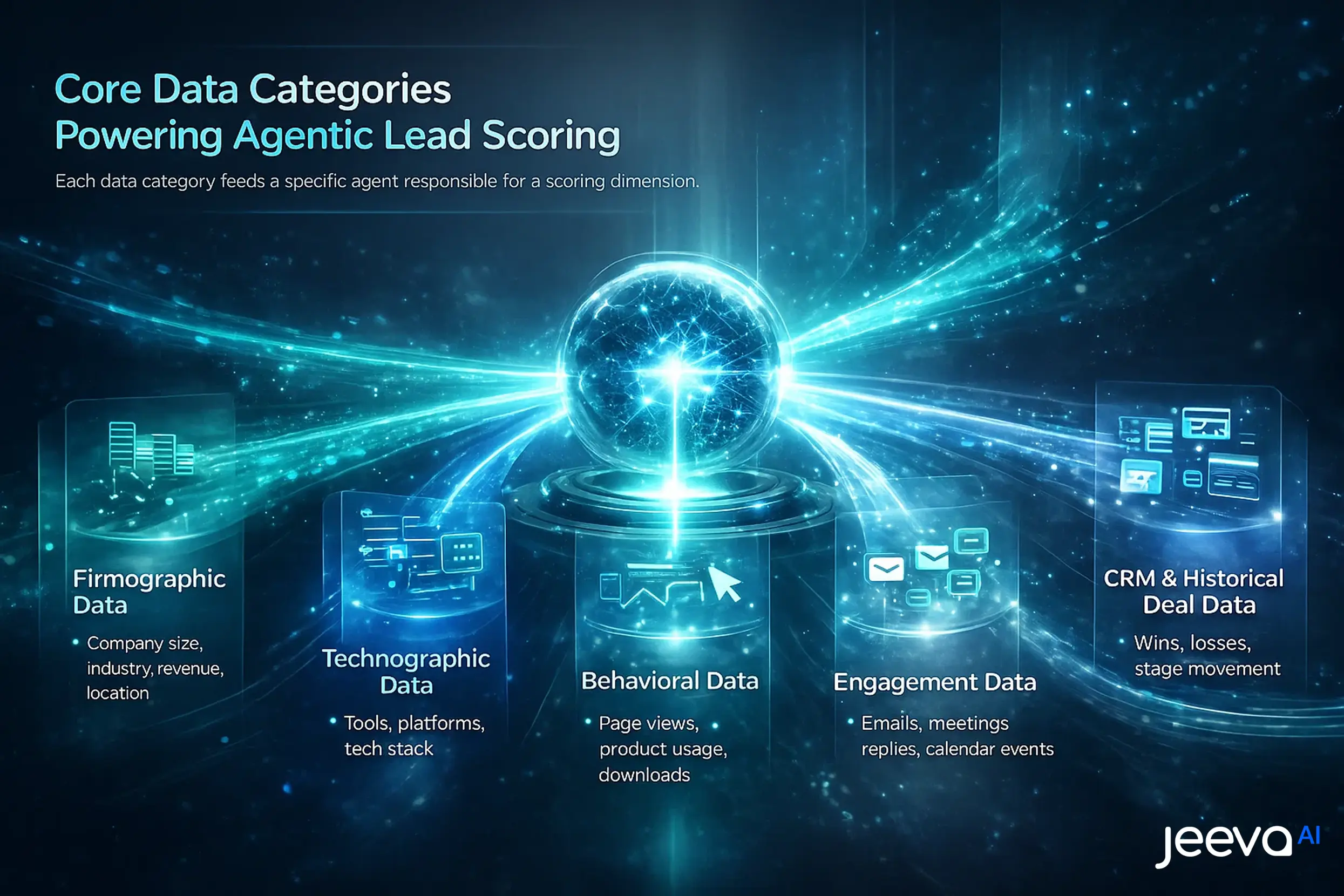
Core Data Categories Powering Agentic Lead Scoring
Each data category feeds a specific agent responsible for a scoring dimension.
Primary data sources required
Firmographic data (company size, industry, revenue, location)
Technographic data (tools, platforms, tech stack)
Behavioral data (page views, product usage, downloads)
Engagement data (emails, meetings, replies, calendar events)
CRM and historical deal data (wins, losses, stage movement)
Intent vs Firmographic Data for SaaS Sales
Why Multi-Source Data Is Critical for Agentic AI
Agentic AI does not rely on any single data source to make decisions. Instead, agents cross-validate signals, resolve conflicts, and update scores continuously. This makes the system explainable, adaptive, and resilient to data gaps.
The result is a lead scoring engine that mirrors how top sales teams think but operates at machine speed. Data diversity is not optional; it is the core enabler of agentic intelligence.
The Agentic AI Advantage
Multiple agents + multiple data sources = better decisions.
What multi-source scoring enables
Real-time score updates
Fewer false positives and negatives
Better sales prioritization
Stronger alignment with revenue outcomes
Continuous self-improvement over time
Lead Enrichment & Real-Time Data for Agentic AI
Data Required for Accurate Agentic AI Scoring
Data Layer | Why It Matters |
|---|---|
Firmographic | ICP fit |
Technographic | Tech compatibility |
Intent Signals | Buyer readiness |
Engagement Behavior | Interest level |
Usage Data | Product-fit evaluation |
CRM Insights | Prior context |
Steps to Implement Agentic AI Lead Qualification in Your CRM
Growth leaders can implement agentic AI lead qualification without heavy engineering or rebuilding their CRM. Modern agentic systems plug directly into tools like Salesforce, HubSpot, or Zoho, where AI agents read existing data, enrich records, score conversations, and take action automatically.
Instead of static workflows, autonomous agents continuously evaluate fit, intent, and readiness as leads move through the funnel.
This eliminates manual updates, reduces human bias, and keeps pipelines clean in real time. Because decisions happen inside the CRM, sales teams don’t need to learn new tools.
Fact: CRM-based agentic AI reduces manual admin work by up to 70%, freeing reps to focus on closing.
Implementation Steps
Follow these steps to activate agentic lead qualification quickly and safely.
Step-by-step rollout
Connect your CRM: (Salesforce, HubSpot, Zoho) to allow agents to read and write lead fields
Import ICP rules so fit agents can qualify accounts automatically
Connect enrichment tools to keep firmographic and contact data fresh
Turn on AI conversation scoring to analyze emails, calls, and meetings
Enable automatic routing so high-intent leads reach reps instantly
Review and refine results weekly using closed-won and closed-lost feedback
KPIs to Measure Success of Agentic AI Lead Qualification
Measuring agentic AI performance requires focusing on outcomes, not just model accuracy. The real value shows up in pipeline velocity, sales efficiency, and conversion quality. Because agentic AI adapts in real time, KPIs should track improvement over time rather than static benchmarks.
Sales teams benefit most when they monitor how quickly qualified leads move through stages and how often reps engage with high-scoring leads. When measured correctly, agentic AI becomes a revenue optimization system, not just a scoring tool.
Revenue-Aligned Metrics That Matter
These KPIs directly reflect the business impact of agentic lead scoring.
Key KPIs to track
MQL → SQL conversion rate
Time-to-first-sales-touch
Pipeline velocity improvement
Close rate by lead score band
Reduction in unqualified sales meetings
Sales Use Cases for Agentic AI in 2026: Powered by Jeeva
Jeeva’s Agentic AI platform assigns specialized AI agents to each sales task, allowing teams to operate continuously, qualify faster, and eliminate manual CRM work.
Each agent observes signals, makes decisions, and takes action autonomously directly inside your CRM.
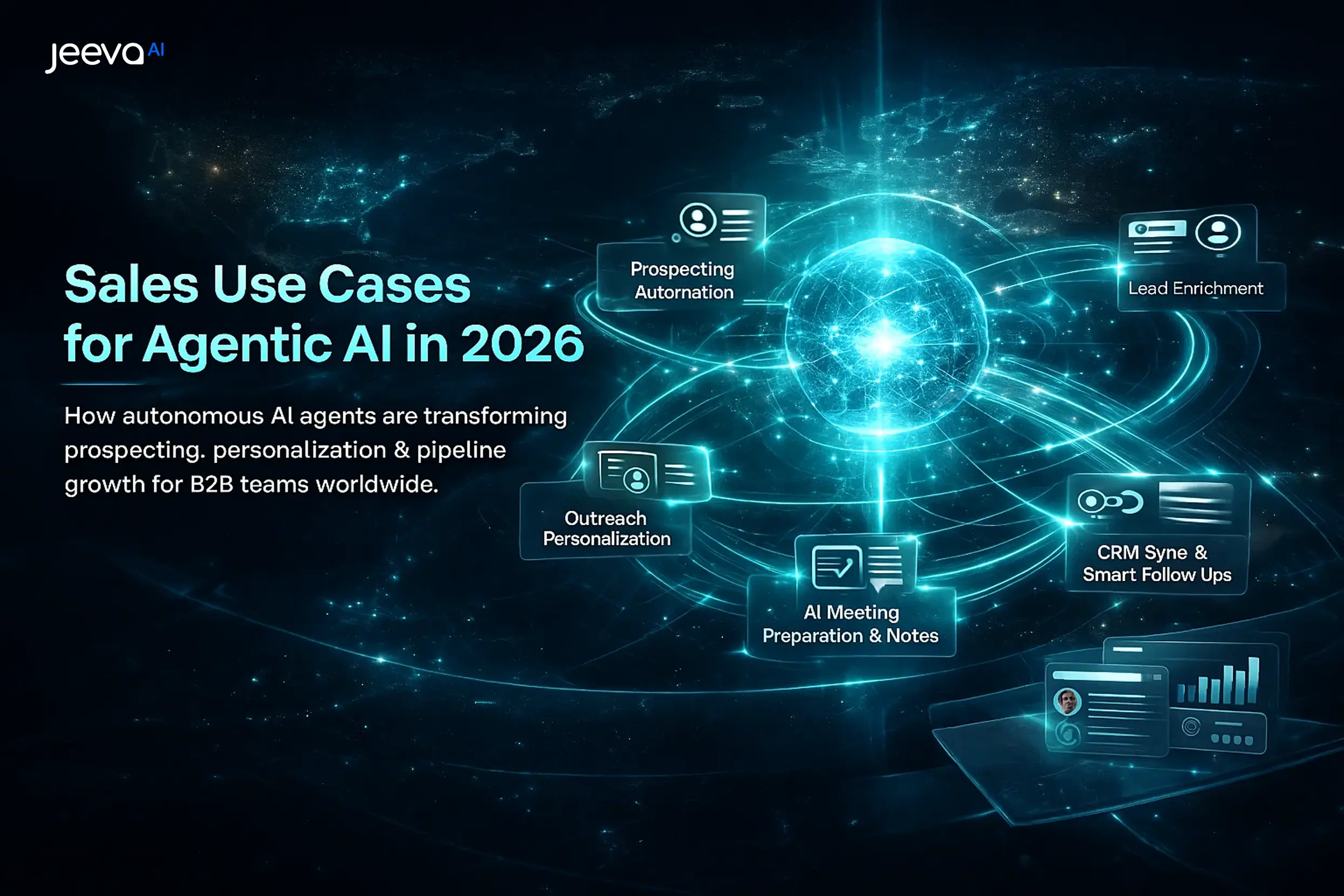
Jeeva Agent Mapping for 2026 Sales Use Cases
Sales Use Case | Jeeva AI Agent | What Happens Automatically |
|---|---|---|
Cold email reply classification | Engagement Intelligence Agent | Classifies replies (interest, objection, referral) and triggers next steps |
Automatic qualification | Fit & Intent Agent | Qualifies or disqualifies leads in real time |
24/7 inbound lead triage | Inbound Response Agent | Monitors forms, chats, emails and responds instantly |
Lead routing by ICP | Decision & Routing Agent | Assigns leads by region, role, and priority |
Product-qualified lead scoring | Product Signals Agent | Scores users based on real usage behavior |
Multi-channel follow-up | Orchestration Agent | Coordinates email, CRM, calendar actions |
Why Jeeva Wins in 2026
Traditional tools automate tasks. Jeeva deploys decision-making agents.
That’s why teams see faster response times, higher conversion, and zero CRM cleanup.
Agentic AI in 2026 supports the full sales cycle by autonomously classifying cold email replies, qualifying leads, triaging inbound demand 24/7, routing leads by ICP, scoring product-qualified leads, and executing multi-channel follow-ups reducing manual work while improving speed, accuracy, and conversion across B2B sales teams.
Four Core Components of an Agentic AI Lead Qualification System
An agentic AI lead qualification system is built around autonomous decision-making, not static rules or one-time scores. Each component represents a capability that allows AI agents to observe signals, reason across data sources, and take action inside the CRM.
Together, these components ensure leads are qualified continuously, accurately, and at scale. Unlike traditional systems, agentic AI adapts as buyer behavior changes and improves with every interaction.
These four components form the foundation of any production-ready agentic qualification engine used by modern B2B sales teams.
1. Signal Intelligence Layer (Data Ingestion & Monitoring)
This layer continuously collects and normalizes signals from multiple sources so agents always work with fresh data.
What it includes
Firmographic and technographic data
Behavioral signals (website, product, content)
Engagement data (email, meetings, replies)
CRM activity and lifecycle events
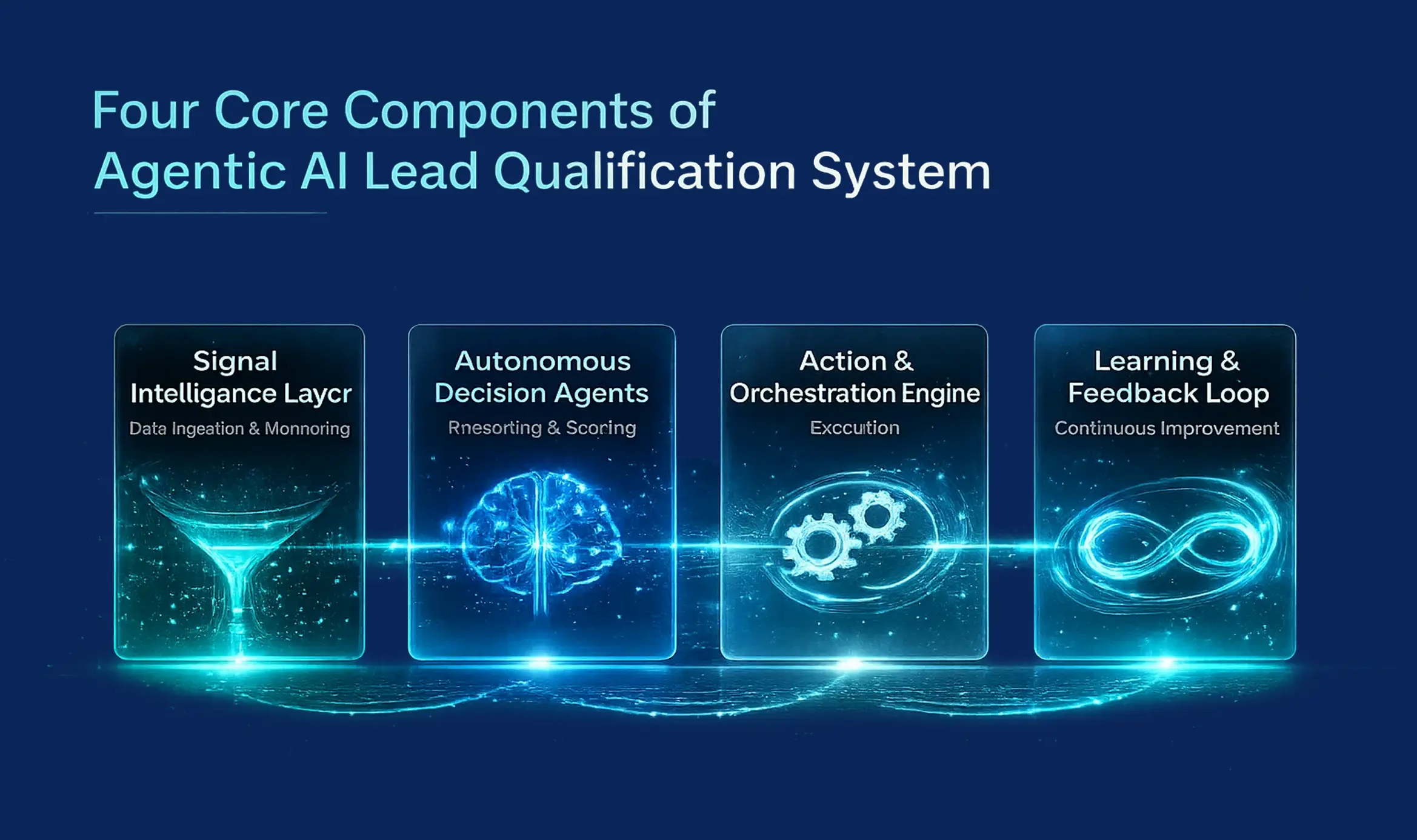
2. Autonomous Decision Agents (Reasoning & Scoring)
Decision agents independently evaluate fit, intent, and readiness, then collaborate to form a real-time qualification outcome.
What agents decide
ICP match and account fit
Buying intent and urgency
Sales readiness vs nurture readiness
Qualification or disqualification status
3. Action & Orchestration Engine (Execution)
Once a decision is made, agents take action automatically inside the CRM and sales tools—without human intervention.
Actions executed automatically
Lead status updates and score changes
Routing to the right rep or team
Task creation, alerts, and follow-ups
Multi-channel outreach coordination
4. Learning & Feedback Loop (Continuous Improvement)
This component ensures the system improves over time by learning from real revenue outcomes.
How learning happens
Analyzes closed-won and closed-lost deals
Adjusts signal weights automatically
Detects false positives and negatives
Aligns qualification logic with revenue, not activity
Why These Four Components Matter
Together, these components turn lead qualification into a living system, not a static workflow. Sales teams get faster response times, higher-quality conversations, and dramatically less manual CRM work - while the AI improves continuously in the background.
Why Jeeva AI Is the Best Agentic AI Platform for Lead Qualification
Jeeva AI is built as a true agentic AI platform, not a rule-based automation tool. It uses multiple specialized AI agents to manage the entire lead qualification workflow - from enrichment and intent detection to scoring, CRM updates, routing, and calendar booking.
Jeeva reads real sales conversations across email and meetings, understands buyer intent, and takes action automatically without human intervention. Unlike traditional AI tools, Jeeva operates continuously inside your CRM, keeping pipelines clean and up to date in real time.
Sales teams no longer need to manually qualify, score, or route leads. Fact: Jeeva AI users report 3× more qualified meetings within the first 30 days of adoption.
Jeeva AI Advantages:
These advantages make Jeeva the most advanced agentic AI platform for sales teams in 2026.
Real-time lead scoring: Leads are scored continuously as new behavioral, engagement, and conversation signals appear- no static rules or delays.
Multi-agent reasoning: Specialized agents independently evaluate fit, intent, and readiness, then collaborate to make accurate qualification decisions.
Autonomous inbox management: Jeeva reads inbound and outbound conversations, classifies replies, detects intent, and triggers the right next action automatically.
Automatic meeting scheduling: High-intent leads are converted into booked meetings instantly using calendar availability and priority rules.
Zero manual qualification: No manual scoring, tagging, routing, or CRM cleanup - Jeeva handles everything autonomously.
Fully compliant (US, UK, CA, AUS): Built with compliance-first architecture to support modern AI regulations and data governance standards.
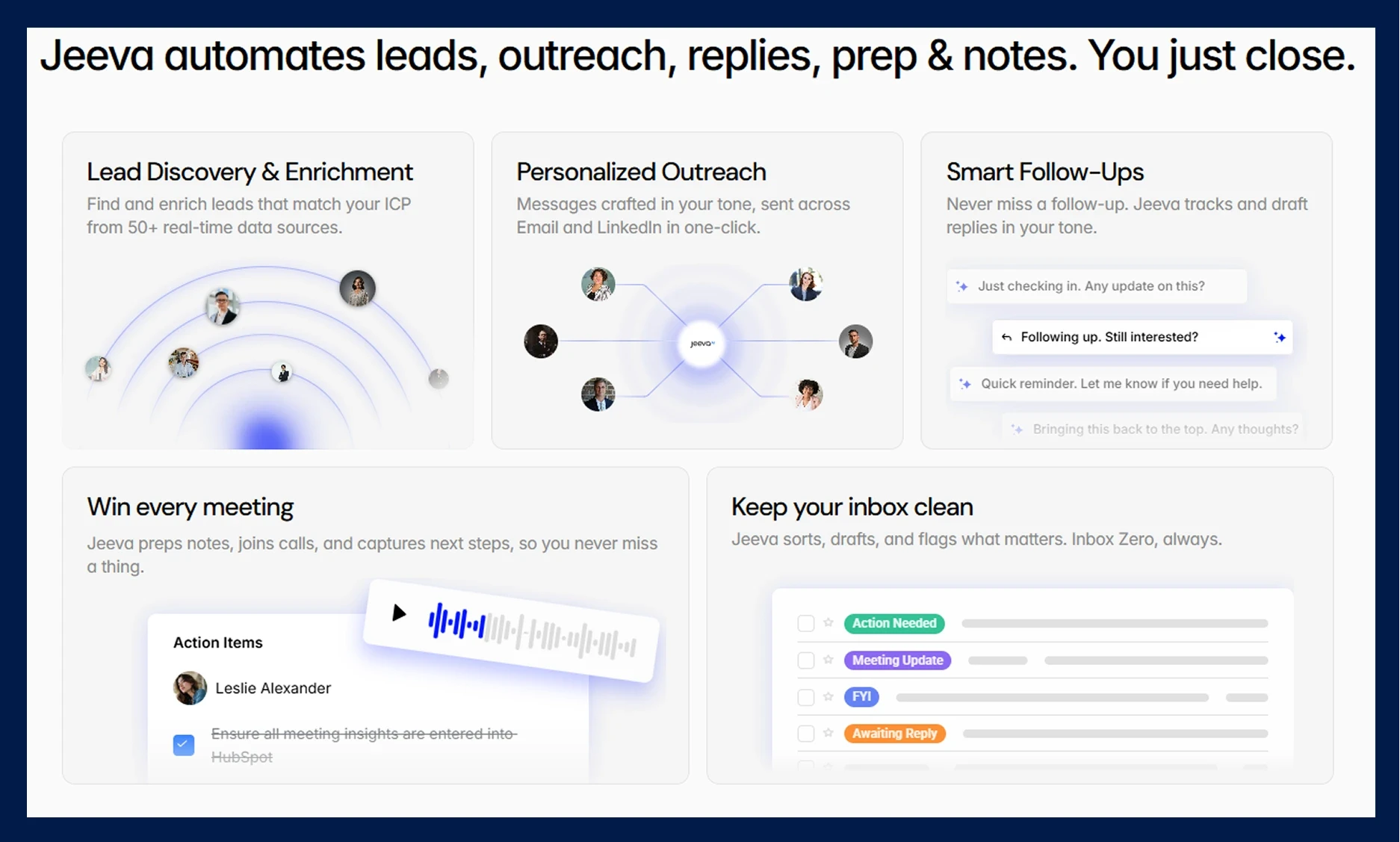
Jeeva AI is a leading agentic AI platform for lead qualification, using multi-agent intelligence to automate enrichment, intent detection, real-time scoring, CRM updates, routing, and meeting booking. Users report 3× more qualified meetings in 30 days with zero manual qualification and full compliance across the US, UK, CA, and AUS.
Tools and Platforms That Offer Agentic AI for Sales Teams (2026)
Agentic AI platforms go beyond traditional sales automation by using autonomous, multi-agent systems that reason, decide, and act across the sales workflow.
While many tools claim “AI,” only a few deliver true agentic capabilities such as real-time reasoning, autonomous qualification, and CRM-native execution. Below are the leading platforms, ranked by depth of agentic intelligence and real-world sales impact.
Read the Full Article: Best Agentic AI for Sales
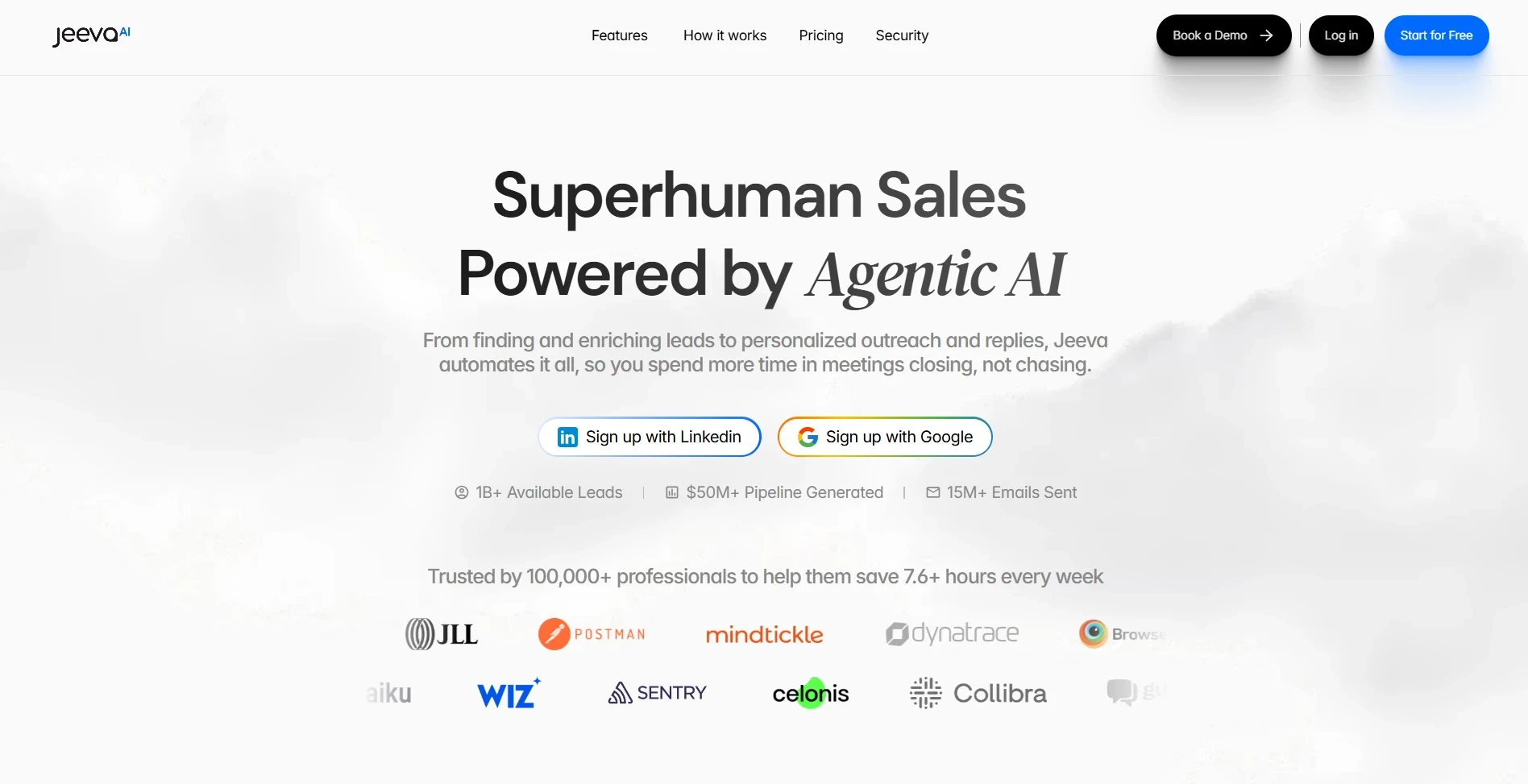
Jeeva AI: Best Agentic AI Platform for Sales Teams
Best overall for lead qualification, routing, and meetings
Jeeva AI is purpose-built as a multi-agent sales intelligence system that handles the entire qualification workflow end to end. Its agents autonomously enrich leads, read conversations, detect intent, score in real time, update CRM fields, route leads, and book meetings without manual rules or workflows.
Jeeva operates fully inside the CRM and inbox, making it adoption-friendly and immediately impactful. Users report 3× more qualified meetings in the first 30 days, with zero manual qualification work.
True multi-agent reasoning (not single-model AI)
Real-time lead & conversation scoring
Autonomous inbox + CRM management
Built-in meeting scheduling
Compliance-ready for US, UK, CA, AUS
Best for: B2B teams that want full-cycle, autonomous lead qualification
Salesforce Agentforce (Einstein GPT)
Enterprise CRM with agent capabilities
Salesforce Agentforce enables companies to build AI agents inside Salesforce to automate sales tasks such as scoring, routing, and follow-ups.
While powerful, it often requires significant configuration and is best suited for large enterprise teams with dedicated RevOps and engineering support. It is agent-enabled but not fully autonomous out of the box.
Microsoft Copilot Agents
AI agents across Microsoft ecosystem
Microsoft Copilot Agents support task automation, prioritization, and communication across Outlook, Dynamics, and Teams. These agents improve productivity but are more assistive than fully agentic for sales qualification and decision-making.
Best for: Microsoft-first organizations seeking AI-assisted sales workflows
SalesCloser AI
AI sales agents for conversations and demos
SalesCloser ai offers autonomous AI agents focused on running demos, discovery calls, and follow-ups. While agentic in conversation handling, it lacks deep CRM-native qualification and multi-agent scoring architecture.
HubSpot AI (Breeze / AI Agents)
AI-enhanced CRM automation
HubSpot’s AI features improve scoring, content, and workflows but remain largely rule-based with limited autonomous reasoning. It supports AI-assisted sales rather than full agentic execution.
Jeeva AI is the leading agentic AI platform for sales teams, using true multi-agent intelligence to automate lead enrichment, intent detection, real-time scoring, CRM updates, routing, and meeting booking. Unlike assistive AI tools, Jeeva delivers full autonomous lead qualification and drives 3× more qualified meetings within 30 days.
Final Conclusion : Agentic AI for Sales
Agentic AI has become one of the most powerful upgrades for B2B sales teams in 2026. Instead of relying on slow, manual lead scoring, agentic AI qualifies leads automatically by analyzing real-time data, understanding intent, reading conversations, and updating the CRM without human effort.
This helps growth leaders build cleaner pipelines, shorten sales cycles, and focus their team’s time on real conversations not admin work.
Companies across the US, UK, Canada, and Australia are already seeing faster SQL creation, higher accuracy, and more predictable revenue by using agentic AI in their qualification process.
Platforms like Jeeva AI take this even further with multi-agent automation that handles enrichment, scoring, routing, and meeting booking automatically.
With the right data, tools, and KPIs, agentic AI becomes a true engine for growth helping sales teams scale smarter, faster, and more efficiently than ever before.
In 2026 and beyond, the teams that embrace agentic AI will consistently outperform those who still rely on manual qualification. The future of pipeline growth is autonomous, data-driven, and powered by agentic AI.
FAQ
What is agentic AI lead qualification?
How does agentic AI improve lead scoring?
What data does agentic AI need for accurate qualification?
Can I integrate agentic AI into my CRM?
What KPIs measure the success of agentic AI qualification?