Introduction
The role of AI Sales Agents has shifted dramatically in the last three years. In 2023–2025, most tools could only automate sequences, send emails, or extract basic data.
By 2026, modern AI Sales Agents can run the entire top and mid-funnel prospecting, enrichment, outreach, engagement, qualification, and handoff.
This article explains the core capabilities of modern AI Sales Agents and how they power B2B lead generation, prospecting, and pipeline growth across the US, UK, Canada, and Australia.
What Is an AI Sales Agent in 2026?
An AI Sales Agent is an autonomous, software-based system that performs core sales tasks traditionally handled by human development teams. These agents don’t just assist - they operate independently, handling prospect research, outreach, reply management, and lead qualification without constant human input.
Unlike basic automation tools, AI Sales Agents understand buyer intent, adapt messaging in real time, and execute full workflows end to end.
Fact: 73% of SaaS companies now use at least one AI Sales Agent as part of their go-to-market strategy.
Core Behaviors of an AI Sales Agent
Understands buyer intent: Interprets signals from email, web, CRM, and social activity.
Uses enriched data to personalize: Tailors messages using role, company context, and technographics.
Communicates like a human: Writes natural, contextual messages instead of rigid templates.
Learns from responses: Improves messaging and timing based on past outcomes.
Executes multi-step workflows: Moves leads from discovery to meeting booking automatically.
What Capabilities Define a Modern AI Sales Agent?
Modern AI Sales Agents operate across the entire top and middle of the sales funnel. They combine data intelligence, language models, and autonomous decision-making to keep pipelines moving without manual effort.
Key AI Sales Agent Capabilities
Lead research & enrichment: Finds ICP-fit accounts and keeps contact data up to date in real time.
Hyper-personalized outreach: Generates role- and context-specific messages at scale.
Automated multi-channel engagement: Coordinates email, LinkedIn, chat, and follow-ups intelligently.
Real-time conversation handling: Reads replies, detects intent, and responds or routes automatically.
Qualification and scoring: Prioritizes leads based on readiness and conversion probability.
Meeting scheduling: Books calls instantly when intent is detected.
CRM updates and logging: Syncs all activity, notes, and status changes without manual input.
In 2026, AI Sales Agents function as always-on digital teammates. They remove repetitive work, improve speed and accuracy, and allow human sellers to focus on strategy, conversations, and closing while AI handles the execution.
How Does an AI Sales Agent Perform Prospect Research?
An AI Sales Agent performs prospect research by automatically aggregating, enriching, and validating buyer data from multiple sources in real time.
Instead of manual lookups, the agent builds a complete buyer profile before any outreach begins - so engagement is informed and relevant from the first touch.
AI Research Capabilities
Job title & role insights: Identifies seniority, responsibilities, and buying influence.
Technographic detection: Discovers tools and platforms the company uses to tailor positioning.
Firmographic data pull: Captures industry, company size, revenue band, and geography.
Funding & growth signals: Flags expansion, budget availability, or change initiatives.
Social activity analysis: Monitors LinkedIn activity and engagement patterns.
ICP matching: Scores fit against your ideal customer profile automatically.
Sales teams start conversations fully prepared without spending hours on research.
How Do AI Sales Agent Personalize Cold Outreach?
AI Sales Agents personalize cold outreach by connecting enriched data, intent signals, and language models to generate messages that reflect each prospect’s role, context, and needs. This replaces generic templates with relevance at scale.
Personalization Methods:
Role-based messaging: Adapts tone and value props for decision-makers vs influencers.
Industry-specific pain points: Aligns messaging with sector challenges and benchmarks.
Trigger-based intros: References funding, hiring, launches, or tech changes.
Case study matching: Uses proof points relevant to the prospect’s industry or size.
Outreach timing optimization: Sends messages when engagement likelihood is highest.
Reference Reading: Cold Email Personalization
Cold outreach feels timely, relevant, and human driving higher reply rates and faster meetings without manual writing.
Capabilities Comparison of Modern AI Sales Agents
Capability | Old AI Tools (2020) | Modern AI (2025) |
|---|---|---|
Email automation | Basic | Fully personalized |
Lead research | Minimal | Real-time enrichment |
Multi-channel engagement | Email only | Email + LinkedIn + SMS |
Qualification | Rule-based | Behavioral ML scoring |
CRM updates | Manual | Fully automated |
Conversation handling | Scripted | Natural, context-aware |
How Do AI Sales Agent Engage Across Multiple Channels?
Modern AI Sales Agents engage buyers through coordinated, multi-channel workflows so prospects are reached on the platform they prefer at the right time and with the right message.
Instead of siloed outreach, AI unifies signals and actions across channels to maintain context and consistency.
Channels Managed by AI
Email outreach: Personalized messages triggered by intent and engagement.
LinkedIn messaging: Connection requests, follow-ups, and contextual replies.
Chatbots: Real-time conversations that qualify and route inbound interest.
SMS follow-ups: Time-sensitive nudges, confirmations, and reminders.
In-app conversations: Contextual prompts and guidance during product usage.
Effect: Diversified touchpoints increase visibility, relevance, and response rates without manual coordination.
How Do AI Sales Agents Score and Qualify Leads?
AI Sales Agents qualify leads by continuously evaluating intent, fit, and urgency across all interactions. Scores update in real time as new signals appear, ensuring prioritization reflects current buyer readiness.
AI Qualification Signals
Website intent: Pricing views, demos, repeat visits, and content depth.
Email engagement: Opens, clicks, replies, response speed, and forwards.
Firmographic triggers: Funding, hiring, expansion, and leadership changes.
Technographic updates: Tool adoption, CRM changes, and stack expansion.
Role seniority: Decision-maker vs influencer weighting.
Urgency indicators: Spikes in activity, deadlines, or direct requests.
Outcome: AI routes high-intent leads instantly, reduces wasted outreach, and keeps the pipeline focused on prospects most likely to convert right now.
How Does an AI Sales Agent Manage Conversations?
Modern AI Sales Agents manage conversations by understanding context, intent, and sentiment, then responding in a way that moves the deal forward.
Instead of scripted replies, AI uses real-time data and conversational intelligence to guide prospects through the buying journey while knowing when to escalate to a human.
Conversation Skills
Handles objections: Responds to common concerns with relevant, context-aware answers.
Answers product questions: Pulls accurate information from product knowledge and past conversations.
Provides follow-up info: Shares case studies, pricing details, or resources automatically.
Routes complex questions: Escalates nuanced or high-stakes queries to the right team member.
Prepares summaries for reps: Creates clear conversation briefs so reps join calls fully informed.
Outcome: Conversations stay warm, responsive, and productive without delays or dropped context.
How Do AI Sales Agents Support CRM Automation?
AI Sales Agents eliminate manual CRM work by logging, updating, and syncing data automatically as conversations and activities happen.
This ensures the CRM reflects reality in real time, not hours or days later.
CRM Tasks AI Automates
Logging conversations: Captures emails, messages, and chat interactions instantly.
Updating lead statuses: Moves leads through stages based on intent and engagement.
Adding notes: Summarizes key insights, objections, and next steps.
Tracking scoring changes: Updates lead scores dynamically as new signals appear.
Notifying AEs: Alerts the right owner when a lead becomes sales-ready.
Outcome: CRMs stay clean, accurate, and actionable allowing sales teams to focus on selling instead of admin work.
What Operational Tasks Can AI Sales Agents Complete?
AI Sales Agents now go beyond outreach and qualification to handle core operational workflows across the entire go-to-market (GTM) motion.
By automating repeatable processes and coordinating actions across systems, AI removes friction from daily sales operations and keeps pipelines moving without manual intervention.
These agents operate continuously, ensuring execution stays consistent, timely, and data-driven.
Operational Functions Handled by AI Sales Agents
Pipeline forecasting: Analyzes real-time engagement, intent, and deal movement to predict pipeline health and revenue outcomes.
Workflow sequencing: Automatically builds and adjusts multi-step sequences based on buyer behavior and funnel stage.
Prospecting cadence setup: Designs outreach cadences (email, LinkedIn, follow-ups) aligned to ICP, role, and intent signals.
Calendar booking: Schedules meetings instantly when readiness is detected, removing back-and-forth coordination.
Account insights generation: Produces summaries on account activity, intent signals, and next-best actions for sales teams.
AI Sales Agents streamline operations across the GTM engine reducing manual effort, improving visibility, and enabling sales teams to focus on strategy, conversations, and closing rather than process management.
Single-Agent vs Multi-Agent AI Systems
Feature | Single-Agent AI | Multi-Agent AI (e.g., Jeeva AI) |
|---|---|---|
Personalization | Limited | High-context personalization |
Scalability | Medium | Enterprise-level |
Task coverage | Narrow | End-to-end sales automation |
Lead research | Slow | Real-time |
Collaboration | None | Agents work together |
How Do AI Sales Agents Integrate With the Sales Stack?
AI Sales Agents integrate by using secure APIs, webhooks, and two-way sync to connect directly with your existing sales tools. This ensures data flows in real time across systems so actions taken by the AI (enrichment, outreach, scoring, scheduling) are reflected instantly everywhere your team works.
The result is a single source of truth with no manual handoffs or duplicate updates.
Key Integrations of AI Sales Agent
Salesforce: Syncs leads, accounts, activities, scores, stages, and notes in real time.
HubSpot: Updates contacts, pipelines, engagement logs, and automation triggers automatically.
LinkedIn: Manages connections, messages, replies, and profile signals for social selling.
Calendars & email clients: Books meetings, sends confirmations, logs emails, and tracks replies automatically.
Outcome: AI Sales Agents operate natively within your stack - keeping data accurate, actions synchronized, and workflows fully automated so teams sell faster without changing how they work.
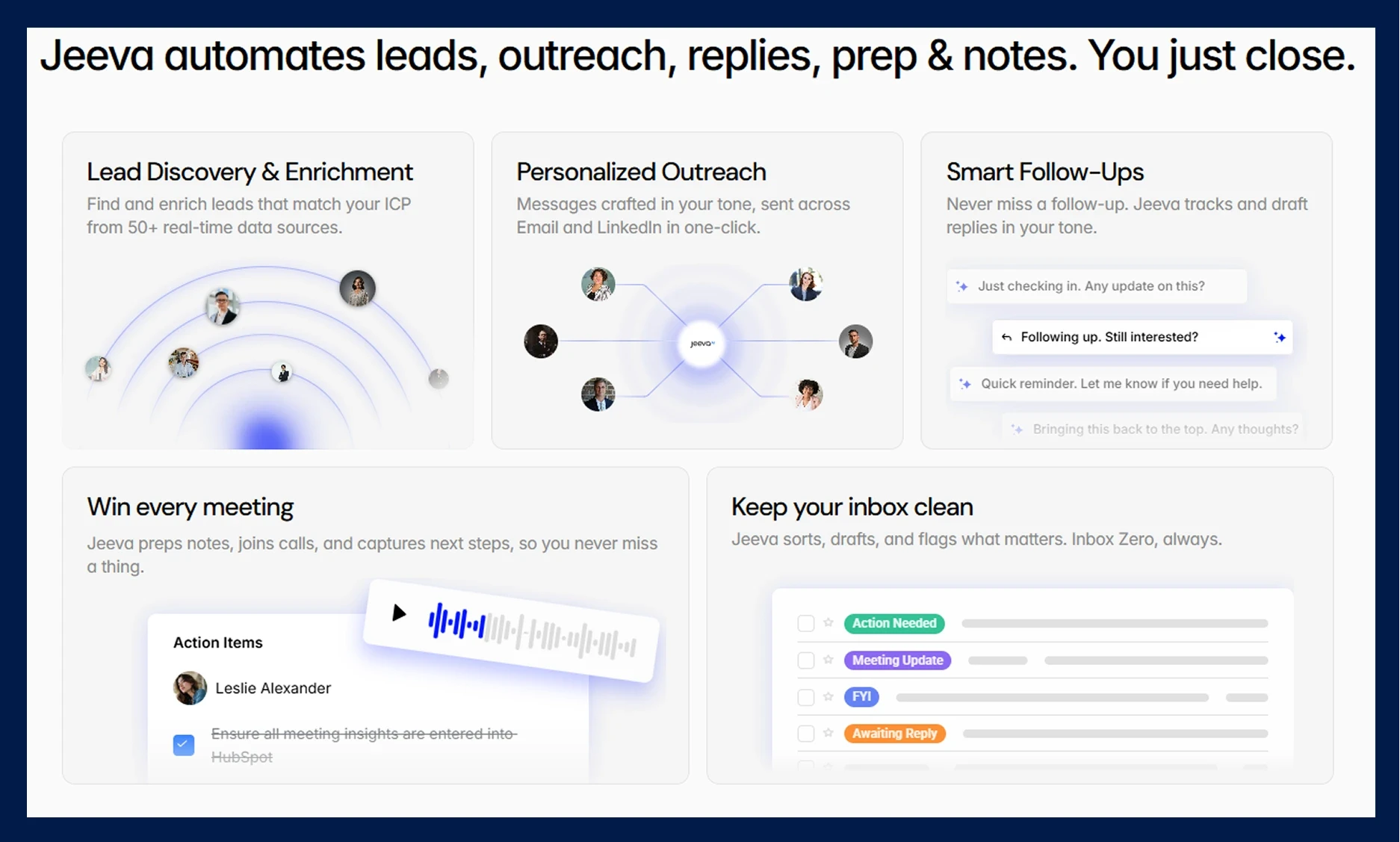
What Advanced Capabilities Do Multi-Agent Systems Provide?
Multi-agent systems represent the next evolution of sales automation. Instead of relying on a single AI model, platforms like Jeeva AI use multiple specialized agents that collaborate in real time each focused on a specific task.
This mirrors how high-performing sales teams operate, but with machine speed and consistency.
By dividing responsibilities, multi-agent systems reduce errors, improve accuracy, and execute end-to-end workflows without manual coordination.
Multi-Agent Capabilities
Prospector Agent → finds leads: Identifies ICP-fit accounts using firmographic, technographic, and intent signals.
Enrichment Agent → pulls data: Adds and refreshes contact and company details in real time.
Writer Agent → drafts personalized outreach: Creates role- and context-specific messages for email and social channels.
Smart Inbox Agent → replies to emails: Interprets intent, handles objections, and routes qualified responses.
Calendar Agent → books meetings: Schedules calls instantly when readiness is detected.
Multi-agent systems deliver true autonomy coordinating research, personalization, engagement, qualification, and scheduling as one continuous workflow.
This is the future of AI sales automation: faster execution, higher accuracy, and predictable pipeline growth at scale.
Why Jeeva AI Is the Most Capable AI Sales Agent in 2026?
Jeeva AI stands out in 2026 because it is built as a true multi-agent ecosystem, not a single chatbot or rule-based automation tool.
Each AI agent is specialized, autonomous, and coordinated - allowing Jeeva to handle the full sales workflow from prospect discovery to meeting booking without manual intervention.
Unlike traditional sales tools that assist humans, Jeeva AI executes sales tasks independently, adapting in real time based on buyer behavior and intent.
Why Jeeva AI Leads the Market
Real-time enrichment: Continuously updates contact and company data so decisions are based on live information.
Context-aware personalization: Crafts outreach using role, industry, technographics, and intent—not templates.
Multi-channel outreach: Coordinates email, LinkedIn, chat, and follow-ups from a single intelligence layer.
Autonomous conversation handling: Reads replies, detects intent, handles objections, and routes qualified leads automatically.
Built for US, UK, and EU compliance: Designed with GDPR, regional consent rules, and deliverability standards in mind.
No manual sequences required: AI decides when, where, and how to engage without prebuilt static workflows.
Jeeva AI functions as a fully autonomous sales engine, not just a productivity tool. It removes manual effort, increases precision, and delivers consistent pipeline growth making it the most capable AI Sales Agent for modern teams in 2026.
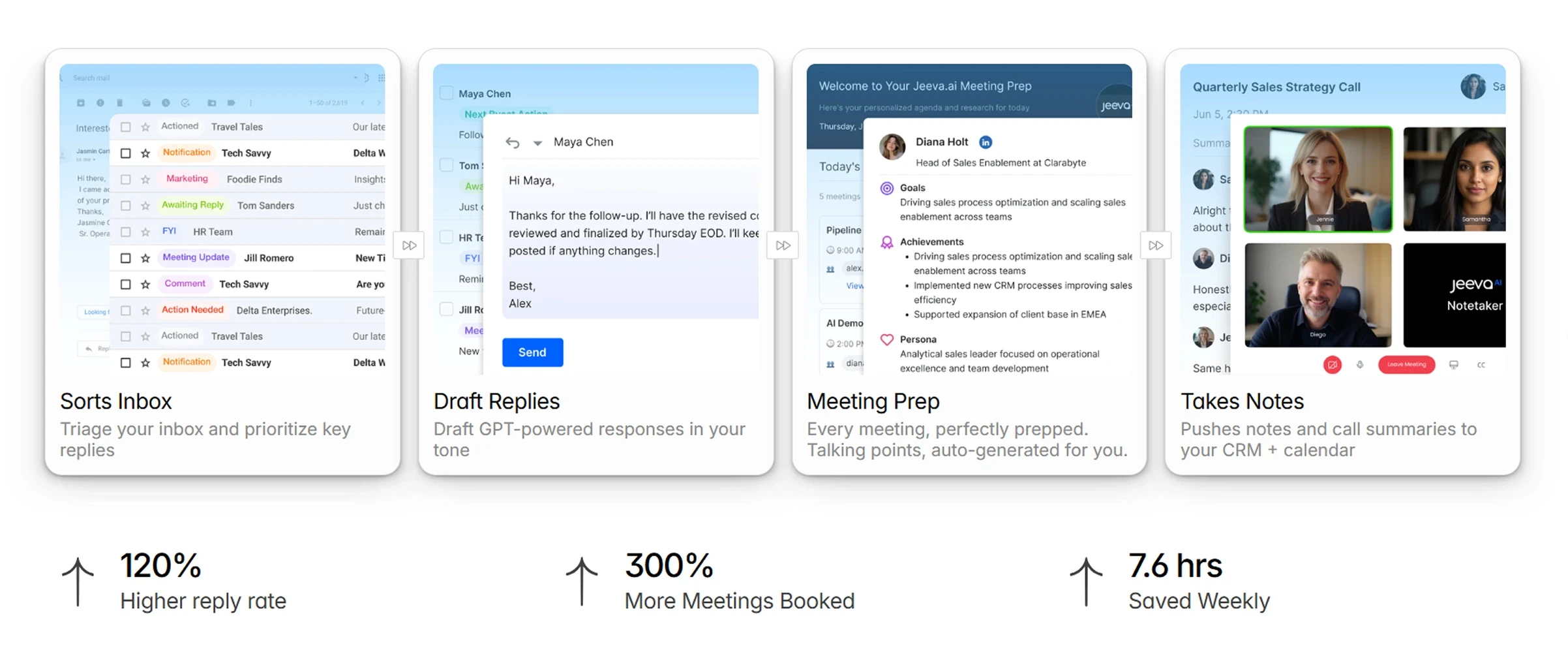
Conclusion : Modern AI Sales Agent
By 2026, AI Sales Agents are no longer optional - they are core infrastructure for modern go-to-market teams. These systems handle prospect research, real-time enrichment, personalized outreach, multi-channel engagement, qualification, and conversation management with speed and consistency that manual teams cannot match.
Multi-agent platforms like Jeeva AI take this a step further by automating the entire outbound motion - from intent detection to meeting booking using coordinated, autonomous agents.
As buyers become more digital and self-directed, AI Sales Agents will continue to drive faster pipeline creation, higher conversion rates, and more predictable revenue growth.
FAQ
What is a modern AI Sales Agent?
What capabilities should an AI Sales Agent have?
How is AI Sales Agent in 2026 different from old tools?
Which AI Sales Agent is the most advanced?
Do AI Sales Agents replace SDRs?