Introduction : Buying Intent in 2026
Buying intent is one of the most important factors in modern sales. When prospects actively search, compare, or engage with content, their behavior reveals how close they are to making a purchase.
Today, AI helps sales teams detect these signals automatically. Instead of guessing who is interested, AI studies data patterns and highlights which leads are most likely to convert.
This gives teams across the US, UK, Canada, Australia, and New Zealand a faster way to prioritize pipeline and increase win rates.
What Is Buying Intent?
Buying intent refers to the observable actions and behaviors that indicate whether a prospect is actively considering a purchase. These signals help sales and AI systems understand who is researching, who is comparing options, and who is close to making a decision. Unlike static profile data, intent reflects real-time readiness.
Organizations that use intent data consistently prioritize the right accounts first, shorten sales cycles, and reduce wasted outreach.
Fact: Companies using intent signals see 2–3× higher conversion rates because they engage prospects at the right moment.
Common Buying Intent Signals
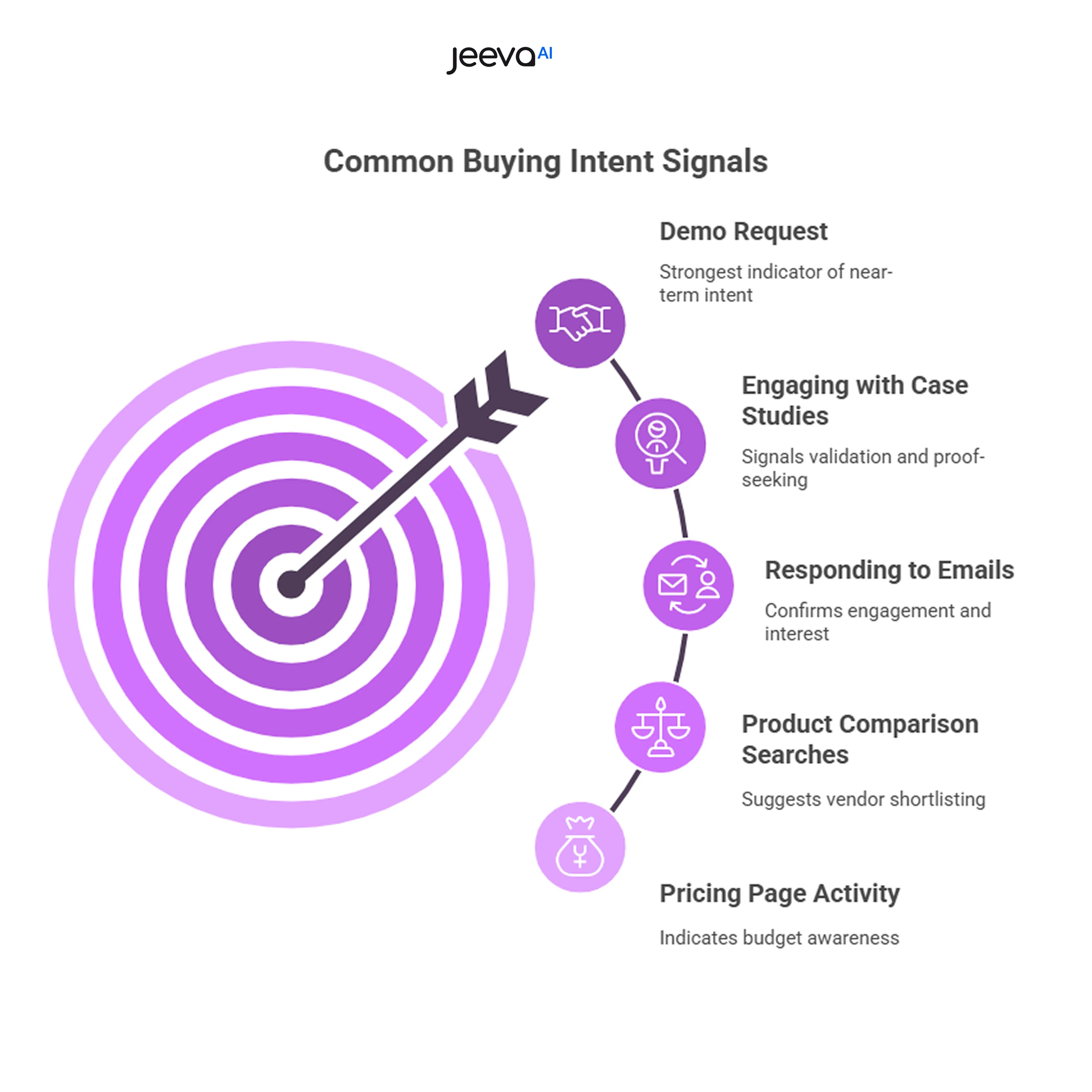
Visiting high-intent pages: Shows active evaluation of solutions.
Pricing page activity: Indicates budget awareness and purchase consideration.
Product comparison searches: Suggests vendor shortlisting behavior.
Responding to emails: Confirms engagement and interest.
Engaging with case studies: Signals validation and proof-seeking.
Demo request behavior: Strong indicator of near-term buying intent.
When multiple signals appear together, intent confidence increases sharply.
How AI Detects Buying Intent Automatically
AI detects buying intent by analyzing large volumes of behavioral data across channels and identifying patterns that historically lead to conversions. Instead of relying on a single action, AI evaluates signal combinations, frequency, and recency to predict likelihood to buy.
Cause → Effect: More signals analyzed → more accurate prediction → better prioritization.
This allows sales teams to focus on prospects who are most likely to convert now, not later.
Data Sources AI Uses
Website analytics: Tracks visits, depth, and repeat behavior.
Email activity: Monitors opens, clicks, replies, and timing.
CRM behavior: Analyzes stage movement, past interactions, and deal history.
Social engagement: Detects LinkedIn activity, follows, and content interaction.
Firmographic changes: Captures growth events like hiring or expansion.
Technographic updates: Identifies new tools, integrations, or stack changes.
AI continuously updates intent scores as new signals arrive.
Intent Signal Strength Table
Intent Type | Strength | Examples |
|---|---|---|
High | Strong | Pricing page, demo request |
Medium | Moderate | Case studies, product pages |
Low | Weak | Blog or general research |
Website Behavior Signals AI Tracks
A company’s website is the richest source of intent data because it captures self-directed buyer research. Most prospects educate themselves long before speaking to sales, and AI ensures those signals are not missed.
Fact: Around 70% of buying intent activity happens before a prospect contacts sales.
Website Behaviors That Indicate Intent
Visiting the pricing page: Indicates cost evaluation and readiness.
Viewing multiple product pages: Shows solution comparison behavior.
Spending extended time on feature pages: Suggests deep interest in capabilities.
Returning to the site within a short period: Signals active buying research.
Downloading resources: Indicates learning and validation intent.
Watching demos or explainer videos: Strong sign of product evaluation.
When AI connects these behaviors with firmographic and engagement data, it creates a high-confidence buying intent profile.
Email Engagement Signals AI Monitors
Email engagement is one of the strongest real-time indicators of buyer interest. AI monitors how prospects interact with emails to understand intent, urgency, and readiness to move forward. Instead of treating all opens equally, AI evaluates patterns, timing, and depth of interaction.
Cause → Effect: More engagement → higher interest → better conversion probability.
Email Signals That Matter
Multiple opens: Indicates sustained interest or internal discussion.
Link clicks: Shows intent to learn more about the product or offer.
Reply behavior: Confirms active engagement, even if the response is neutral or exploratory.
Forwarding a message internally: Signals buying committee involvement.
Quick response times: Suggest urgency or active evaluation.
Interaction with follow-ups: Shows continued consideration rather than passive interest.
AI combines these signals to dynamically raise or lower lead priority in real time.
Content Consumption Signals
Prospects who actively consume educational and problem-solving content tend to convert at much higher rates. AI tracks what content is consumed and how deeply to infer buying stage.
Content engagement often signals problem awareness, solution research, or vendor validation.
Content Signals AI Uses
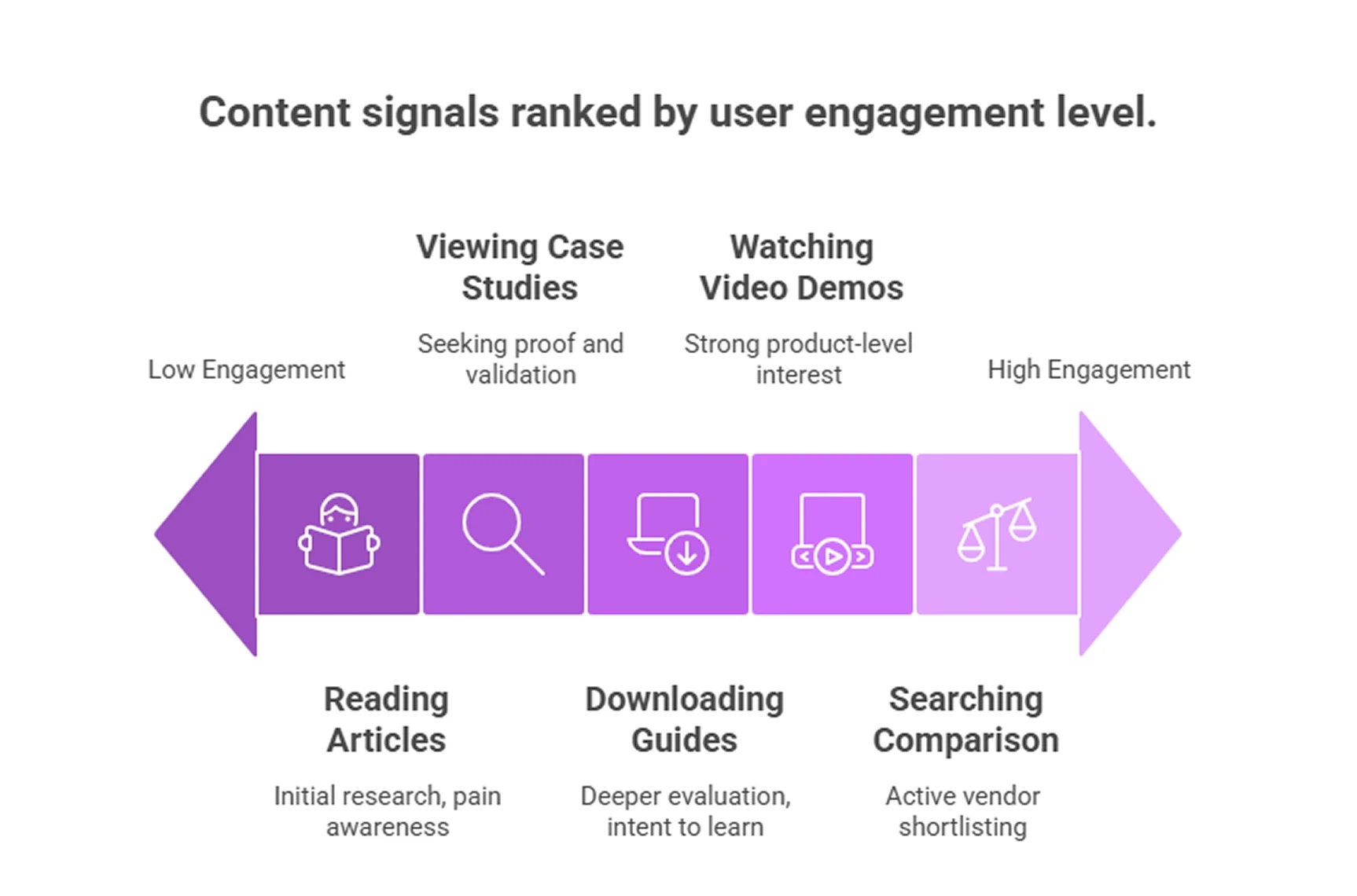
Reading blog articles: Indicates early-stage research or pain awareness.
Viewing case studies: Signals validation and proof-seeking behavior.
Downloading guides or whitepapers: Suggests deeper evaluation and intent to learn.
Watching video demos: Strong indicator of product-level interest.
Searching for comparison content: Shows active vendor shortlisting.
AI uses these signals to move leads from awareness → consideration → decision stages automatically.
Search Intent & Keyword Behavior
Search behavior reveals what problem the buyer is trying to solve right now. AI analyzes keyword patterns to understand intent and predict purchase readiness more accurately than demographics alone.
Search intent often precedes direct sales contact, making it a critical early signal.
Types of Search Intent
Informational intent: Example: “How to fix low sales conversion” Indicates early problem awareness.
Comparison intent: Example: “Tool A vs Tool B” Signals active evaluation of options.
Transactional intent Example: “Book demo tool X” Strong indicator of near-term buying readiness.
Cause → Effect: Search queries reveal problem awareness → AI ranks buying readiness → sales teams engage at the right moment.
How CRM Activity Signals Works?
CRM activity shows mid- to late-funnel intent because it reflects how prospects interact after initial engagement. AI scans CRM timelines continuously to detect momentum, re-engagement, and buying progression that humans often miss.
These signals are especially valuable because they come from direct sales interactions, not anonymous browsing.
CRM-Based Intent Signals
Lead returning after inactivity: Indicates renewed interest or internal alignment.
Opening a previous proposal:Strong signal of evaluation or comparison.
Interacting with shared content: Shows continued engagement with sales materials.
Booking additional meetings: Suggests deeper buying conversations.
Increasing frequency of communication: Signals urgency or internal decision-making.
CRM signals help AI identify which opportunities are heating up again. This prevents missed follow-ups and improves deal timing.
Firmographic & Technographic Intent Signals
Changes inside a company often trigger buying cycles before outreach even begins. AI monitors these structural shifts to detect when accounts are most likely to buy.
Firmographic and technographic signals are powerful because they reflect organizational readiness, not just individual interest.
Signals AI Tracks
New funding rounds: Indicates budget availability and growth plans.
Hiring new sales or marketing roles: Signals expansion and tooling needs.
Switching CRMs: Strong indicator of active vendor evaluation.
Tech stack expansion: Suggests scaling infrastructure or integrations.
Rapid employee growth: Often precedes process and tooling changes.
Reference Reading : Technographic Signals to Prioritise Leads in US Enterprise Sales
These signals allow AI to engage accounts before competitors do.
How AI-Powered Predictive Intent Scoring does?
Predictive intent scoring uses historical data and real-time behavior to estimate conversion likelihood, not just interest. Instead of rule-based scoring, AI models learn which patterns consistently lead to closed deals.
Fact: Predictive scoring improves pipeline accuracy by 32–45%.
What Predictive Models Use?
Past lead conversions: Learns which behaviors led to revenue.
Behavior patterns: Evaluates timing, frequency, and depth of engagement.
Company growth signals: Adjusts scoring based on expansion indicators.
Role seniority: Prioritizes decision-makers appropriately.
Account-level signals: Considers overall buying readiness, not just individuals.
Predictive scoring ensures sales teams focus on leads most likely to convert now.
How Multi-Channel Intent Tracking works ?
Modern buyers engage across multiple platforms. AI centralizes intent signals from every channel to build a single, unified view of buyer readiness.
This prevents soiled data and inconsistent prioritization.
Channels AI Monitors
Email: Opens, clicks, replies, and response timing.
Website activity: Page visits, repeat sessions, and content depth.
LinkedIn messages: Replies, profile views, and engagement.
Social engagement: Likes, comments, and follows.
Chatbot interactions: Questions, intent keywords, and routing.
SMS replies: Urgency and confirmation signals.
By combining signals across channels, AI identifies true buying intent earlier. Sales teams engage prospects at the right time with the right message.
How Agentic AI Identifies & Acts on Intent ?
Agentic AI goes beyond traditional intent detection by closing the loop between insight and action. Instead of surfacing intent data for humans to review later, agentic systems interpret signals in real time and immediately execute the next best step in the sales workflow.
This is what turns intent data into actual pipeline movement.
At its core, agentic AI combines intent detection, decision-making, and execution into one continuous process. When buyer behavior changes, the system reacts instantly without waiting for manual input.
How Agentic AI Identifies Intent
Agentic AI continuously monitors signals across email, website activity, CRM updates, social engagement, and technographic changes. It evaluates:
Signal strength (how meaningful the action is)
Signal frequency (how often it occurs)
Signal recency (how fresh the behavior is)
Historical outcomes (what similar signals led to in the past)
By combining these factors, the AI determines whether the intent is early interest, active evaluation, or purchase-ready.
Agentic AI Workflow (Intent → Action)
Once intent is detected, agentic AI moves through a fully automated execution loop:
Detects an intent signal: Identifies meaningful buyer behavior such as pricing page visits, email replies, or tech stack changes.
Scores the lead instantly: Updates priority based on fit, urgency, and likelihood to convert.
Sends the right message: Triggers a personalized response aligned to the buyer’s current stage and context.
Routes to the right rep: Assigns ownership based on region, account, or deal type without delays.
Books a meeting automatically: Offers calendar slots or confirms meetings the moment readiness is detected.
Why This Matters for Sales Teams
Traditional systems stop at “alerting.” Agentic AI acts.
No waiting for manual follow-ups
No missed high-intent moments
No lag between interest and engagement
Sales teams engage buyers while intent is highest, not hours or days later.
Why Accurate Intent Detection Improves the Sales Pipeline?
Accurate intent detection ensures sales teams focus their time and effort on prospects who are most likely to convert. Instead of spreading outreach evenly across all leads, AI highlights which accounts are actively researching, evaluating, or preparing to buy.
This shifts sales from reactive follow-ups to proactive, well-timed engagement.
When intent is clear, pipeline decisions become data-driven rather than assumption-based. Sales teams can prioritize conversations that matter and avoid wasting resources on low-interest prospects.
Pipeline Benefits of Accurate Intent Detection
Better prioritization: High-intent leads rise to the top, ensuring reps work the most promising opportunities first.
Higher reply rates: Outreach aligned with buyer readiness feels relevant and timely, increasing responses.
Faster sales cycles: Engaging prospects during active evaluation shortens time to close.
Less wasted outreach: Fewer messages are sent to leads that are not ready or not a good fit.
Higher ROI from outbound: Sales effort is concentrated where conversion probability is highest.
Accurate intent transforms pipeline management from volume-based to signal-based execution.
Conclusion
AI has fundamentally changed how sales teams identify and act on buying intent. Instead of relying on intuition or static lead scores, teams now gain clear, real-time insight into who is ready to buy and why.
By analyzing website behavior, email engagement, search activity, CRM interactions, and firmographic or technographic changes, AI creates a reliable, data-driven system for pipeline prioritization.
The result is a more predictable pipeline, higher conversion rates, and sales teams that spend their time where it delivers the greatest impact.
FAQ
What is buying intent in sales?
How does AI identify buying intent?
Why is intent important?
What tools detect buying intent?
Can AI act on intent signals automatically?