Summary of the Article: Sales automation tools follow fixed rules to send sequences, update CRM fields, and manage tasks. Agentic AI platforms go beyond automation by reasoning, adapting, and acting autonomously. They use perception loops to understand context, personalize outreach, qualify leads, and manage conversations without human intervention.
While automation improves efficiency, agentic AI transforms the sales process entirely delivering smarter outbound workflows, better lead quality, and stronger ROI. Jeeva AI leads this category by offering a multi-agent outbound engine built for modern B2B teams.
Introduction to Agentic AI vs sales Automation
Traditional sales automation tools were built to follow predefined rules: send this sequence, update this field, move this deal. They save time, but they cannot think, analyze signals, or adjust strategy based on live buyer behavior.
Agentic AI platforms, on the other hand, operate like digital workers. They observe, reason, decide, and act. They use perception loops, multi-agent orchestration, and real-time data to run entire sales workflows automatically.
This article breaks down the differences so revenue teams can make better, informed decisions.
What Is Sales Automation and How Does It Work?
Sales automation tools follow preset workflows that trigger predictable actions. These systems are helpful for repetitive tasks like sequences, reminders, data entry, and CRM updates. However, they can only do what they are told they cannot interpret signals or adjust strategy.
Core Functions of Sales Automation
Executes static email sequences
Sends batch-and-blast campaigns
Automates CRM data updates
Manages task reminders
Sends timed follow-ups
Moves deals based on predefined rules
Sales automation is fast and structured, but not intelligent.
What Are Agentic AI Platforms and How Do They Work?
Agentic AI platforms behave like autonomous digital workers. They analyze data, interpret context, make decisions, and act without being manually prompted.
They operate in a perception → reasoning → action loop that makes them dynamic and adaptive.
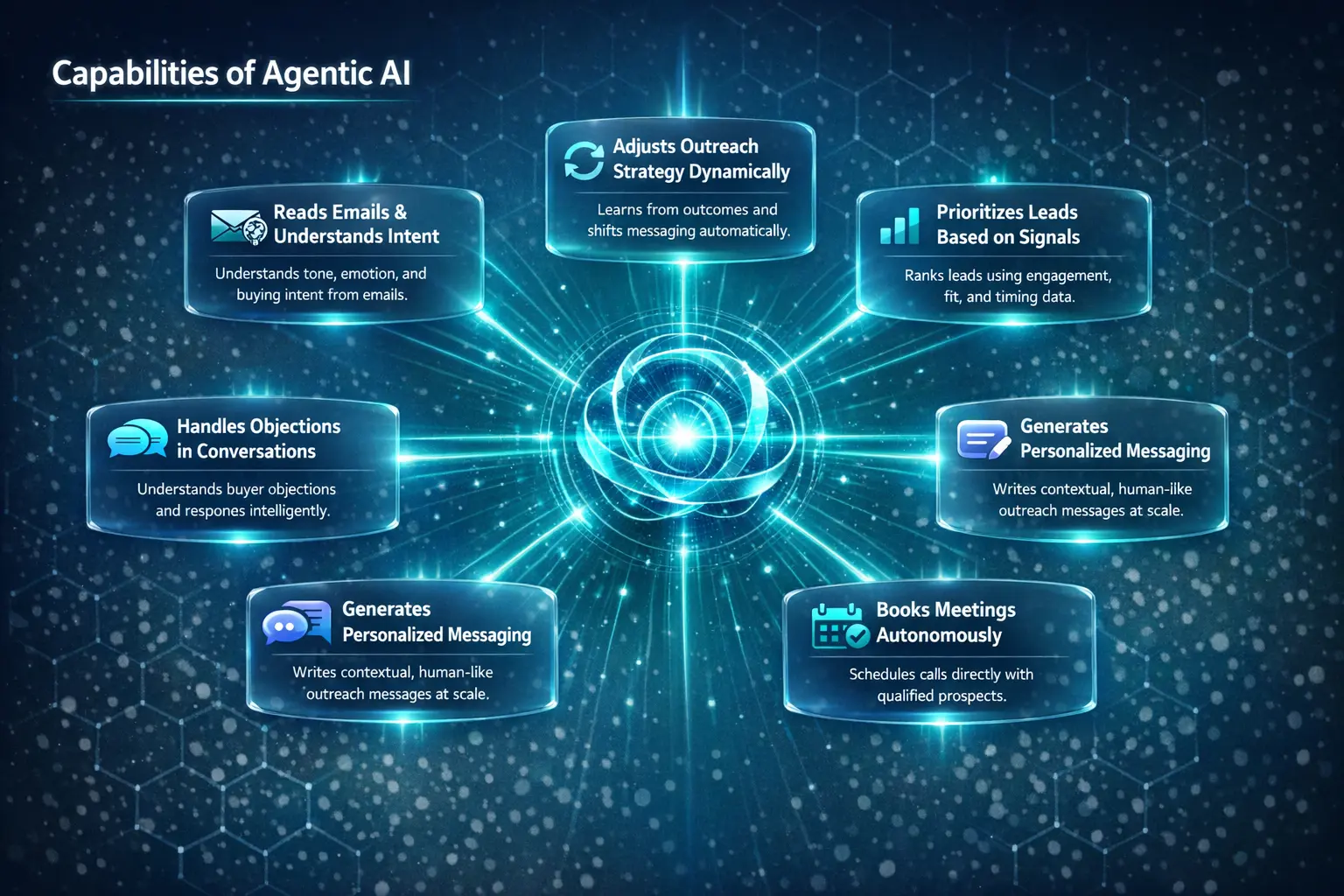
Capabilities of Agentic AI
Reads emails and understands intent
Adjusts outreach strategy dynamically
Prioritizes leads based on signals
Generates personalized messaging
Handles objections in conversations
Books meetings autonomously
Agentic AI adds intelligence, adaptability, and autonomy not just automation.
How Does the Perception Loop Work in Agentic AI?
The perception loop is the core mechanism that enables agentic AI to behave intelligently rather than mechanically. Instead of responding to fixed triggers, the AI continuously observes inputs from multiple systems and interprets their meaning.
It analyzes context such as buyer behavior, intent signals, and historical interactions to understand what is happening right now. Based on this understanding, the agent decides the most appropriate next action. It then plans the steps required and executes them across tools like email, CRM, or calendars.
This loop runs continuously, allowing the AI to adapt in real time as conditions change.
What Happens During Perception?
Collects signals from email, web, and CRM
Interprets buyer intent and urgency
Identifies behavioral and contextual patterns
Chooses the optimal next action
Plans follow-up steps logically
Executes actions across systems
This perception loop allows AI to operate with consistency and adaptability similar to a human sales professional.
Key Differences between Sales Automation vs. Agentic AI
Sales automation and agentic AI differ fundamentally in how they think and operate. Traditional automation follows predefined rules and executes tasks only when specific conditions are met. It cannot reason, adapt, or change behavior without manual updates.
Agentic AI, by contrast, evaluates real-time signals, reasons through context, and decides what to do next on its own. It adjusts messaging, timing, and actions dynamically based on outcomes. This makes agentic AI far more flexible, scalable, and resilient in complex sales environments.
Major Differences
Logic: Static rules vs. dynamic reasoning
Personalization: Templates vs. real-time generation
Response handling: Manual review vs. autonomous action
Data usage: Static fields vs. live signals
Follow-ups: Fixed schedules vs. adaptive timing
Scalability: Linear growth vs. exponential output
Automation saves time. Agentic AI changes how work gets done at scale.
Sales Automation vs Agentic AI
Feature | Sales Automation | Agentic AI |
|---|---|---|
Decision-making | Rule-based | Context-aware |
Personalization | Template-driven | Dynamic + data-driven |
Follow-ups | Pre-scheduled | Behavior-adaptive |
Qualification | Manual or score-based | Real-time + autonomous |
Response handling | Human-led | AI-led |
Scale | Limited by humans | Unlimited |
When Should You Use Sales Automation?
Sales automation is best suited for simple, repeatable tasks that follow fixed rules and do not require judgment or context. It works well when processes are stable, inputs are predictable, and outcomes are clearly defined. Automation helps teams reduce manual effort on administrative work without changing how decisions are made.
It is commonly used to keep systems organized and workflows moving consistently. However, it does not adapt when buyer behavior changes or when context spans multiple tools. Sales automation improves efficiency, but it does not improve intelligence.
Good Use Cases
Basic email sequences
CRM cleanup and updates
Task and follow-up reminders
Deal stage transitions
Pipeline notifications
Lead or form routing
Automation is dependable for execution, but limited in strategic impact.
When Should You Use Agentic AI?
Agentic AI is designed for complex, dynamic sales work that requires reasoning, personalization, and continuous decision-making. It is ideal when teams need to scale outbound efforts without increasing headcount. Agentic AI can interpret buyer intent, adapt messaging, and manage conversations autonomously.
It replaces manual prospecting and qualification while coordinating across multiple channels. This makes it effective in fast-moving, high-volume, or highly personalized sales environments. Agentic AI drives growth by transforming how work is done, not just how fast it is done.
Use Cases for Agentic AI
Personalized outbound at scale
AI-managed email conversations
Behavior-based lead scoring
Always-on prospecting
Use agentic AI when the goal is scalable growth, not just operational efficiency.
What Are Agentic AI Applications in Sales?
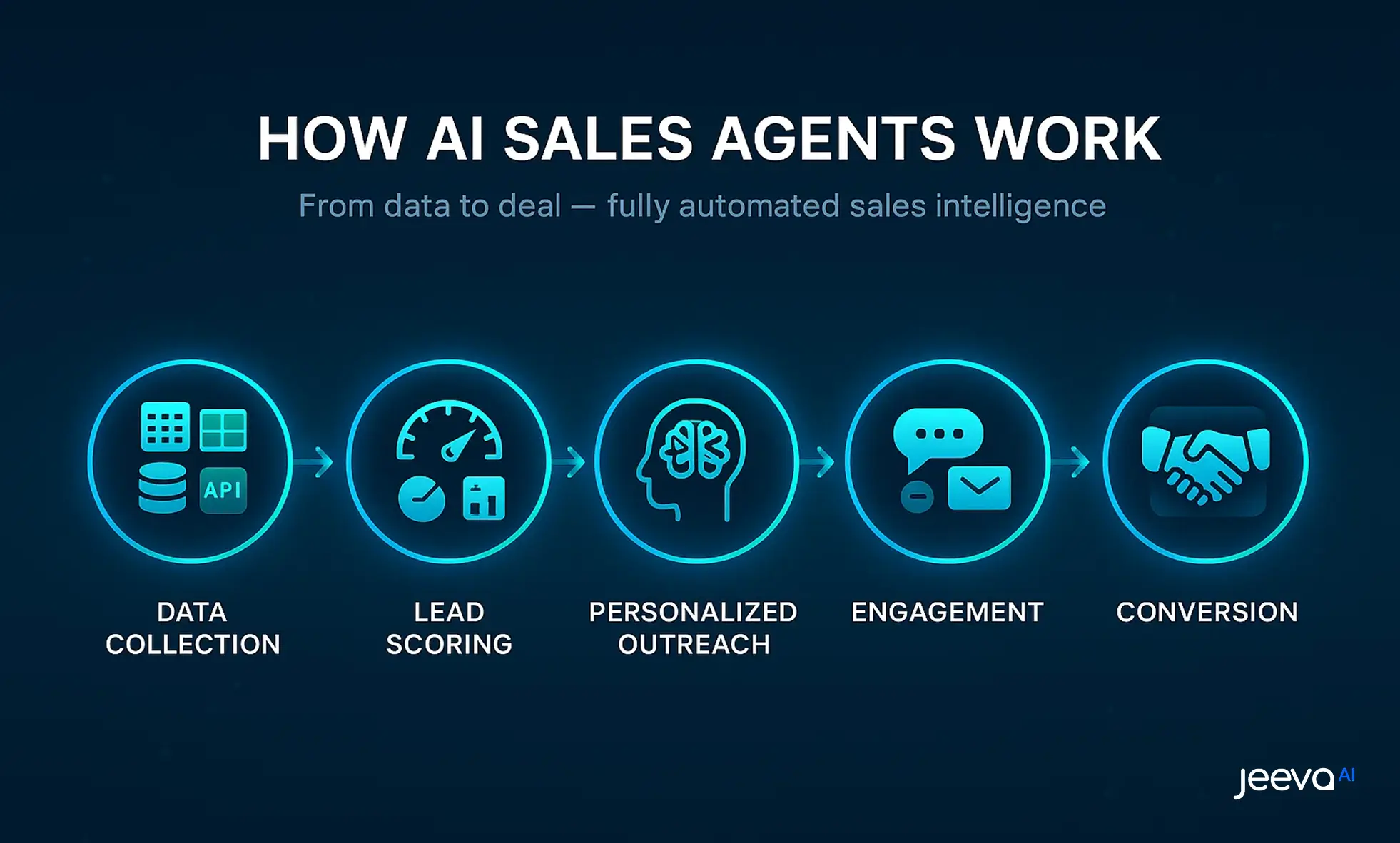
Agentic AI can operate autonomously across email, CRM systems, websites, and intent-signal layers, making it applicable across the entire sales funnel. Instead of handling isolated tasks, agentic AI manages end-to-end workflows with reasoning and context awareness.
It can identify prospects, enrich data, engage leads, manage conversations, and move opportunities forward without constant human input. These systems coordinate multiple actions in parallel, something manual teams cannot do at scale. As a result, sales teams achieve higher throughput with consistent quality.
Agentic AI effectively expands sales capacity without expanding headcount.
Applications
AI cold email writing
Smart inbox reply handling
AI pipeline management
Agentic AI performs the work of multiple sales development roles simultaneously.
What Is the Cost Difference Between Sales Automation and Agentic AI?
Sales automation and agentic AI differ fundamentally in cost structure and return profile. Automation tools are cheaper to adopt but still depend heavily on human labor to operate, monitor, and optimize workflows. Agentic AI has a higher upfront technology cost but significantly reduces ongoing labor requirements.
Over time, this shifts spend from headcount to software, improving margins. As volume increases, agentic AI becomes more cost-efficient because output scales faster than cost. This creates a stronger long-term ROI compared to traditional automation.
Cost Comparison
Automation: low tech cost, high labor cost
Agentic AI: medium tech cost, low labor cost
Automation requires continuous human effort
Agentic AI reduces manual workload dramatically
Automation scales linearly with people
Agentic AI scales exponentially with volume
Agentic AI becomes cheaper per lead as scale increases.
Cost and ROI Comparison
Metric | Sales Automation | Agentic AI |
|---|---|---|
Monthly cost | Low | Medium |
Labor requirement | High | Low |
Personalization quality | Low–Medium | High |
Speed | Medium | Very high |
Meeting rate | Inconsistent | Strong + predictable |
ROI | Moderate | High |
What Happens During the Perception Part of the Agentic AI Loop?
The perception stage is where agentic AI turns raw signals into understanding. Instead of reacting to simple triggers, the AI observes inputs from emails, CRM updates, website behavior, and conversations. It interprets meaning by analyzing context, intent, and sentiment across these signals.
This allows the agent to understand what a buyer is trying to communicate, not just what action occurred. Based on this understanding, the AI updates its internal state and prepares for decision-making. Perception is what enables agentic AI to behave intelligently rather than mechanically.
Perception Outputs
Detects buying intent
Identifies sentiment in replies
Interprets message context
Understands objections
Updates qualification scores
Predicts next-best action
Perception functions as the “brain” that guides every downstream action.
How Do Agentic Platforms Fit Into Enterprise Sales?
Agentic platforms are designed to operate in complex enterprise environments with high data volume and multiple systems. They connect deeply with CRMs, data providers, and communication tools to manage workflows end to end. Instead of isolated automations, agentic platforms coordinate multiple agents working in parallel.
This allows enterprises to cover the entire pipeline consistently, from prospecting to qualification and scheduling. Built-in governance ensures compliance, auditability, and control at scale. As a result, enterprises reduce manual coordination while increasing execution speed.
Enterprise Benefits
Automated pipeline coverage
Scalable multi-agent workflows
Deep CRM and data integrations
Cross-team orchestration
Governance and compliance controls
AI-driven revenue insights
Enterprises adopt agentic AI to lower operational overhead while scaling execution.
Why Agentic AI Outperforms Traditional Automation
Traditional automation follows fixed rules and assumes predictable behavior. Agentic AI outperforms by adapting to real buyer behavior in real time. It learns from interactions, adjusts messaging dynamically, and reasons through next steps instead of executing static scripts.
This allows it to handle objections, personalize follow-ups, and change timing automatically. Because it understands context, it reduces errors caused by rigid workflows. The result is not just faster execution, but better sales outcomes.
Superiority Factors
Learns continuously from behavior
Adjusts messaging dynamically
Understands replies and intent
Handles objections autonomously
Schedules meetings intelligently
Reduces human error
Agentic AI improves efficiency, accuracy, and conversion results simultaneously.
Which Platform Leads the Agentic AI Category? (Jeeva AI)
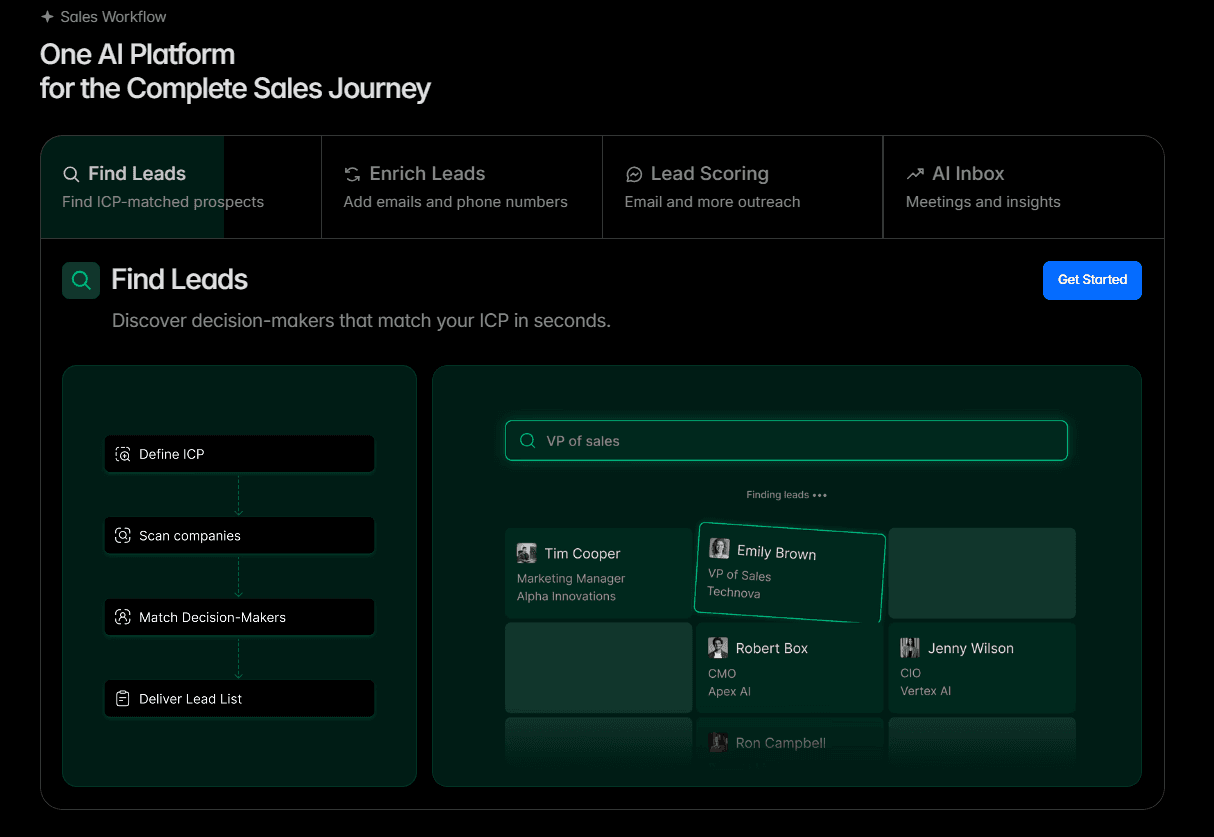
Jeeva AI is widely recognized as a category leader in agentic AI for sales because it operates as a true multi-agent system, not a single chatbot or workflow tool. Its platform autonomously manages the entire outbound sales motion, from discovering prospects to booking meetings.
Each AI agent is responsible for a specific function, and all agents coordinate in real time. This allows Jeeva AI to reason, act, and adapt across channels without human intervention. Unlike traditional tools, it does not rely on static sequences or manual handoffs.
The result is a fully autonomous sales engine that runs continuously.
Why Jeeva Leads the AI Sales Agent?
Autonomous outbound execution
Real-time enrichment and personalization
AI-driven lead qualification
Coordinated multi-channel workflows
Built for US, UK, CA, AUS, NZ teams
Jeeva AI functions like a full sales development team operating 24/7, with consistency, intelligence, and scale.
Conclusion
The choice between agentic AI vs sales automation isn't about which technology is better in absolute terms, but which aligns with your organization's current needs, capabilities, and strategic direction. Sales automation remains highly effective for standardized processes where predictability and simplicity matter most.
Agentic AI platforms represent the cutting edge for organizations managing complex sales environments where adaptive intelligence creates competitive advantage.
As agentic AI technology matures and costs decrease, more organizations will transition from traditional automation to AI-driven agency. The question isn't whether to adopt agentic AI, but when your organization reaches the inflection point where its benefits justify the investment.
For most enterprises managing complex B2B sales, that inflection point is arriving now. The organizations that successfully implement agentic AI platforms today will establish significant advantages in efficiency, effectiveness, and scalability that competitors using traditional automation will struggle to match.
FAQ
What is the core difference between sales automation and agentic AI?
Why do agentic AI platforms outperform traditional sales automation tools?
When should teams choose sales automation over agentic AI?
Can sales automation and agentic AI be used together?
How does agentic AI improve outbound pipeline generation?