Introduction: Agentic AI for Sales
Agentic AI is reshaping sales faster than any technology in the last decade. Instead of simple automation, agentic systems behave like digital teammates that research prospects, enrich data, personalize messages, manage follow-ups, qualify leads, and even book meetings.
Sales teams across the US, UK, Canada, Australia, and New Zealand are adopting it because it removes repetitive work and helps reps spend more time selling not doing admin tasks.
But despite its capabilities, agentic AI is not replacing salespeople. Instead, it's amplifying their output by handling the tasks humans shouldn’t waste time on.
What Is Agentic AI?
Agentic AI refers to artificial intelligence systems that can operate independently, make decisions, and complete tasks end to end without constant human input. These systems understand context, evaluate options, and choose the next best action in real time.
Unlike traditional automation that follows fixed rules or scripts, agentic AI can plan, act, learn, and self-correct across multi-step workflows. It doesn’t just trigger actions - it decides what to do and when to do it.
In simple terms, agentic AI works like a digital teammate.
It doesn’t just assist humans: it executes work autonomously and continuously.
What Exactly Is Agentic AI in Sales?
Agentic AI in sales refers to autonomous AI systems that can work independently, make decisions, and complete sales tasks end to end without constant human prompts. It represents a shift from passive tools to digital teammates that actively run parts of the sales process. These systems understand context, evaluate buyer signals, and take the next best action automatically.
Fact: 78% of SaaS companies in 2025 adopted at least one agentic AI workflow in sales.
What Agentic AI Can Do
Research prospects: Identifies high-fit accounts using live data signals
Enrich lead data: Adds accurate contact, company, and intent information
Write personalized emails: Creates context-aware outreach automatically
Manage follow-ups: Adjusts timing and content based on engagement
Classify replies: Understands interest, objections, or disinterest
Book meetings: Schedules calls without manual coordination
Agentic AI turns sales execution into an always-on system. Teams spend less time managing tasks and more time closing deals.
Why Agentic AI Is Transforming Sales?
Traditional sales technology helps teams do tasks faster. Agentic AI goes a step further-it does the tasks for you, end to end, with consistency and accuracy. Instead of managing tools, sales teams rely on autonomous systems that execute prospecting, outreach, follow-ups, and qualification on their own.
Fact: Teams using agentic AI see up to 3× more qualified meetings.
Why It’s Game-Changing in Sales?
Works 24/7: Runs sales workflows continuously without downtime
Makes no mistakes: Follows logic consistently without human error
Personalizes instantly: Adapts messaging in real time using live data
Learns from data: Improves decisions based on past performance
Handles large volumes: Scales outreach without adding headcount
Improves pipeline visibility: Updates lead status and intent automatically
Agentic AI delivers more pipeline with less manual effort. Sales teams shift from execution to strategy and closing conversations.
How Does Agentic AI Work?
Agentic AI works by combining language understanding, autonomous agents, real-time data, and decision logic to take action on its own. Instead of waiting for instructions, it continuously decides what to do next and executes it.
Core Components of Agentic AI
LLMs (Large Language Models): Understand context, interpret messages, and generate human-like responses.
Autonomous Agents: Specialized AI units handle tasks like prospecting, writing, scoring, or reply handling.
Orchestration Layer: Coordinates agents, manages task flow, and shares context between them.
Real-Time Data Inputs: Pulls live data from CRMs, websites, inboxes, LinkedIn, chat, and user behavior.
Decision Policies: Combines rules and AI predictions to choose the next best action.
Action APIs: Executes actions such as sending emails, updating CRM fields, booking meetings, or replying to messages.
Together, these components let agentic AI think, decide, and act continuously.
That’s what enables end-to-end automation instead of simple task execution.
Why Agentic AI Is Not Replacing Salespeople?
Agentic AI automates execution, but it does not replace the human side of selling. While AI can run prospecting, outreach, and qualification efficiently, it cannot build trust, read emotional nuance, or navigate complex stakeholder dynamics. Sales still depends on human judgment, empathy, and relationship-building at critical moments.
Fact: 92% of buyers say human interaction influences their purchase decision.
What AI Cannot Replace
Human relationships: Trust is built through real conversations
Emotional intelligence: Understanding tone, hesitation, and motivation
Strategic thinking: Adapting approach for complex accounts
Negotiation: Handling trade-offs, pricing, and terms
Discovery conversations: Asking nuanced, exploratory questions
Complex decision-making: Navigating multi-stakeholder approvals
Agentic AI handles execution at scale. Salespeople remain essential for influence, trust, and closing complex deals.
How Agentic AI and Humans Work Together
The future of sales is not AI versus humans: it is AI working alongside humans. Agentic AI takes over repetitive, data-heavy, and time-consuming tasks, while humans focus on judgment, relationships, and decision-making. This collaboration allows teams to scale output without sacrificing trust or quality. Instead of replacing people, AI amplifies what sales teams do best.
Fact: Agentic AI reduces manual workload by 60–80% in sales development and prospecting roles.
Agentic AI operates continuously in the background, ensuring no lead is missed, no follow-up is delayed, and no data goes stale. Humans step in where empathy, persuasion, and strategic thinking are required. Together, they create a faster, more consistent, and more effective sales engine.
Division of Work Between AI and Humans
A clear separation of responsibilities is what makes human + AI collaboration successful.
AI → Research & discovery: Identifies high-fit accounts using firmographic, technographic, and intent data
AI → Outreach execution: Sends personalized emails, LinkedIn messages, and follow-ups automatically
AI → Scoring & qualification: Evaluates engagement, intent, and readiness in real time
Human → Sales calls: Leads discovery and qualification conversations
Human → Product demos: Explains value, answers nuanced questions, and tailors solutions
Human → Closing & negotiation: Handles pricing, objections, and final decisions
Human → Relationship building: Maintains long-term trust and account growth
AI acts as the execution layer that keeps the pipeline moving. Humans guide direction, build trust, and close complex deals.

How Agentic AI Improves Prospect Targeting & ICP Accuracy?
Agentic AI identifies high-fit accounts faster and more accurately than manual research by analyzing large volumes of live data. Instead of relying on static lists, it continuously refines targeting based on real buyer signals.
Fact: AI-based ICP targeting improves win rates by 34%.
Signals AI Reads
Firmographics: Company size, industry, and location
Technographics: Tools and platforms in use
Intent signals: Buying behavior across digital channels
Website behavior: Visits to pricing, product, or demo pages
Funding news: Growth and expansion indicators
Role-specific triggers: Signals tied to decision-makers
AI filters out low-fit accounts automatically. Sales teams engage only with prospects that truly matter.
How Agentic AI Personalizes Outreach at Scale?
Agentic AI uses real-time enrichment and context to personalize outreach instantly even across thousands of prospects. Each message adapts to the buyer’s role, company, and current situation.
Fact: Personalized AI outreach boosts reply rates by 65%.
What AI Personalizes in Outreach
Pain points: Problems specific to the buyer’s role
Role challenges: Responsibilities and priorities
Industry trends: Relevant market context
Tech stack notes: Alignment with existing tools
Competitor references: Context-aware comparisons
Company activity: Recent news or changes
Personalization stays consistent at any scale. Every message feels relevant without slowing outreach.
How Multi-Channel AI Outreach Increases Engagement?
Agentic AI increases engagement by coordinating outreach across email, LinkedIn, chat, SMS, and web based on real buyer behavior. Instead of forcing prospects into one channel, AI adapts outreach to where and how buyers prefer to respond.
Fact: Multi-channel AI flows improve engagement by 3.2×.
Channels AI Manages
Email: Personalized outreach at scale
LinkedIn: Professional, trust-based engagement
SMS: Fast responses and reminders
Chatbots: Real-time conversations on websites
Calendar: Instant meeting booking
Website: Behavioral tracking and follow-ups
AI meets buyers where they are most active. This leads to higher response rates and smoother conversations.
AI Smart Inboxes Make Reps More Productive
AI smart inboxes automatically read incoming replies, detect intent, respond where appropriate, and route conversations without manual effort. This removes inbox overload and ensures every prospect gets a timely response.
Fact: AI smart inboxes save 10–14 hours per rep per week.
What AI Handles
Positive replies: Detects interest and moves leads forward
Objections: Identifies concerns and triggers the right response
No-interest messages: Suppresses or nurtures automatically
Qualification questions: Gathers missing information
Meeting scheduling: Books or reschedules meetings instantly
CRM updates: Logs activity and updates fields in real time
Replies are handled instantly and consistently. No messages are missed, and response speed improves dramatically.
Why Agentic AI Strengthens Sales Roles Instead of Replacing Them
Agentic AI removes repetitive execution so salespeople can focus on higher-value work. Instead of acting as task managers, reps become strategic advisors who guide deals forward.
Fact: Reps using AI spend 3× more time in live customer conversations.
New Human Strengths
Better call prep: More context before every conversation
Higher-quality demos: Tailored to real buyer needs
Stronger discovery: Deeper, more thoughtful questions
Smarter negotiation: Focus on value and trade-offs
Faster pipeline movement: Less friction between stages
Greater revenue impact: Time spent where it matters most
AI handles execution at scale. Salespeople focus on trust, judgment, and closing complex deals.
Why Jeeva AI Is Leading the Agentic AI Movement
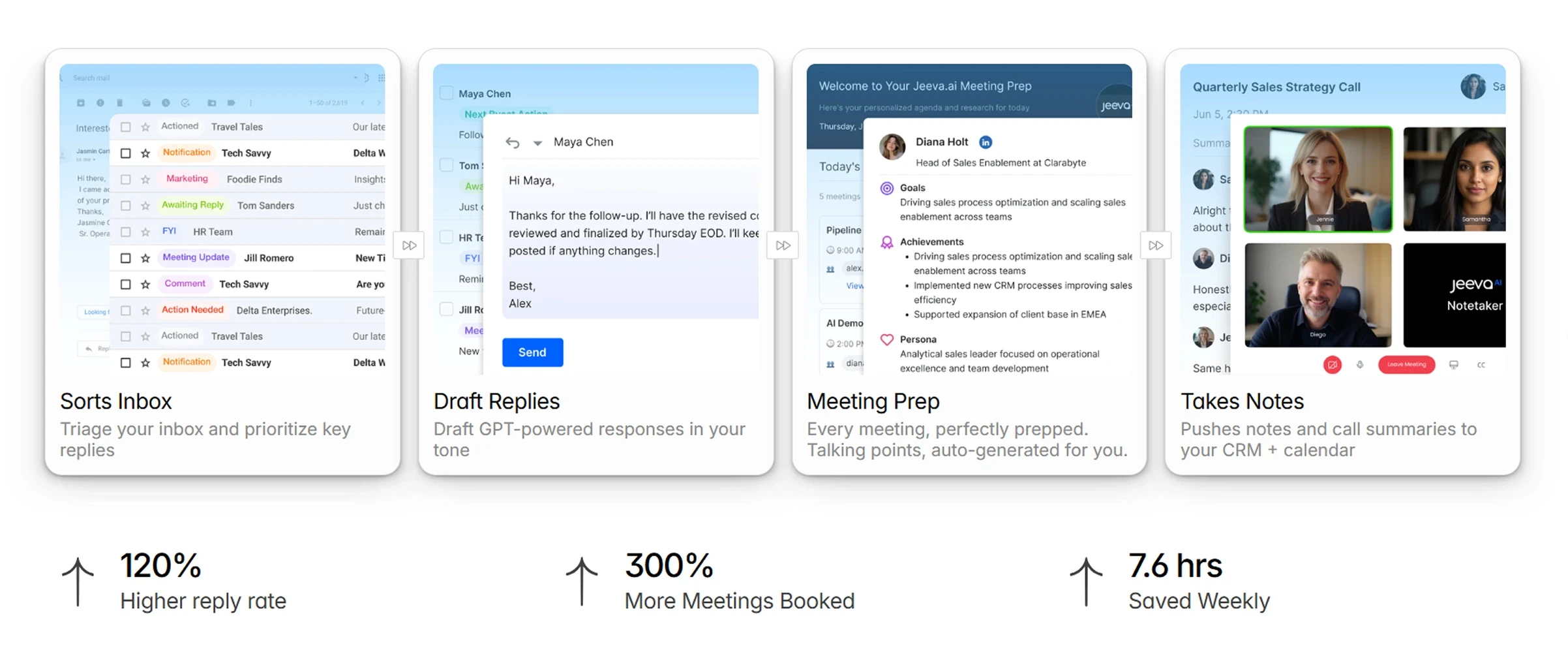
Jeeva AI is leading the agentic AI movement because it was built from the ground up as a true multi-agent sales system, not a collection of disconnected automations. Each AI agent has a defined role and works in coordination with others to run the full sales workflow from prospect discovery to meeting booking without constant human input.
Fact: Teams using Jeeva AI report 3× more qualified meetings within the first 30 days.
Unlike traditional tools that assist users, Jeeva AI acts autonomously. It understands context, shares data across agents, adapts to buyer behavior, and takes the next best action automatically. This makes Jeeva AI closer to a digital sales team than a software tool.
Jeeva AI’s Agents and Their Roles
Prospector Agent: Identifies ICP-matched accounts using firmographic, technographic, and intent signals
Enrichment Agent: Keeps contact and company data accurate in real time using live sources
Smart Inbox Agent: Reads replies, detects intent, handles objections, and routes conversations
Outreach Agent: Coordinates multi-channel sequences across email, chat, and SMS
Qualification Agent: Scores leads continuously and decides sales readiness automatically
Each agent operates independently but shares memory and context with the system. This coordination allows Jeeva AI to execute complex, multi-step sales workflows without delays or handoffs.
Jeeva AI represents a shift from “sales tools” to autonomous sales execution. It is the closest model today to a fully self-running sales engine.
Conclusion
Agentic AI is reshaping sales by automating repetitive work, improving personalization, and scaling outreach across every channel. It replaces slow, manual execution with intelligent systems that act, adapt, and learn in real time.
But agentic AI is not replacing humans - it is elevating them. While AI handles research, outreach, follow-ups, and qualification, sales teams focus on conversations, demos, strategy, and closing. The teams that win next are those that let AI do the heavy lifting and keep humans where they matter most.
FAQ
What makes agentic AI different from normal sales automation?
Is agentic AI replacing salespeople?
What tasks can agentic AI automate?
What is the biggest benefit of agentic AI for sales teams?
Which platform is best for agentic AI in sales?