TD;LR : AI Sales Agents automate the entire sales workflow research, enrichment, outreach, follow-ups, qualification, and scheduling. In 2026, businesses across the US, UK, Canada, Australia, and New Zealand rely on these agents to handle repetitive tasks, personalize communication instantly, and operate 24/7 without human oversight.
AI agents help teams scale prospecting, speed up sales cycles, qualify leads more accurately, and increase pipeline coverage with less effort. They have become a core part of modern GTM operations, making sales faster, smarter, and more predictable.
Introduction : Complete Guide to AI Sales Agents 2026
AI Sales Agents are becoming the backbone of modern revenue teams across the US, UK, Canada, Australia, and New Zealand. What started as simple outreach automation tools has now matured into autonomous, Agentic AI systems that can research prospects, enrich profiles, write personalized emails, manage follow-ups, qualify inbound and outbound leads, update CRMs, and book meetings without human supervision.
By 2026, the adoption of AI Sales Agents is no longer experimental. Companies of every size now rely on them to speed up sales cycles, expand pipeline coverage, and automate tasks that previously drained hours of manual effort.
This guide breaks down everything you need to know about AI Sales Agents from how they work to how to choose the right platform.
Related reading:
- Agentic AI for B2B Sales
- Multi-Channel Sales Automation With Agentic AI
- AI Lead Enrichment for Real-Time Email & Sales Outreach
What is AI Sales Agent ?
An AI Sales Agent is a digital worker that performs end-to-end sales tasks traditionally handled by SDRs research, personalization, outreach, follow-ups, qualification, and scheduling. It uses natural language understanding and multi-agent workflows to operate more intelligently than rule-based tools.
Fact: 73% of SaaS companies in the US and UK now deploy at least one AI Sales Agent in their GTM operations.
Why AI Sales Agents Are Game-Changers?
AI agents improve both speed and accuracy.
They never forget follow-ups
They personalize instantly using data
They operate 24/7 across regions
They scale to thousands of leads effortlessly
They use objective signals to qualify leads
They remove human admin fatigue
AI takes over repetitive work so reps can focus on closing.
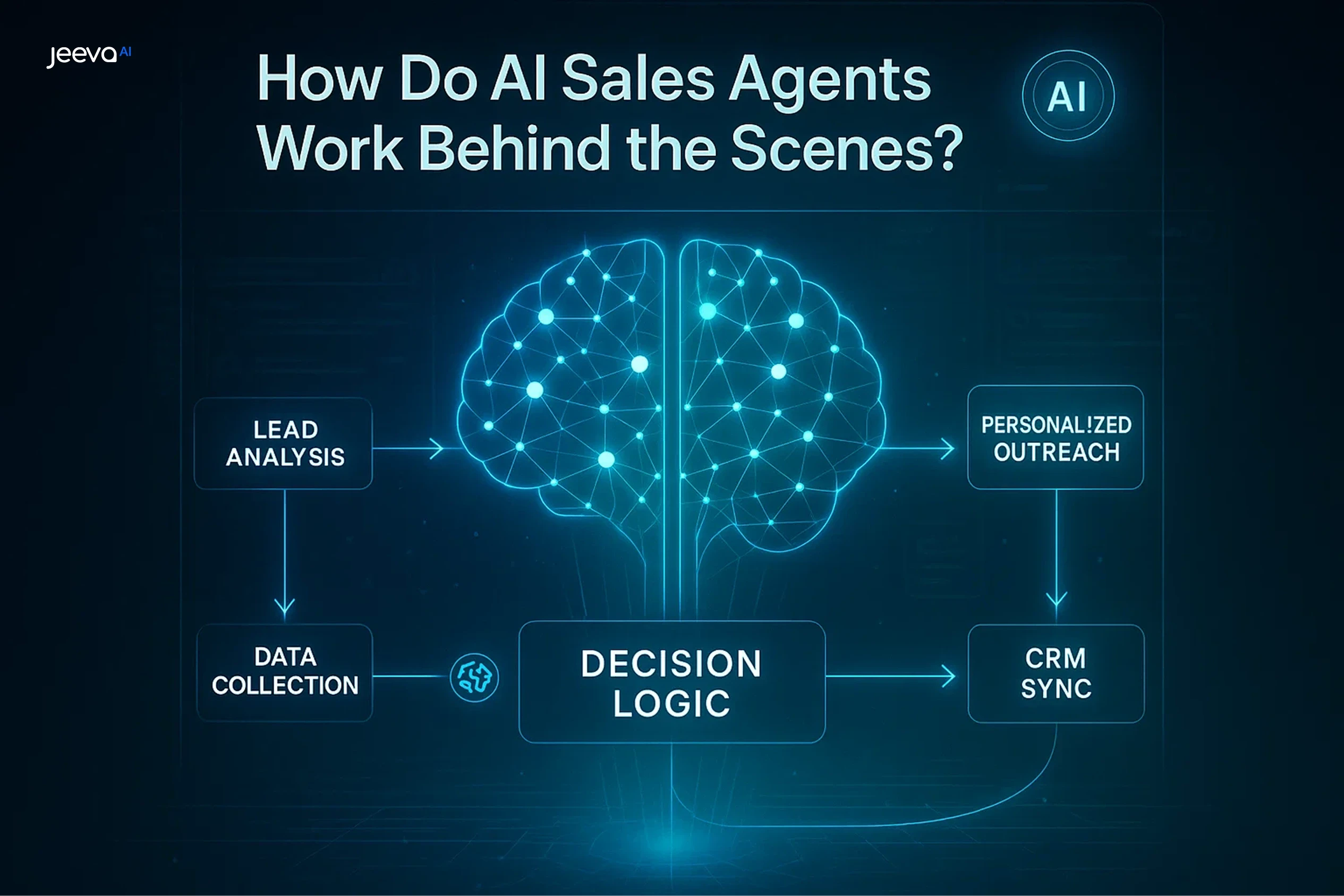
How Do AI Sales Agents Actually Work Behind the Scenes?
AI sales agents work by combining natural language processing (NLP), predictive analytics, large language model (LLM) reasoning, and agentic AI design. Instead of running one-off tasks, they follow a structured decision loop: collect data, interpret signals, create personalized communication, and take action across channels.
These agents continuously learn from engagement and outcomes to improve accuracy over time. When fully integrated with CRM and enrichment tools, they operate at scale without manual input.
Fact: A single AI sales agent can perform the work of 5–10 people when fully integrated.
Key Stages of the AI Sales Workflow
AI moves every prospect through a clear, repeatable pipeline.
Data collection from CRM + enrichment - Pulls firmographic, technographic, and contact data in real time
ICP matching and prioritization - Ranks prospects based on fit and likelihood to convert
Personalized message creation - Generates context-aware emails and messages
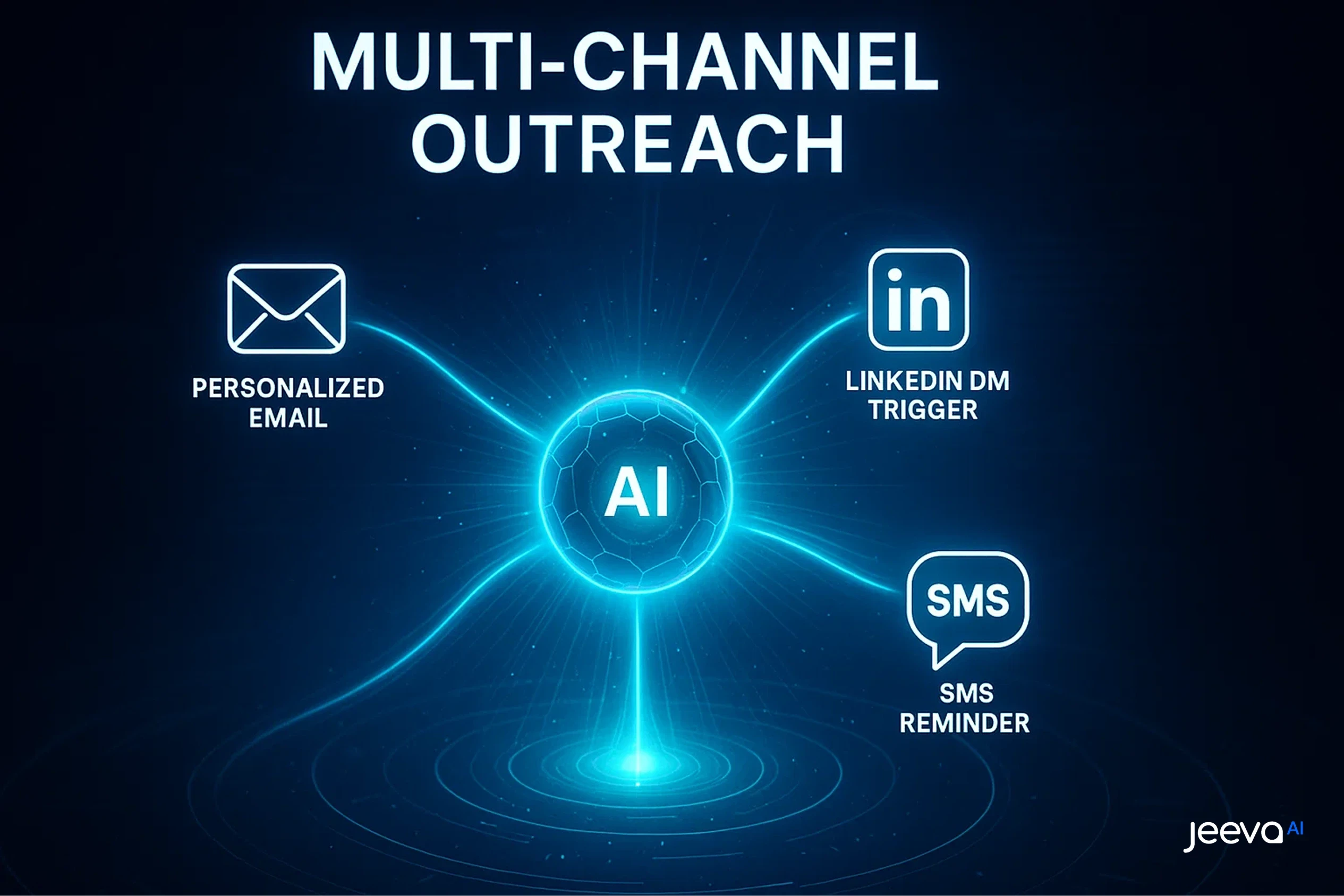
Multi-channel execution - Sends outreach across email, LinkedIn, and other channels
Engagement and reply handling - Reads replies and detects intent or objections
Qualification and meeting routing - Advances high-intent leads to booked meetings
This workflow turns outbound into a predictable system rather than guesswork. Teams get consistent pipeline generation without relying on manual execution.
AI Sales Agent vs Human SDR vs Basic Automation
Capability | Human SDR | Basic Automation | AI Sales Agent |
|---|---|---|---|
Personalization | High | Low | High & scalable |
Volume | Low | High | Very high |
Lead Research | Manual | None | Automated |
Conversation Handling | Strong | Weak | Strong |
Learning Over Time | Yes | No | Yes (continuous) |
Cost Efficiency | Medium | High | Very high |
What Makes Agentic AI Better Than Traditional Automation Tools?
Traditional automation tools follow fixed rules like scheduled emails and static sequences. They can’t understand context, adjust tone, or decide what to do next based on buyer behavior.
Agentic AI is different - it can plan, act, reflect, and self-correct across multiple steps. It reads messages, interprets intent, and adapts outreach dynamically instead of blindly following a script.
Fact: Agentic AI can increase response rates by up to 300% by adapting communication based on real buyer signals.
Why Agentic AI Wins in 2026
Agentic AI consistently outperforms static workflows.
Interprets buyer intent in messages - Understands meaning, not just keywords
Autonomously decides next steps - Chooses actions without human input
Coordinates multiple sub-agents - Different agents handle different tasks together
Writes human-grade personalized messages - Outreach feels natural and relevant
Adjusts sequences dynamically - Changes timing and content based on behavior
Learns from historical performance - Improves decisions over time
Agentic AI behaves like a skilled human operator. It delivers that intelligence at scale, without fatigue or delay.
What Sales Tasks Can AI Agents Handle Today?
AI sales agents have evolved far beyond basic outreach. They now manage full-cycle prospect engagement and many operational tasks that once required constant human effort. This reduces friction and speeds up pipeline creation.
Fact: AI-driven lead research saves an average of 8 hours per rep per week.
High-Impact Tasks AI Owns in 2026
These tasks no longer require manual effort.
Prospect research - Collects demographic, firmographic, and intent data
Personalized message generation - Writes tailored outreach automatically
Adaptive follow-up sequencing - Adjusts follow-ups based on engagement
Lead scoring and qualification - Prioritizes prospects by readiness
Reply handling and sentiment detection - Understands interest and objections
Meeting scheduling and routing - Books and assigns meetings automatically
AI now covers the entire top of the funnel. Human teams focus on conversations that actually move deals forward.
Which Communication Channels Do AI Sales Agents Manage?
Modern buyers expect to engage across multiple channels, not just email. AI sales agents coordinate outreach and responses across platforms while keeping context consistent. This creates smoother, more natural buyer journeys.
Fact: Using 3 or more channels increases reply probability by 85%.
Channels AI Handles Better Than Humans
Each channel plays a specific role in engagement.
Email - Scalable, personalized outreach
LinkedIn - Trust-building and professional engagement
SMS - Timely reminders and nudges
Chat - Real-time qualification and responses
Web forms - Automated follow-ups and routing
Calendar - Frictionless meeting booking
AI unifies all channels into one coordinated strategy. Prospects experience consistent, timely communication instead of scattered touchpoints.
Channel Strength and Use Case
Channel | AI Strength | Best Use Case |
|---|---|---|
⭐⭐⭐⭐⭐ | Cold outreach | |
⭐⭐⭐⭐ | Warm engagement | |
SMS | ⭐⭐⭐⭐⭐ | Rapid follow-ups |
Chat | ⭐⭐⭐⭐ | Inbound screening |
Calendar | ⭐⭐⭐⭐⭐ | Call booking |
How Do AI Sales Agents Score and Qualify Leads?
AI sales agents score and qualify leads using real-time data, behavior signals, and engagement patterns instead of gut feeling or static rules. They continuously evaluate how a prospect interacts with emails, content, and messages, then compare that behavior against your ideal customer profile.
This allows AI to filter out low-intent leads early and surface only serious prospects. The process runs automatically and updates as new signals appear.
Fact: AI qualification reduces pipeline noise by 40–60%, improving overall sales efficiency.
Qualification Signals AI Considers
AI looks beyond basic demographics to understand real buying intent.
Email open and click behavior - Measures interest based on engagement patterns
Firmographic and ICP match - Checks company size, industry, and fit
Technographic stack compatibility - Verifies tools and platforms the company uses
LinkedIn activity and recency - Tracks recent profile and content engagement
Buying intent from content - Detects interest from downloads, visits, and searches
Response quality and tone - Analyzes replies for intent, urgency, and sentiment
This approach ensures only high-intent prospects move forward. Sales teams spend time on real opportunities instead of unqualified leads.
How Do AI Agents Integrate With CRM and Sales Tools?
AI sales agents become truly powerful when they are deeply integrated with your CRM and sales stack. When connected to tools like Salesforce, HubSpot, Zoho, or Pipedrive, AI can automatically log activities, update lead statuses, sync enriched data, and trigger workflows in real time. This removes manual data entry and keeps records consistent across systems.
Fact: 91% of teams report cleaner CRM data after deploying AI-driven updates.
The Components of Strong CRM Integration
To deliver real value, AI platforms must support the following:
Two-way sync - Data flows both into and out of the CRM automatically
Activity + sequence logging - Emails, messages, and follow-ups are logged without manual work
Lead scoring fields - AI updates scores directly inside CRM records
Qualification notes - Intent, sentiment, and readiness are written back automatically
Meeting tracking - Booked meetings and outcomes sync instantly
Real-time enrichment updates - Company and contact data stays current
Strong integration keeps your CRM accurate without constant cleanup. Sales teams can trust their data and focus on real conversations instead of admin work.
CRM Integration Comparison
CRM | Integration Level | Notes |
|---|---|---|
Salesforce | ⭐⭐⭐⭐⭐ | Best enterprise fit |
HubSpot | ⭐⭐⭐⭐ | Great mid-market |
Zoho | ⭐⭐⭐ | Budget option |
Pipedrive | ⭐⭐⭐⭐ | Fast + simple |
Dynamics | ⭐⭐⭐⭐ | Regulated industries |
What Are the Limitations of AI Sales Agents?
AI sales agents dramatically speed up prospecting, outreach, and qualification, but they are not a replacement for human judgment and relationships. While AI excels at scale, consistency, and data-driven decisions, it lacks real-world context in complex, emotional, or high-stakes conversations. Buyers still want to speak with people when decisions involve risk, budget, and long-term impact.
Fact: 86% of B2B buyers say human interaction is essential when evaluating solutions.
Where Humans Still Outperform AI ?
AI supports these areas, but people lead them.
Discovery and needs analysis - Humans ask nuanced questions and read between the lines
Complex objections - Experienced sellers handle ambiguity and emotion better
Negotiations - Pricing, terms, and trade-offs require human judgment
Enterprise procurement cycles - Multi-stakeholder decisions need trust and alignment
Technical deep dives - Product experts explain edge cases and custom needs
Long-term account relationships - Trust is built through ongoing human interaction
AI accelerates pipeline building and removes manual effort. Humans remain essential for closing deals and building lasting customer relationships.
How Do You Choose the Best AI Sales Agent in 2026?
With dozens of AI sales platforms entering the market, choosing the right one is no longer about flashy features. The best AI sales agent must fit your existing workflow, scale with your growth, and operate safely across regions. A tool that disrupts your process or creates compliance risk will slow you down, not speed you up.
Fact: 72% of buyers say integrations and safety matter more than features.
Qualities of the Best AI Agent Platforms
When evaluating AI sales agents, prioritize platforms that offer:
Deep CRM compatibility - Works seamlessly with your existing CRM without data loss
Real-time enrichment - Keeps lead and account data fresh automatically
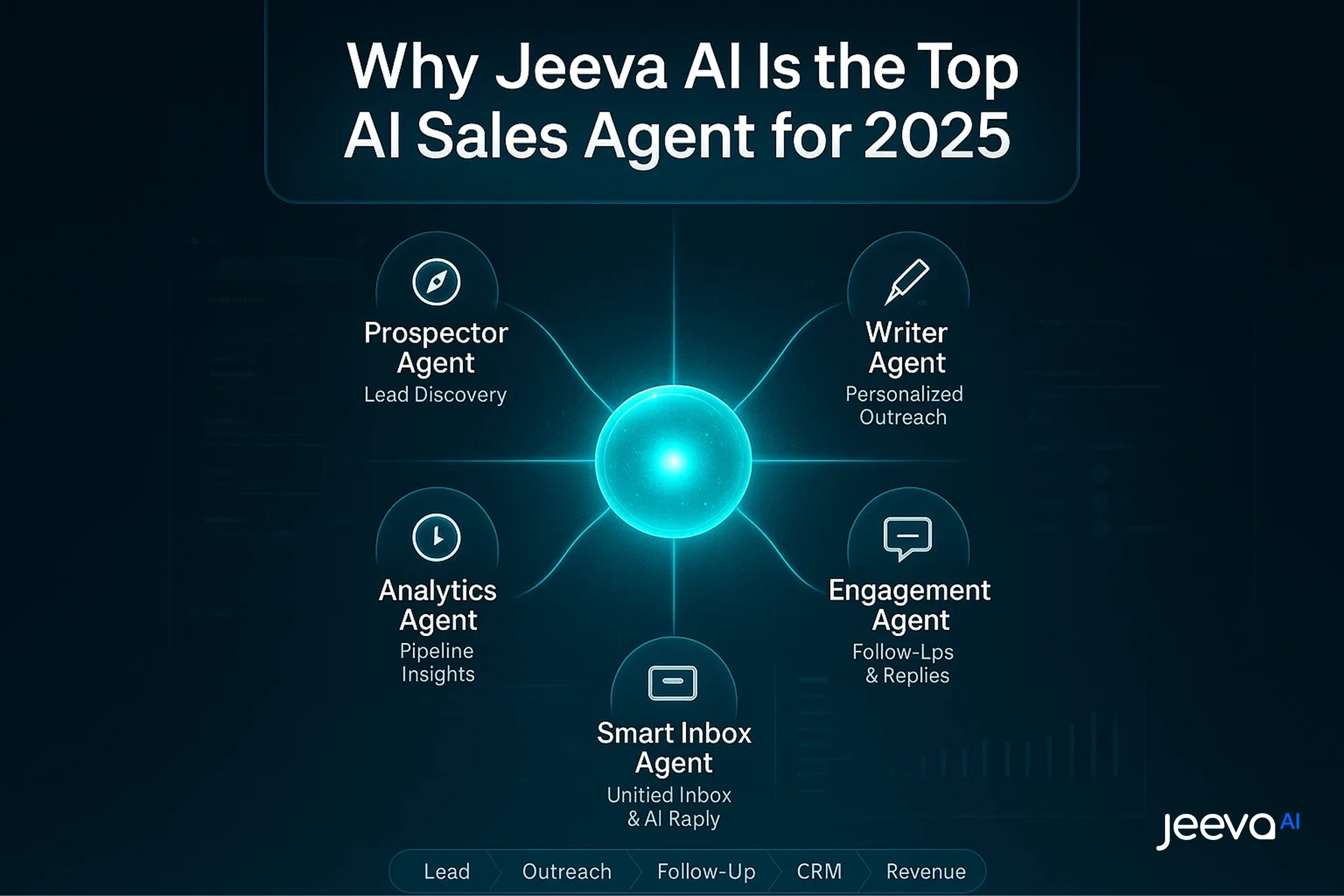
Multi-agent capabilities - Uses specialized agents for prospecting, outreach, and qualification
Compliance-ready architecture - Built to support GDPR, CCPA, CASL, and regional rules
Multi-channel automation - Coordinates email, LinkedIn, chat, and follow-ups
Platform scalability - Handles higher volumes without breaking workflows
The best AI sales agent adapts to how your team sells. Your process should stay intact while AI handles the execution.
Why Jeeva AI Is the Most Complete AI Sales Agent for 2026
Jeeva AI uses agentic, multi-agent orchestration to run prospecting, enrichment, outreach, qualification, and scheduling in one unified system. Built for enterprise security and regional compliance, it scales globally across US, UK, CA, AUS, and NZ without breaking workflows.
Fact: Jeeva AI users save 3+ hours per rep daily and generate pipeline faster.
Why Global Teams Choose Jeeva AI
Multi-agent automation framework - Specialized agents collaborate across the full outbound lifecycle
Real-time data enrichment built-in - Lead and account data stays fresh automatically
Adaptive outreach personalization - Messages adjust to role, intent, and context
Compliance-driven sending logic - Regional rules enforced by design
Integration with major CRMs - Seamless sync with existing systems
End-to-end outbound automation - From first touch to booked meeting, hands-free
Jeeva AI becomes your entire outbound engine. It sets the standard for AI-powered teams in 2026.
Conclusion
AI Sales Agents are redefining how revenue teams operate in 2026. They automate time-consuming work, improve personalization, reduce manual errors, and accelerate pipeline growth.
As Agentic AI evolves, sales teams gain an intelligent co-pilot capable of handling thousands of leads with precision.
With its advanced multi-agent architecture and enterprise-ready integrations, Jeeva AI stands out as the most complete Sales AI Agent for modern teams across the US, UK, CA, AUS, and NZ making sales smarter, faster, and more predictable.
FAQ
What is an AI Sales Agent?
Why pick Jeeva AI over other tools?
How are AI Sales Agents different from normal sales automation tools?
Are AI Sales Agents used by real companies today?
What skills or tools do I need to start using an AI Sales Agent?